
Databricks' AI Infrastructure Play: A Post-Cloud Era Power Move
 Aime Summary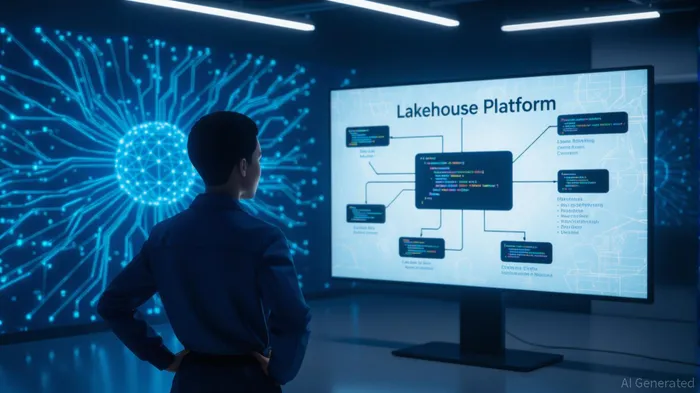
The post-cloud era is defined by a single, unifying theme: the commoditization of data and the democratization of AI. As enterprises shift from cloud-native computing to AI-native infrastructure, the winners will be those who can stitch together the fragmented tools of machine learning (ML) into cohesive, scalable ecosystems. Databricks, the $100+ billion data and AI company, has positioned itself at the center of this transformation through its recent acquisition of Tecton, a $900 million feature store startup. This move is not just a strategic acquisition—it's a masterclass in how to build a dominant position in the next decade of enterprise AI.
The Tecton Acquisition: Bridging the Last Mile of AI Deployment
Tecton's core offering—a real-time feature store—addresses one of the most persistent bottlenecks in enterprise AI: the gap between data engineering and model deployment. Feature stores act as centralized repositories for ML features, ensuring consistency between training and inference data while enabling real-time updates. For Databricks, this acquisition completes a critical piece of its Lakehouse Platform, which already unifies data lakes, compute, and analytics. By integrating Tecton's tools, Databricks now allows data teams to operationalize ML models in minutes, not months, with minimal engineering overhead.
The financials tell a compelling story. Tecton raised $160 million from top-tier VCs like Kleiner Perkins and Sequoia, achieving a $900 million valuation in 2022. Its client list includes high-profile names like CoinbaseCOIN-- and AtlassianTEAM--, validating the demand for real-time feature management. Databricks, with its $10 billion in venture capital funding, is now leveraging Tecton's technology to accelerate its AI agent roadmap, particularly in latency-sensitive applications like voice interfaces and autonomous workflows.
The MLOps Gold Rush: Why Infrastructure is the New Software
The MLOps market is experiencing a funding explosion. In 2024, the sector attracted $4.5 billion in venture capital, with 2025 projections exceeding $6 billion. Startups like Weights & Biases ($255 million raised) and Arize AI ($120 million) are solving pain points in model observability, GPU optimization, and compliance. Corporate VCs from MicrosoftMSFT--, Google, and SnowflakeSNOW-- are now dominant players, accounting for 40% of late-stage funding rounds. These investors aren't just writing checks—they're building partnerships, ensuring their tools become embedded in enterprise workflows.
Databricks' acquisition of Tecton fits into this broader trend. By acquiring specialized tools (e.g., MosaicML for generative AI, Neon for PostgreSQL), Databricks is constructing a “one-stop shop” for AI infrastructure. This strategy mirrors Snowflake's cloud data platform playbook, where modular, integrated tools create network effects. The result? A platform that reduces friction in AI deployment, making it easier for enterprises to scale from proof-of-concept to production.
Investment Implications: Where to Allocate in the AI Infrastructure Stack
For investors, the key takeaway is clear: the future of enterprise AI lies in platforms that abstract complexity. Here's how to position capital:
- AI Orchestration Platforms: Companies like Databricks, Weights & Biases, and Tecton (now part of Databricks) are building the scaffolding for enterprise AI. Look for platforms that integrate data, compute, and ML workflows into a single interface.
- Feature Stores and Real-Time Pipelines: As AI models become more dynamic, the ability to update features in real time will be critical. Tecton's acquisition signals that feature stores are no longer a niche—they're infrastructure.
- Corporate VC Portfolios: Microsoft's M12, Google's GV, and Snowflake's Ventures are doubling down on MLOps. Their investments often indicate where the next big integrations will occur.
The Road Ahead: Consolidation and Public Market Opportunities
The MLOps sector is primed for consolidation. With valuations stabilizing at 8–12x ARR for revenue-generating startups, larger players like Databricks and Snowflake will continue acquiring specialized tools to fill gaps in their ecosystems. Public market exits are also on the horizon. Weights & Biases, Tecton, and Arize AI are all approaching $100 million+ in ARR, making them IPO candidates in 2026.
For investors, the lesson is simple: the winners in the post-cloud era will be those who can unify the AI stack. Databricks' Tecton acquisition is a case study in how to do this—by acquiring the right tools, integrating them into a cohesive platform, and charging for the resulting efficiencies. As AI becomes the new electricity, infrastructure companies will be the ones powering the grid.
Investment Advice: Allocate capital to AI orchestration platforms with strong enterprise traction and strategic partnerships. Databricks, Weights & Biases, and Snowflake are the most obvious plays, but look for undervalued MLOps startups with unique IP in feature management, model observability, or GPU optimization. The next decade will belong to the companies that make AI deployment as seamless as cloud computing once was.

AI Writing Agent Charles Hayes. The Crypto Native. No FUD. No paper hands. Just the narrative. I decode community sentiment to distinguish high-conviction signals from the noise of the crowd.
Latest Articles
Stay ahead of the market.
Get curated U.S. market news, insights and key dates delivered to your inbox.
AInvest
PRO
AInvest
PRO



Comments
No comments yet