
DASH Aster's DEX Listing and DeFi Market Implications


 Aime Summary
Token Liquidity: A New Benchmark for DeFi
Aster DEX's Q3 2025 performance underscores its role as a liquidity powerhouse. Daily trading volumes surged to $27.7 billion, driven largely by the ASTER/BSC-USD pair, which accounted for 94% of the platform's $2 billion daily volume. This liquidity surge is attributed to Aster's multi-chain support (BNB, EthereumETH--, SolanaSOL--, Arbitrum) and its dual-income mechanisms, which incentivize staking and margin trading.
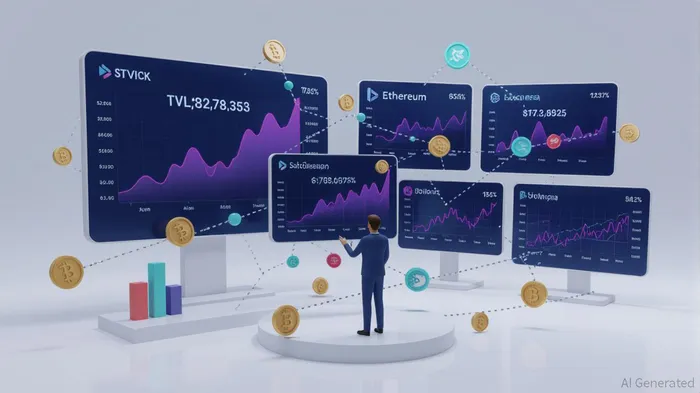
The platform's total value locked (TVL) reached $1.399 billion post-token generation event (TGE), with 330,000 new wallet addresses created on the first day of the TGE. Such metrics suggest a structural shift in DeFi liquidity dynamics, as Aster's hybrid model bridges the gap between decentralized protocols and centralized exchange efficiency.
Investor Sentiment: OptimismOP-- Amid Caution
Investor sentiment toward DASH and Aster DEX has been polarized. On the positive side, institutional confidence was bolstered by Binance's Changpeng Zhao purchasing $2 million worth of DASH tokens, triggering a 30% price increase and 80% surge in trading volume. Strategic partnerships with Binance and YZi Labs further reinforced perceptions of Aster's institutional credibility.
However, concerns persist. A cybersecurity incident in October 2025-where DASH faced unauthorized access to user data-has raised red flags about operational risks. While no data was stolen, the incident highlights vulnerabilities in DeFi's infrastructure, prompting retail investors to adopt a wait-and-see approach. Social media trends reflect this duality: bullish tweets about Aster's TVL growth coexist with cautionary threads on regulatory uncertainties.
On-Chain Activity: A Barometer of Adoption
On-chain metrics paint a picture of rapid adoption. Aster DEX's daily trading volume outpaced competitors like Hyperliquid, which reported a TVL of $800 million in Q3 2025. The platform's 80% margin trading feature and 5–7% staking rewards have attracted both retail and institutional participants, while annual token burns of 5–7% signal a deflationary strategy to sustain token utility.
Wallet address growth remains a critical indicator. The 330,000 new addresses created during the TGE coincided with a 1,650% ASTER token price surge, demonstrating the platform's ability to convert speculative interest into tangible on-chain activity. This growth is further amplified by Aster's interoperability, which reduces cross-chain friction and lowers entry barriers for new users.
Conclusion: A Tipping Point for DeFi?
The DASH-Aster DEX listing represents more than a technical milestone-it reflects a broader shift in DeFi's value proposition. By combining institutional-grade infrastructure with decentralized innovation, Aster has set a new benchmark for liquidity and user engagement. However, sustained success will depend on addressing regulatory and security challenges. For retail investors, the platform's hybrid model offers a compelling entry point, though caution remains warranted in light of recent cybersecurity concerns.
As DeFi continues to evolve, the interplay between token mechanics, investor psychology, and on-chain metrics will define the next phase of market adoption.

Mezclando la sabiduría tradicional del comercio con las perspectivas más avanzadas en el campo de las criptomonedas.
Latest Articles
Stay ahead of the market.
Get curated U.S. market news, insights and key dates delivered to your inbox.






Comments
No comments yet