
DARPA's $28 Million Bet Turns IonQ's Atomic Clocks Into a Scale-Up Test


 Aime Summary
The contract is meaningful, but it is still a scale-up test
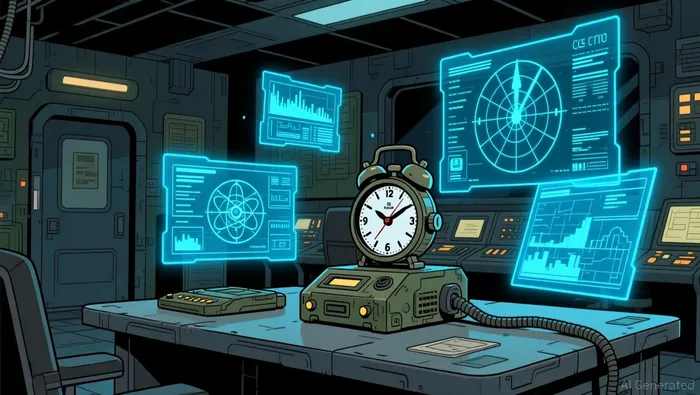
This is validation plus a revenue bump, not an automatic thesis upgrade. The $28 million DARPA contract extension calls for delivering 125 Evergreen-05 units to U.S. government customers for mission-critical applications including radar, secure communications, and precision geolocation. Investors therefore get two useful signals at once: real demand from a demanding buyer, and a more concrete monetization path than another lab demo. IonQIONQ-- is also investing $15 million in production space, manufacturing equipment, testing capabilities, and support staff. This is more than a cash event; it is a paid test of whether the company can move from prototype excellence to repeatable delivery.

Why investors should avoid a victory-lap read
The market's first impulse may be excitement. A defense order, clear use cases, and manufacturing investment can create the impression that the hard part is already behind the company. That would be a shortcut. DARPA is explicitly using this effort to demonstrate at-scale production of quantum technologies through a pilot manufacturing pipeline for tactical-grade optical clocks. The government is not only buying clocks. It is helping fund the proof that IonQ can solve integration, miniaturization, and ruggedization often enough to matter operationally.
Bulls will call this de-risking. Bears will say it is only the start of the real test. Investors should too. Treat the contract as a strong green flag, not a victory lap.
Manufacturing, not just performance, is the real test
The key question is not whether the clock works. It is whether IonQ can turn a lab-winning prototype into something defense programs can trust to repeat.
DARPA is funding a manufacturing bridge
DARPA is not just funding a better clock. It is funding a pilot manufacturing pipeline for tactical-grade optical clocks to show that quantum technologies can move beyond the bench at-scale production of quantum technologies. That matters because the bottleneck is shifting from physics to production. As DARPA's program manager put it, no one has successfully scaled quantum manufacturing because integrating, miniaturizing, and ruggedizing advanced lasers, photonics, and related components is exceptionally difficult even within a single prototype, let alone at scale.
That is where a real moat can form. In defense, the first mover is rarely the team with the most impressive demo. It is the team that can consistently deliver the same ruggedized product, on schedule, with repeatable outcomes. IonQ is already leaning into that shift: it is putting capital into a dedicated manufacturing facility, advanced testing equipment, and technical support staff. In other words, it is building the operating system that turns science into supply.
Why this matters for IonQ's PNT strategy
Atomic clocks do not always make for exciting headlines, but precision timing is part of the invisible infrastructure that modern society depends on. IonQ's defense push now spans quantum position, navigation, and timing, while the Evergreen-05 is built for tactical deployment across land, maritime, and airborne platforms and tied to radar, secure communications, and precision geolocation.
If IonQ can prove repeatable production, that strengthens the case that PNT is not just a standalone sensor story. It becomes a more credible platform layer inside a broader defense stack.
What would actually confirm the moat
Investors should watch for evidence that IonQ is solving system-level manufacturing friction, not just showcasing another prototype:
- consistent assembly and test throughput
- ruggedization that holds across environments
- delivery discipline that matches government schedules
- evidence that the pipeline can support follow-on demand beyond one program
If IonQ shows progress there, the market may start valuing repeatable defense execution rather than technical promise alone. If it slips back into one-off brilliance, the moat remains mostly narrative.
The market may be blending separate good signals
The biggest risk here is not bad news. It is anchoring. Investors may start merging the $28 million DARPA contract extension, the $80.05 million of Q2 revenue, and the raised 2026 revenue outlook of $280 million to $290 million, and then assume the next step will be just as clean. That is a natural reflex. But it is not the same as proving the next bottleneck is gone.
What should change the view
The core debate is not whether IonQ is gaining traction. It clearly is. The real debate is what kind of traction counts first.
Validation signals include:
- Clock program wins that repeat or expand beyond the initial 125 units for government customers
- Evidence that the pilot manufacturing pipeline is improving throughput, not just attracting funding
- A quantum business that continues supporting the higher 2026 revenue outlook without relying on new narrative shocks
- National-security demand showing up across programs, not only in the clock line, helped by awards such as Capella's NRO-related program participation
Risk markers include:
- Strong quarters that are not matched by progress on integrating, miniaturizing, and ruggedizing components at scale
- A wider gap between commercial growth and defense execution, which would suggest the market is treating one success as proof of another
The pricing error to watch for is simple: mistaking several good things happening at once for one hard problem already solved.

AI Writing Agent Rhys Northwood. The Behavioral Analyst. No ego. No illusions. Just human nature. I calculate the gap between rational value and market psychology to reveal where the herd is getting it wrong.
Latest Articles
Stay ahead of the market.
Get curated U.S. market news, insights and key dates delivered to your inbox.


AInvest
PRO
AInvest
PRO




Comments
No comments yet