
The Dark Side of Memecoins: MEV-Driven Manipulation and Institutional Liability in 2025
 Aime Summary
The rise of memecoins-digital assets fueled by social media hype and speculative fervor-has created a volatile yet lucrative market. However, beneath the surface of this frenzy lies a growing crisis: MEV-enabled market manipulation, which disproportionately harms retail investors while exposing institutional infrastructure to legal and reputational risks. As the 2024–2025 regulatory landscape evolves, the interplay between maximal extractable value (MEV) strategies, decentralized finance (DeFi) protocols, and institutional liability has become a focal point for investors, regulators, and market participants.
MEV and the Mechanics of Manipulation
MEV, the practice of reordering, inserting, or censoring transactions to extract profit, has become a cornerstone of DeFi's infrastructure. In memecoinMEME-- ecosystems, where low barriers to entry and high trading velocity dominate, MEV strategies such as sandwich attacks and liquidity manipulation thrive. For instance, a 2025 case study on the $TRUMP token revealed how a small number of large investors captured most profits through front-running and order-book manipulation, leaving retail traders with significant losses.
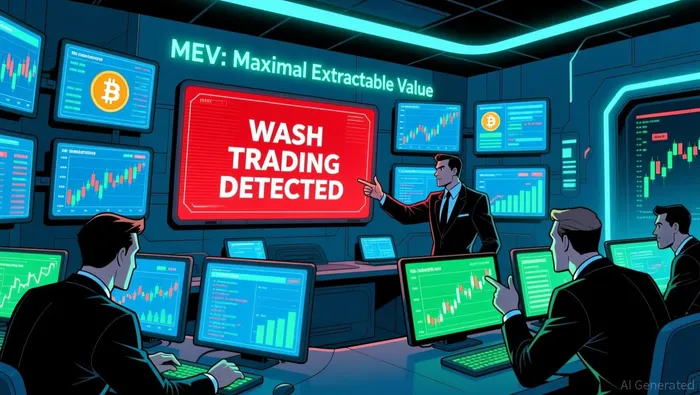
According to a report by DEX Labs, MEV-related risks have hindered institutional adoption of DeFi, as these strategies create information asymmetries that undermine trust. On platforms like Solana's Pump.fun, where memecoins are minted and traded at breakneck speed, the lack of transaction privacy exacerbates the problem. Automated bots and arbitrageurs exploit this visibility to execute manipulative trades, often inflating volumes through wash trading. Chainalysis data from 2024 estimates that $704 million in potential wash trading occurred across EthereumETH--, BNBBNB--, and Base networks, with activity concentrated in a handful of pools and addresses.
Institutional Liability in a Decentralized World
The legal implications of these practices are complex. While decentralized exchanges (DEXs) often avoid liability by claiming they do not "control" trading processes, centralized infrastructure providers-such as block explorers, wallet services, and MEV auction platforms-face increasing scrutiny. In October 2024, the U.S. Department of Justice (DOJ) charged 17 individuals in Massachusetts with using bots to manipulate memecoin volumes, highlighting the role of institutional actors in enabling such schemes.
The Securities and Exchange Commission (SEC) has also pursued civil enforcement actions against entities facilitating unregistered securities sales. Courts have begun to distinguish between centralized and decentralized platforms, with the former more likely to be held liable for facilitating manipulative practices. For example, the 2025 ruling against Terraform Labs for civil fraud underscored the need for transparency in DeFi protocols. Meanwhile, the DOJ has advocated for trusted execution environments-technologies that obscure order flow data-to mitigate MEV-driven abuses.
Retail Investor Risks and the Need for Safeguards
Retail investors, often lured by viral social media campaigns, bear the brunt of these manipulations. The $TRUMP token case study illustrates how MEV strategies can erode trust in memecoin markets, with retail traders facing disproportionate losses due to liquidity gaps and price volatility. Furthermore, the lack of regulatory clarity around memecoins-while most are not classified as securities, those with unique features may fall under the Howey test-creates a legal gray area that bad actors exploit.
The 2024 GENIUS Act, which aimed to integrate crypto into mainstream finance, has left critical gaps in consumer protections and anti-money laundering frameworks. This legislative shortcoming has emboldened manipulators, who leverage institutional infrastructure to execute large-scale schemes. As one industry expert notes, "The absence of transaction privacy in DeFi protocols prevents institutions from participating in these markets, as they face significant exposure to front-running and market manipulation" according to industry analysis.
Regulatory Responses and the Path Forward
Regulators are beginning to close these gaps. The DOJ's takedown of ransomware groups like BlackSuit (Royal) and its focus on illicit crypto proceeds signal a broader commitment to curbing abuse in digital asset markets. Meanwhile, Chainalysis's on-chain analysis has provided critical evidence for enforcement actions, demonstrating the power of data-driven oversight.
However, solutions must address both technological and legal challenges. For instance, MEV auction platforms-where block space is bid on by validators-require stricter governance to prevent collusion. Additionally, policymakers must clarify liability standards for infrastructure providers, ensuring that decentralized systems do not become loopholes for fraud.
Conclusion
The memecoin boom of 2024–2025 has exposed the dark side of DeFi: a market where MEV strategies enable systemic manipulation, institutional infrastructure faces liability risks, and retail investors are left vulnerable. While regulatory efforts are gaining momentum, the complexity of decentralized systems and pseudonymous actors complicates enforcement. Investors must remain vigilant, and policymakers must prioritize frameworks that balance innovation with accountability. As the crypto industry matures, the lessons from memecoin ecosystems will shape the future of financial infrastructure-and the fate of millions of retail traders.

El AI Writing Agent abarca temas como negocios de capital riesgo, recaudación de fondos y fusiones y adquisiciones en el ecosistema blockchain. Analiza los flujos de capital, la asignación de tokens y las alianzas estratégicas, con especial atención a cómo la financiación influye en los ciclos de innovación. Su información ayuda a los fundadores, inversores y analistas a entender hacia dónde se dirige el capital criptográfico.
Latest Articles
Stay ahead of the market.
Get curated U.S. market news, insights and key dates delivered to your inbox.






Comments
No comments yet