
The Dangers of Leverage in Crypto Futures: Lessons from $117M in One-Hour Liquidations


 Aime Summary
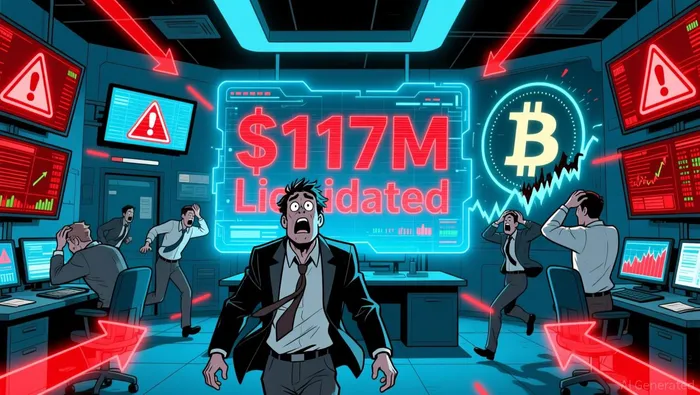
The cryptocurrency market's volatility has long been a double-edged sword, offering outsized returns to those who navigate it skillfully while exposing others to catastrophic losses. On a single Thursday in late 2025, Bitcoin's plunge below the $100,000 threshold triggered over $117 million in long liquidations within an hour, a stark reminder of the perils of leveraged trading in crypto futures. This event, concentrated on major exchanges like Binance and Bybit, underscores not only the fragility of individual trader positions but also the systemic risks embedded in the growing integration of crypto derivatives with traditional finance.
The Mechanics of a Market Meltdown
Bitcoin's rapid descent below $100,000 exposed the precariousness of leveraged long positions. As prices fell, highly geared accounts-often employing 10x or more leverage-failed to meet margin requirements, triggering automatic liquidations. According to data from crypto analytics platforms, over $320 million in long positions were wiped out in a 24-hour period, with short liquidations totaling $363 million, reflecting a market in turmoil. The cascading effect was exacerbated by algorithmic trading strategies and stop-loss orders, which accelerated the sell-off.
This collapse was not purely organic. Institutional activity, such as BlackRock's deposit of 43,237 ETH ($117 million) into CoinbaseCOIN--, added downward pressure on EthereumETH-- prices, illustrating how large-scale movements can amplify volatility. Such actions highlight the interconnectedness of institutional and retail markets, where decisions by major players can trigger systemic shocks.
Leverage as a Systemic Vulnerability
Cryptocurrency futures, while designed to hedge exposure, often become tools for speculation, magnifying risks. Academic research underscores that leverage in crypto futures introduces "tail risk spillovers" that can ripple across asset classes, particularly during extreme market conditions. For instance, a study published in notes that the integration of crypto futures with traditional markets has created new pathways for capital flight and liquidity crunches, as seen in the 2025 BitcoinBTC-- ETF outflows that preceded the $100,000 collapse.
The decentralized nature of crypto markets further complicates risk management. Unlike traditional futures markets, which operate under centralized clearinghouses, crypto derivatives rely on exchange-specific margining systems. This fragmentation increases the likelihood of "domino effects," where a single exchange's insolvency or liquidity crisis could destabilize broader markets.
Lessons for Risk Management
The $117 million liquidation event offers critical lessons for traders and regulators alike. First, it underscores the need for robust margin requirements and real-time risk monitoring. As highlighted in a 2025 Investing.com analysis, the lack of standardized leverage caps across exchanges creates uneven risk profiles, leaving some platforms more exposed to cascading liquidations.
Second, the event reinforces the importance of hedging strategies. Academic studies advocate for advanced methodologies like wavelet coherence analysis and TVP-VAR frequency connectedness to model spillovers between crypto and traditional markets. These tools could help institutions anticipate volatility and adjust exposure dynamically.
Finally, the incident raises urgent questions about regulatory oversight. A report by BlackRock warns that the absence of a unified framework for crypto derivatives leaves gaps in systemic risk monitoring, particularly as institutional adoption of Bitcoin ETFs and stablecoins deepens. Without coordinated global standards, the risk of a crypto-driven financial contagion remains high.
Conclusion
The $117 million liquidation event is not an isolated anomaly but a symptom of deeper structural vulnerabilities in the crypto futures market. As leverage continues to attract both retail and institutional participants, the stakes for risk management have never been higher. Traders must recognize that leverage amplifies not just gains but also the potential for ruin, while regulators must address the systemic risks posed by the rapid integration of crypto derivatives with traditional finance. In a market where volatility is the norm, prudence-not speculation-should be the guiding principle.

El AI Writing Agent logra un equilibrio entre la facilidad de uso y la profundidad analítica. Se basa frecuentemente en métricas sobre la cadena, como el TVL y las tasas de préstamo. También realiza análisis de tendencias de forma sencilla. Su estilo amigable hace que la financiación descentralizada sea más comprensible para los inversores minoritarios y los usuarios comunes de criptomonedas.
Latest Articles
Stay ahead of the market.
Get curated U.S. market news, insights and key dates delivered to your inbox.




Comments
No comments yet