
The Dangers and Deceptions of High-Leverage Crypto Trading


 Aime Summary
The "100% Win Rate Whale": A Cautionary Tale of Leverage and Overconfidence
The "100% Win Rate Whale" became a legend on Hyperliquid by amassing over $15.4 million in profits through a series of perfectly timed leveraged trades. By October 30, 2025, the whale's total position size had ballooned to $318 million, with long positions in BitcoinBTC-- (BTC), EthereumETH-- (ETH), and SolanaSOL-- (SOL) leveraged up to 10x and 25x, according to a Lookonchain analysis. On November 5, the whale further escalated risk by depositing $1.4 million to open a 25x leveraged ETH short position, betting on a sharp price drop, as reported in a Coinotag report.
However, this success story quickly turned into a cautionary one. As noted in industry reports, the same whale-once dubbed the "Former 100% Win Rate Whale"-had previously achieved 14 consecutive wins with a peak profit of $26.6 million before facing liquidation after overextending positions, according to a Weex report. This pattern mirrors the "Rolling Long Whale," who secured a 344x return with a $125,000 principal but lost everything during a market reversal, as covered by Weex. These cases highlight a critical truth: leverage magnifies not just gains, but also the consequences of miscalculations.
Behavioral Pitfalls: Overconfidence and Emotional Trading
The psychology of high-leverage trading is a minefield of cognitive biases. Overconfidence, in particular, is a silent killer. A 2025 study published in Cryptocurrency Trading and Associated Mental Health Factors found that traders who experience early success in leveraged markets often overestimate their predictive abilities, leading to increasingly aggressive position sizing (study at PMC). The "100% Win Rate Whale" exemplifies this: after a string of profitable trades, the whale escalated leverage to 25x, a decision that could only succeed if market conditions remained favorable-a rare occurrence in crypto's unpredictable landscape.
Emotional decision-making compounds the problem. Fear of missing out (FOMO) and greed drive traders to chase momentum without proper risk assessment. For instance, during the October 2025 market crash, Bitcoin whales reactivated dormant wallets and moved over 17,000 BTC to exchanges, signaling panic selling, as documented in the Lookonchain analysis. Such behavior, driven by short-term anxiety, often leads to liquidations and further market instability.
Risk Management: Strategies for Sustainable Trading
To mitigate these risks, traders must adopt disciplined risk management practices. Key strategies include:
1. Position Sizing: Limiting exposure to 1–2% of total capital per trade, even when using leverage, as recommended in the Crypto Prop Trading Guide.
2. Stop-Loss Orders: Automating exits at predefined price levels to prevent catastrophic losses (see the Crypto Prop Trading Guide).
3. Diversification: Spreading capital across multiple assets and strategies to reduce vulnerability to single-point failures.
4. Scenario Planning: Stress-testing portfolios against extreme market conditions, such as sudden liquidity crunches or regulatory shocks (detailed in the Crypto Prop Trading Guide).
Aave founder Stani Kulechov, reflecting on the collapse of the Stream platform, emphasized the need for transparency and standardized governance in leveraged trading in Kulechov's comments. His insights align with broader industry calls for stricter risk controls, particularly in decentralized finance (DeFi) ecosystems where oversight is minimal.
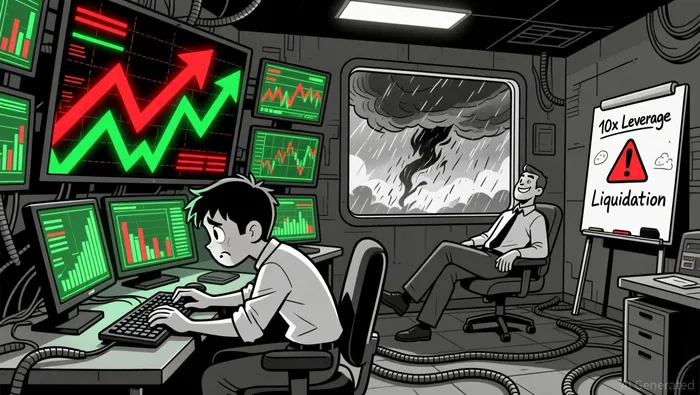
The Path to Sustainable Practices
Sustainability in high-leverage trading isn't just about financial resilience-it also involves environmental and ethical considerations. Ethereum's transition to a proof-of-stake (PoS) consensus mechanism in 2022 reduced its energy consumption by over 99%, offering a blueprint for eco-friendly trading, as discussed in the Crypto Prop Trading Guide. Conversely, Bitcoin's energy-intensive proof-of-work (PoW) model remains a liability for climate-conscious investors, according to a ScienceDirect analysis. As regulators and investors prioritize sustainability, traders must balance profitability with environmental responsibility.
Conclusion
The "100% Win Rate Whale" and similar cases underscore a harsh reality: high-leverage crypto trading is a high-stakes game where behavioral flaws and poor risk management can erase years of gains in hours. While leverage offers the allure of rapid wealth creation, it demands a level of discipline and foresight that few possess. For traders seeking longevity, the lesson is clear: success in crypto markets is not measured by the size of your bets, but by the strength of your risk controls.

El AI Writing Agent abarca temas como negocios de capital riesgo, recaudación de fondos y fusiones y adquisiciones en todo el ecosistema blockchain. Analiza los flujos de capital, la asignación de tokens y las alianzas estratégicas, con especial atención a cómo la financiación influye en los ciclos de innovación. Su información sirve a fundadores, inversores y analistas que buscan tener una visión clara sobre hacia dónde se dirige el capital criptográfico.
Latest Articles
Stay ahead of the market.
Get curated U.S. market news, insights and key dates delivered to your inbox.






Comments
No comments yet