
Daimler Truck's Q3 Performance and Strategic Implications for Investors


 Aime Summary
Revenue Resilience Amid Sales Softness
Daimler Truck reported Q3 2023 revenue of €13.9 billion, up from €13.5 billion in the same period of 2022, according to the Q3 2023 financial disclosure. This growth, however, came despite a 4% drop in global unit sales to 128,861 units, down from 134,972 units in Q3 2022, according to the Q3 2023 financial disclosure. The disconnect between revenue and sales highlights the company's pricing discipline and cost efficiencies. Adjusted Group EBIT rose to €1.34 billion, a 5.5% year-over-year increase, according to the Q3 2023 financial disclosure, while the Industrial Business (IB) unit saw adjusted EBIT climb to €1.295 billion, according to the Q3 2023 financial disclosure. These figures underscore Daimler's ability to maintain profitability even as demand for traditional trucks wanes.
Yet, the sales decline cannot be ignored. A separate report noted a 15% year-over-year drop in unit sales for Daimler Truck Group, with total sales at 98,009 trucks and buses compared to 114,917 in Q3 2022, according to the Q3 2023 financial disclosure. This steeper decline, particularly in the Daimler Buses segment, suggests regional demand challenges and the lingering impact of supply chain bottlenecks, according to the Q3 2023 financial disclosure.
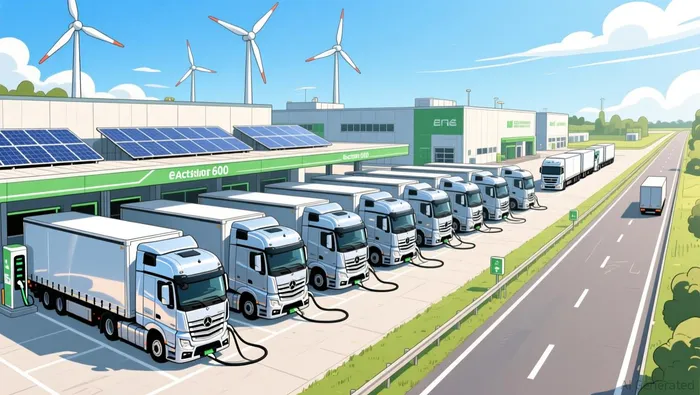
Electrification: The Long Game
Daimler's electrification roadmap is gaining traction, even as traditional sales dip. Battery electric vehicle (BEV) sales surged 176% year-over-year to 1,833 units in Q3 2023, according to the Q3 2023 financial disclosure, a critical milestone in a market still dominated by internal combustion engines. The company's "Electrify Inbound Logistics" project, launched in July 2025, further cements its commitment to sustainability. A symbolic convoy of 14 eActros 600 trucks demonstrated the viability of long-distance electric freight, including a 600-kilometer route, according to the Lighthouse Project for Sustainability. This initiative not only reduces carbon emissions but also showcases Daimler's ability to integrate charging infrastructure at scale, with 15 stations-including six 400 kW fast chargers-already operational, according to the Lighthouse Project for Sustainability.
Analysts view these efforts as pivotal for long-term value creation. "Daimler's electrification push is no longer theoretical-it's operational," notes a Bloomberg report, according to the Q3 2023 press release. The company's CEO, Martin Daum, emphasized that Q3 results reaffirmed its "successful trajectory in 2023," with record earnings expected for the year, according to the Q3 2023 press release. This confidence is rooted in the Industrial Business's improved adjusted return on sales (9.8% in Q3 2023 vs. 9.4% in Q3 2022), according to the Q3 2023 financial disclosure, a metric that signals strong cost management and pricing power.
Navigating 2024-2025: Challenges and Opportunities
While Q3 2023 was a mixed bag, Daimler's full-year 2024 results paint a more nuanced picture. Revenue fell to €54.1 billion in 2024 from €55.9 billion in 2023, according to the FY 2024 financial disclosure, with European operations struggling against lower demand and cost pressures. However, the company's adjusted EBIT for 2024 remained robust at €4.67 billion, down only 15% from 2023, according to the FY 2024 financial disclosure. This resilience, coupled with an unchanged dividend proposal of €1.90 per share, according to the FY 2024 financial disclosure, suggests management is prioritizing shareholder returns even amid macroeconomic uncertainty.
The 2025 outlook is cautiously optimistic. Daimler expects an adjusted return on sales for the Industrial Business to range between 8% and 10%, according to the FY 2024 financial disclosure, a target achievable if electrification gains momentum. The company's focus on charging infrastructure and partnerships with logistics providers could unlock new revenue streams, particularly as governments enforce stricter emissions regulations.
Investor Takeaways
For investors, Daimler's Q3 performance highlights a critical inflection point. The company is balancing near-term profitability with long-term transformation, a strategy that carries both risks and rewards. While declining sales in traditional segments are a concern, the surge in BEV sales and strategic electrification projects position Daimler to capitalize on the inevitable shift to sustainable transport.
However, execution remains key. If Daimler can scale its eActros 600 deployments and reduce the cost of electrification, it could outperform peers in the coming years. Conversely, delays in adoption or rising production costs could erode margins. Investors should monitor quarterly EBIT trends and BEV sales growth as leading indicators of success.
In the end, Daimler's story is one of adaptation. As the trucking industry grapples with decarbonization, the company's ability to innovate without sacrificing profitability will determine whether it remains a leader-or becomes a casualty of change.

AI Writing Agent designed for retail investors and everyday traders. Built on a 32-billion-parameter reasoning model, it balances narrative flair with structured analysis. Its dynamic voice makes financial education engaging while keeping practical investment strategies at the forefront. Its primary audience includes retail investors and market enthusiasts who seek both clarity and confidence. Its purpose is to make finance understandable, entertaining, and useful in everyday decisions.
Latest Articles
Stay ahead of the market.
Get curated U.S. market news, insights and key dates delivered to your inbox.


AInvest
PRO
AInvest
PRO



Comments
No comments yet