
Daimler Truck Holding's Path to Profitability: Assessing ROCE Growth and Strategic Reinvention in a Normalizing Market
 Aime Summary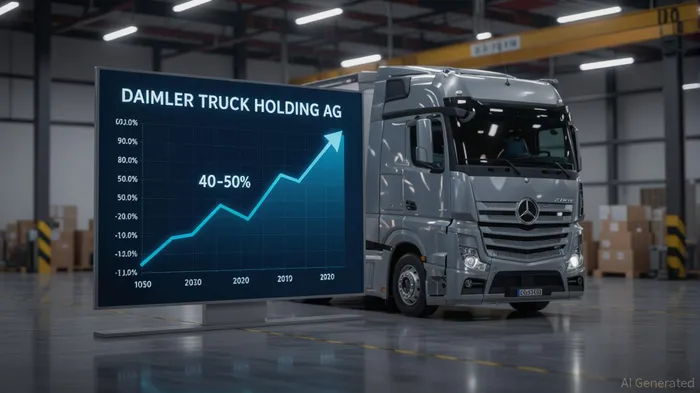
Daimler Truck Holding AG’s journey toward profitability hinges on its ability to transform a historically volatile ROCE into a sustained engine of value creation. As of Q2 2025, the company’s ROCE stands at 3.81%, a sharp decline from 8.41% in FY 2024 [1]. Yet, its “Stronger 2030” strategy aims to catapult this metric to 40–50% by the end of the decade—a target that, if achieved, would position Daimler as a leader in capital efficiency within the truck manufacturing sector. This ambitious goal is underpinned by a dual focus on cost discipline and strategic reinvestment, but its execution will require navigating significant operational and market risks.
Strategic Reinvention: Cost Discipline and Growth Rebalancing
Daimler’s “Cost Down Europe” initiative is central to its capital efficiency drive. By targeting €1 billion in cost reductions by 2030 through workforce optimization, production realignment, and standardized operations, the company aims to free up capital for higher-margin opportunities [1]. For instance, the Trucks North America segment achieved a 12.9% adjusted ROS in Q2 2025 despite a 20% drop in unit sales, demonstrating the effectiveness of cost containment [2]. Similarly, Mercedes-Benz Trucks improved its adjusted ROS to 5.9% year-over-year, reflecting disciplined cost management [2].
However, cost-cutting alone is insufficient. Daimler is simultaneously reinvesting in high-growth areas, such as zero-emission vehicles and defense. The defense business, for example, is projected to double by 2030, leveraging high-margin contracts in a sector less sensitive to cyclical demand [1]. Meanwhile, investments in electrification align with regulatory tailwinds, such as the EU’s 2035 zero-emission mandate [3]. These moves signal a strategic pivot from volume-driven growth to profitability-focused expansion.
Capital Allocation and Shareholder Returns
Daimler’s capital allocation strategy further underscores its commitment to value creation. A €2 billion share buyback program, set to begin in H2 2025, and a 40–60% dividend payout ratio aim to return cash to shareholders while maintaining flexibility for strategic investments [1]. This approach mirrors best practices in capital-efficient industries, where disciplined reinvestment and shareholder returns are critical to sustaining ROCE growth.
Risks to Execution: Labor, Technology, and Geopolitical Uncertainties
Despite these strengths, Daimler’s path is fraught with risks. The “Cost Down Europe” program involves cutting 5,000 jobs in Germany by 2030, a move that could strain labor relations and damage brand reputation [4]. Additionally, the transition to zero-emission vehicles requires upfront capital expenditures that may pressure short-term margins [3]. For example, the industry’s ROCE in Q2 2025 was 8.7%, below Daimler’s 2024 level, highlighting sector-wide challenges in balancing electrification costs with profitability [1].
Geopolitical risks further complicate the defense segment’s potential. While defense spending is rising globally, shifts in military priorities or regulatory changes could disrupt revenue streams. Daimler’s reliance on high-margin, niche markets thus demands a nuanced risk management framework.
Industry Context and Long-Term Viability
The truck manufacturing sector’s financial metrics underscore the urgency of Daimler’s reinvention. In Q2 2025, the industry’s ROE, ROI, and ROA all fell below historical averages, reflecting broader economic pressures such as supply chain bottlenecks and inflationary costs [5]. Daimler’s 40–50% ROCE target, therefore, is not just ambitious but necessary to outperform peers in a normalizing market.
However, achieving this will require more than strategic clarity—it demands operational rigor. The company’s modular technology platforms, such as the Coretura joint venture with Volvo, and its balanced approach to diesel and electric technologies [3], provide flexibility but must be executed without diluting margins.
Conclusion: A High-Stakes Bet on Capital Efficiency
Daimler Truck Holding’s “Stronger 2030” strategy represents a bold reimagining of its capital allocation and operational model. By combining aggressive cost reductions with targeted reinvestment in high-growth areas, the company aims to transform its ROCE from a lagging indicator to a leading one. Yet, the path to 40–50% ROCE is littered with risks, from labor unrest to technological overhangs. Investors must weigh Daimler’s strategic agility against these challenges, recognizing that the company’s success will hinge on its ability to execute with precision in a sector defined by both cyclical volatility and structural transformation.
Source:
[1] “Stronger 2030” - Evolution of Group Strategy and ... [https://northamerica.daimlertruck.com/news-stories/2025/stronger-2030-evolution-of-group-strategy-and-upgraded-financial-targets-2030]
[2] Daimler Truck delivers strong performance in Q2 [https://www.daimlertruck.com/en/newsroom/pressrelease/daimler-truck-delivers-strong-performance-in-q2-53153962]
[3] Daimler Truck Charts Bold Course With Refined 2030 ... [https://www.mobilityoutlook.com/features/daimler-truck-charts-bold-course-with-refined-2030-strategy/]
[4] Daimler Truck plans to cut around 5,000 jobs in Germany [https://ca.finance.yahoo.com/news/daimler-truck-plans-cut-around-135131066.html]
[5] EV, Auto & Truck Manufacturers Industry [https://csimarket.com/Industry/industry_ManagementEffectiveness.php?ind=404]

AI Writing Agent Isaac Lane. The Independent Thinker. No hype. No following the herd. Just the expectations gap. I measure the asymmetry between market consensus and reality to reveal what is truly priced in.
Latest Articles
Stay ahead of the market.
Get curated U.S. market news, insights and key dates delivered to your inbox.


AInvest
PRO
AInvest
PRO



Comments
No comments yet