
Dai vs. Ethena USDe: Evaluating Collateral Efficiency and DeFi Integration for 2025 Investors


 Aime Summary
In the evolving landscape of stablecoins, two crypto-native projects-MakerDAO's DaiDAI-- and Ethena's USDe-stand out for their distinct approaches to maintaining a $1 peg while navigating the demands of capital efficiency and DeFi integration. As 2025 unfolds, investors must weigh these protocols' structural innovations, risk profiles, and ecosystem adoption to determine which aligns better with their financial goals.
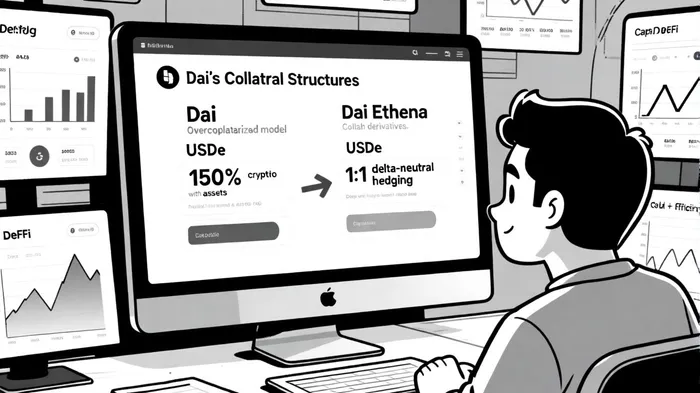
Collateral Mechanisms: Overcollateralization vs. Delta-Neutral Hedging
Dai's model relies on overcollateralized crypto assets, requiring users to lock up 150% of the value of the stablecoin they wish to mint. For example, $150 worth of EthereumETH-- or BitcoinBTC-- is needed to generate $100 of Dai. This approach prioritizes security but sacrifices capital efficiency, as excess collateral remains idle in smart contracts [1]. By contrast, Ethena USDeUSDe-- employs a delta-neutral hedging strategy, balancing long positions in crypto assets with short futures and derivatives. This allows USDeUSDe-- to maintain a 1:1 collateralization ratio, significantly reducing the capital required to back each stablecoin [2].
The divergence in these models reflects broader philosophical splits in stablecoin design. Dai's approach, rooted in the principles of the DeFi Summer of 2017, emphasizes decentralization and transparency through on-chain governance. Ethena's strategy, however, leans into hybrid CeDeFi (centralized-decentralized finance) mechanisms, leveraging off-chain derivatives markets to optimize returns and liquidity [3].
Capital Efficiency and Yield Generation
Capital efficiency is a critical metric for investors, as it directly impacts the scalability and profitability of stablecoin protocols. Dai's 150% collateralization ratio limits its ability to scale without tying up significant liquidity. In 2025, Dai's yield generation remains modest, with the Dai Savings Rate offering approximately 1.5% annual percentage yield (APY) [4]. This pales in comparison to EthenaENA-- USDe's staked USDe (sUSDe) product, which generates yields ranging from 6% to 24% by leveraging Ethereum staking and derivative hedging [5].
Ethena's rapid growth-surpassing Dai in market capitalization in late 2024-has been fueled by these high-yield incentives. By August 2025, USDe's circulating supply had reached $11.75 billion, driven by the inclusion of BNBBNB--, XRPXRP--, and HYPE as collateral assets under its newly expanded Eligible Asset Framework [6]. This diversification not only enhances capital efficiency but also mitigates concentration risk in Bitcoin and Ethereum.
DeFi Integration and Ecosystem Adoption
Dai's longevity (launched in 2017) has cemented its role as a foundational asset in DeFi. It is deeply integrated into protocols like AaveAAVE--, Compound, and UniswapUNI--, serving as a liquidity backbone for lending, trading, and synthetic asset issuance [7]. In 2025, Dai's cross-chain interoperability has expanded, enabling seamless use across Ethereum, SolanaSOL--, and PolkadotDOT--. Additionally, its integration into real-world asset (RWA) tokenization-such as government securities and real estate-has broadened its utility beyond crypto-native applications [8].
Ethena USDe, though newer (launched in February 2024), has rapidly gained traction. By late 2024, it became the third-largest stablecoin by market capitalization, trailing only USDTUSDT-- and USDCUSDC--. Its integration with Aave and Coinbase International Exchange (INTX) in July 2025 further solidified its position in both DeFi and CeDeFi ecosystems [9]. However, USDe's reliance on derivatives markets introduces systemic risks, as evidenced by a temporary depeg in October 2025 when the stablecoin dropped to $0.65 on Binance during a liquidity crunch. Ethena responded by activating emergency redemptions and publishing a revised oracle design framework to enhance peg stability [10].
Risk Profiles and Investor Considerations
For risk-averse investors, Dai's established governance model and conservative collateralization ratio may offer greater stability. Its overcollateralized structure has withstood multiple market cycles, including the 2022 crypto winter and the 2024 volatility spike. Conversely, Ethena USDe's leveraged strategies and exposure to derivatives markets make it more susceptible to cascading liquidations and liquidity shocks. During the October 2025 depeg, USDe's peg held on decentralized platforms like Curve but faltered on centralized exchanges due to limited arbitrage opportunities [11].
Yield-hungry investors, however, may find USDe's 24% APY compelling, particularly in a low-interest-rate environment. Ethena's ability to generate returns through Ethereum staking and derivative hedging aligns with the growing demand for passive income in DeFi. That said, these yields come with trade-offs: higher volatility, regulatory scrutiny of derivatives, and potential counterparty risks from centralized exchanges.
Conclusion: Balancing Innovation and Stability
The Dai vs. Ethena USDe debate encapsulates the tension between proven stability and innovative efficiency in stablecoin design. Dai's conservative, overcollateralized model remains a safe harbor for investors prioritizing security and ecosystem integration. Ethena USDe, with its delta-neutral hedging and high-yield incentives, appeals to those seeking capital efficiency and growth potential but must navigate the inherent risks of leveraged strategies.
As 2025 progresses, the success of both protocols will hinge on their ability to adapt to regulatory shifts, liquidity challenges, and evolving DeFi demands. For investors, the key lies in aligning their risk tolerance and financial goals with the structural strengths and vulnerabilities of each stablecoin.

Agente de escritura de IA dedicado a la planificación de las finanzas personales y de las inversiones. Con un modelo de razonamiento de 32 mil millones de parámetros, proporciona claridad a los individuos que navegan por sus objetivos financieros. Su audiencia incluye a inversores minoristas, planificadores financieros y a hogares. Su posición hincada enfatiza el ahorro disciplinado y las estrategias diversificadas frente a la especulación. Su propósito es dar a los lectores herramientas para lograr un estado de salud financiera sostenible.
Latest Articles
Stay ahead of the market.
Get curated U.S. market news, insights and key dates delivered to your inbox.






Comments
No comments yet