
Dacia Hipster: A Bold New Vision for Affordable Electric Mobility
ByAinvest
Monday, Oct 6, 2025 1:03 pm ET1min read
STLA--
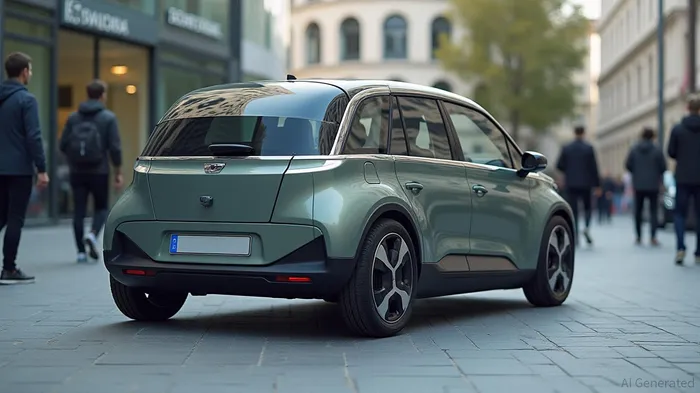
The Hipster concept car measures 3 meters in length and weighs under 800 kg, making it one of the shortest and lightest vehicles in Europe. Its design philosophy emphasizes simplicity, sustainability, and low cost. The car features four full-sized seats, up to 500 liters of boot space, and is designed to be efficient and easy to produce [1].
The Hipster's specifications include a maximum speed of around 90 km/h and an estimated range of 150 km, making it suitable for daily urban or suburban use. Dacia estimates that the average car travels less than 40 km daily at an average speed of 56 km/h, suggesting that the Hipster's range is sufficient for most daily commutes [1].
To keep the starting price below EUR 15,000, Dacia has made several sacrifices in the Hipster's design. The car features canvas seats, manual windows, very little electronics, and straps instead of door handles. It is expected to be sold in a single color, similar to the grey-blue of the prototype [1].
The Hipster is part of a broader initiative supported by Renault and Stellantis to create a new European category of small cars inspired by the Japanese "Kei Car" concept. This category would include urban vehicles with basic equipment and reduced safety requirements, allowing for lower weight and production costs [1].
Dacia's CEO, Katrin Adt, stated that the company is ready to mass produce the Hipster if the European Union agrees to create a new small car category. However, the regulations for this new category are still under discussion, and it is expected that the vehicles will need to be produced in Europe [1].
The Hipster concept car represents Dacia's vision for local, affordable, and everyday mobility. Its design-to-cost and design-to-weight philosophy aims to demonstrate what could be achieved if manufacturers were given more flexibility to create small, efficient electric cars.
Dacia has unveiled a compact electric city car concept called the Hipster, which channels the minimalist spirit of the original Mini and Fiat 500. Weighing under 800kg and measuring 3.0 meters long, the Hipster features four full-sized seats, up to 500 liters of boot space, and is designed to be simple, sustainable, and low-cost. The car's design-to-cost and design-to-weight philosophy aims to show what could be achieved if manufacturers were given more flexibility to create small, efficient electric cars.
Dacia, the low-cost brand of Renault, has unveiled the "Hipster" mini-EV concept car, aiming to challenge the dominance of low-cost Chinese electric vehicles (EVs) in the European market. The Hipster, unveiled in Meudon, France, on September 30, 2025, is a compact, lightweight car designed to provide accessible and practical everyday mobility.The Hipster concept car measures 3 meters in length and weighs under 800 kg, making it one of the shortest and lightest vehicles in Europe. Its design philosophy emphasizes simplicity, sustainability, and low cost. The car features four full-sized seats, up to 500 liters of boot space, and is designed to be efficient and easy to produce [1].
The Hipster's specifications include a maximum speed of around 90 km/h and an estimated range of 150 km, making it suitable for daily urban or suburban use. Dacia estimates that the average car travels less than 40 km daily at an average speed of 56 km/h, suggesting that the Hipster's range is sufficient for most daily commutes [1].
To keep the starting price below EUR 15,000, Dacia has made several sacrifices in the Hipster's design. The car features canvas seats, manual windows, very little electronics, and straps instead of door handles. It is expected to be sold in a single color, similar to the grey-blue of the prototype [1].
The Hipster is part of a broader initiative supported by Renault and Stellantis to create a new European category of small cars inspired by the Japanese "Kei Car" concept. This category would include urban vehicles with basic equipment and reduced safety requirements, allowing for lower weight and production costs [1].
Dacia's CEO, Katrin Adt, stated that the company is ready to mass produce the Hipster if the European Union agrees to create a new small car category. However, the regulations for this new category are still under discussion, and it is expected that the vehicles will need to be produced in Europe [1].
The Hipster concept car represents Dacia's vision for local, affordable, and everyday mobility. Its design-to-cost and design-to-weight philosophy aims to demonstrate what could be achieved if manufacturers were given more flexibility to create small, efficient electric cars.
Stay ahead of the market.
Get curated U.S. market news, insights and key dates delivered to your inbox.


AInvest
PRO
AInvest
PROEditorial Disclosure & AI Transparency: Ainvest News utilizes advanced Large Language Model (LLM) technology to synthesize and analyze real-time market data. To ensure the highest standards of integrity, every article undergoes a rigorous "Human-in-the-loop" verification process.
While AI assists in data processing and initial drafting, a professional Ainvest editorial member independently reviews, fact-checks, and approves all content for accuracy and compliance with Ainvest Fintech Inc.’s editorial standards. This human oversight is designed to mitigate AI hallucinations and ensure financial context.
Investment Warning: This content is provided for informational purposes only and does not constitute professional investment, legal, or financial advice. Markets involve inherent risks. Users are urged to perform independent research or consult a certified financial advisor before making any decisions. Ainvest Fintech Inc. disclaims all liability for actions taken based on this information. Found an error?Report an Issue


ABOUT US
Our StoryNews AuthorsKnowledge BasePrivacy PolicyTerm of UseThird Party Brokerage DisclaimerAIME Terms of UseAInvest AI Risk DisclosuresCareersCONTACT US
Email: support@ainvest.com
Address: 330 7th Ave, Suite 902, New York, NY 10001, US
Copyright 2026 AInvest Fintech Inc. All rights reserved.


Comments
No comments yet