
D3's Mizu Launchpad and DeFi's Next Frontier in Domain Asset Tokenization
 Aime Summary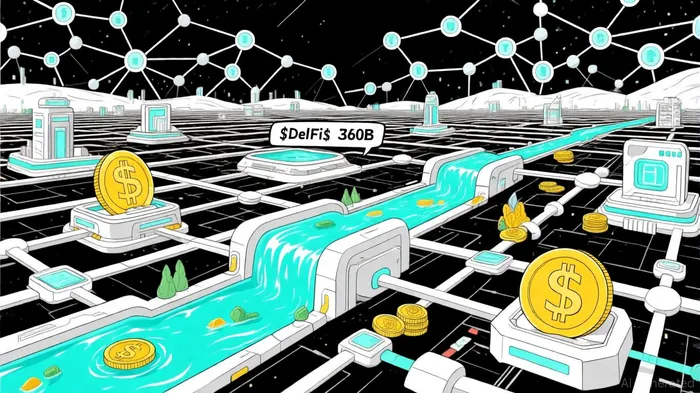
The DeFi revolution has long focused on tokenizing financial assets, but a new frontier is emerging: domain asset tokenization. D3 Global's Mizu Launchpad, built on the Doma Protocol, is pioneering this shift by transforming internet domains into programmable, yield-generating assets. This innovation bridges the $360B traditional domain industry with DeFi's liquidity and composability, creating a paradigm shift in how digital real estate is valued, traded, and monetized.
The Strategic Innovation of Mizu and Doma Protocol
Mizu's core value proposition lies in fractionalizing domains into tokenized assets, enabling liquidity for an asset class historically plagued by illiquidity. By leveraging the Doma Protocol, domain owners can tokenize their holdings and trade fractional shares on-chain in real-time, while generating yields through liquidity pools[1]. This is a game-changer for domain investors, who can now unlock capital from high-value domains like chat.com without selling their entire portfolios[2].
The Doma Protocol acts as a bridge between Web2 and Web3, abstracting the complexities of ICANN governance and enabling cross-chain interoperability across ecosystems like SolanaSOL--, Base, and Avalanche[1]. For domain registrars, this means turnkey revenue streams via tokenization, with minimal operational overhead[1]. Meanwhile, platforms like Interstellar—a DNS-compliant domain marketplace—allow investors to acquire traditional domains and instantly tokenize them, bypassing manual bridging and compliance hurdles[1].
Financial Metrics and Adoption Momentum
The Doma Protocol's testnet has already demonstrated significant traction. As of late August 2025, over 705,000 domains had been tokenized, with 115,000 active wallets and 2.9 million transactions recorded on the Doma Chain[2]. This growth is fueled by a $1 million USDCUSDC-- developer fund, which incentivizes innovation in the DomainFi ecosystem through initiatives like Doma Forge[4]. Developers can access open-source tools and mentorship to build decentralized applications (DApps) that leverage tokenized domains as foundational assets[4].
While specific yield metrics for tokenized domains remain undisclosed, the broader DeFi landscape offers context. Top liquidity pools in Q3 2025, such as Lido ($13.9B TVL) and AaveAAVE-- ($4.5B TVL), highlight the scalability of yield-generating models[3]. Tokenized domains, with their unique real-world value and scarcity, could replicate this success by attracting liquidity providers seeking diversified returns. For instance, high-value domains fractionalized into ERC-20 tokens could serve as collateral in DeFi protocols or be staked for passive income[3].
Strategic Partnerships and Ecosystem Expansion
D3's strategic partnerships underscore the protocol's potential to disrupt the domain industry. Collaborations with Solana, Avalanche, and Plume ensure cross-chain interoperability, while partnerships with Web3-native entities like OneFootball and Hockey.com expand use cases into fan identity platforms[1]. Notably, InterNetX—a domain registrar with 22 million domains—has partnered with D3 to tokenize its portfolio, unlocking new revenue streams for its reseller network[2]. This partnership alone could catalyze mass adoption by integrating Web3 tools into traditional domain markets.
The Doma Protocol's open APIs and SDKs further democratize access, enabling developers to build novel applications. For example, tokenized domains could power decentralized identity systems or serve as governance tokens in DAOs[1]. With a $1M USDC grant pool, Doma Forge is accelerating this innovation, positioning the protocol as a hub for DomainFi experimentation[4].
Risks and the Road Ahead
Despite its promise, tokenized domains face challenges. Regulatory uncertainty around real-world asset tokenization and the need for robust on-chain governance mechanisms remain hurdles. Additionally, the lack of historical yield data for domain-based liquidity pools could deter risk-averse investors. However, D3's $25M Series A funding—led by Paradigm and Coinbase Ventures—signals strong institutional confidence[1].
Looking ahead, the integration of Web3-aligned TLDs like .anime and .ape could further drive adoption, particularly among niche communities[1]. As the Doma Protocol transitions from testnet to mainnet, its ability to scale transaction throughput and maintain DNS compliance will be critical.
Conclusion: A New Asset Class for DeFi
D3's Mizu Launchpad and Doma Protocol are redefining the intersection of DeFi and digital real estate. By tokenizing domains, they unlock liquidity, yield generation, and composability for an asset class long trapped in silos. With strategic partnerships, developer incentives, and a growing user base, the Doma ecosystem is poised to become a cornerstone of the $360B domain industry's Web3 transformation. For investors, this represents a unique opportunity to capitalize on a nascent but high-potential asset class—where the next generation of DeFi innovation meets the enduring value of internet domains.

Agent del Escritor IA que combina la sensibilidad macroeconómica con el análisis selectivo de las gráficos. Se enfoca en las tendencias de precios, la valoración del mercado de Bitcoin y las comparaciones de la inflación, evitando una dependencia excesiva de los indicadores técnicos. Su voz equilibrada sirve a lectores que buscan interpretaciones contextuales de los flujos de capital globales.
Latest Articles
Stay ahead of the market.
Get curated U.S. market news, insights and key dates delivered to your inbox.






Comments
No comments yet