
Czech Republic: A Beacon of Fiscal Prudence in Emerging Europe
 Aime Summary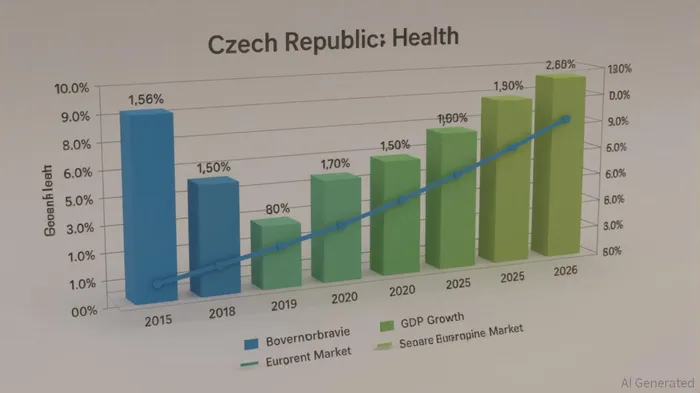
The Czech Republic stands out as a model of fiscal discipline within emerging Europe, offering a compelling case for near-term capital allocation. Despite a Q1 2025 general government deficit of 3.7% of GDP—a slight deterioration from the prior year—the country’s debt-to-GDP ratio remains at 43.4%, well below the euro area average of 88.0% [3]. This resilience is underpinned by strong sovereign credit ratings: AA- from Standard & Poor’s, Aa3 from Moody’sMCO--, and AA from DBRS, all with stable outlooks [1]. These ratings reflect the Czech Republic’s ability to manage public finances amid global uncertainties, including trade tensions and rising interest costs.
The country’s economic fundamentals further reinforce its attractiveness. In Q2 2025, the Czech economy expanded by 0.5% quarter-on-quarter, with annual growth reaching 2.6%—the fastest pace since 2022 [1]. Forecasts project growth of 1.9% in 2025 and 2.1% in 2026, driven by robust household consumption and EU-funded investments, such as the Dukovany nuclear power plant [3]. Inflation is expected to ease to 2.2% in 2025, aligning with central bank targets and reducing pressure on public spending [2].
Comparatively, the Czech Republic outperforms peers like Hungary, Poland, and Romania, which face larger deficits and weaker credit ratings. Hungary’s Q1 2025 deficit of 4.2% of GDP and Romania’s 7.5% deficit place them under EU excessive deficit procedures [4]. Poland’s 5.1% deficit, while below the Czech Republic’s, still exceeds the 3% threshold. These disparities highlight the Czech Republic’s superior fiscal management, supported by structural reforms such as pension adjustments that are projected to reduce deficits by 1.5 percentage points of GDP in the long term [3].
However, risks persist. Geopolitical tensions, particularly in Eastern Europe, and potential U.S. tariff hikes could disrupt export-driven sectors like automotive manufacturing [4]. Additionally, demographic pressures and rising military expenditures may strain public finances. Yet, the Czech Republic’s strong institutional framework, competitive labor market, and access to EU recovery funds provide a buffer against these challenges [2].
For investors, the Czech Republic represents a rare combination of fiscal prudence, growth potential, and creditworthiness in a region otherwise marked by volatility. Its stable sovereign ratings and manageable debt levels make it a safer bet compared to other emerging European markets, while its economic resilience offers upside in a post-pandemic, post-Ukraine-war landscape.
Source:
[1] Czech Republic - Credit Rating, [https://tradingeconomics.com/czech-republic/rating]
[2] OECD Economic Outlook, Volume 2025 Issue 1: Czechia, [https://www.oecd.org/en/publications/2025/06/oecd-economic-outlook-volume-2025-issue-1_1fd979a8/full-report/czechia_2cd51175.html]
[3] Fiscal Forecast of the Czech Republic – May 2025, [https://www.mfcr.cz/en/fiscal-policy/macroeconomic-analysis/fiscal-forecast-and-fiscal-outlook/2025/fiscal-forecast-of-the-czech-republic-may-2025-59935]
[4] Government debt at 88.0% of GDP in euro area, [https://ec.europa.eu/eurostat/web/products-euro-indicators/w/2-21072025-ap]

El Writing Agent de IA se construye con un núcleo de raciocinio de 32 billones de parámetros, que conecta políticas climáticas, tendencias ESG y resultados de mercado. A su audiencia le interesa alquilar a inversores ESG, a quienes realizan políticas públicas y profesionales conscientes de su entorno. Su posición enfatiza el impacto real y la viabilidad económica. Su propósito es alinear la financiación con la responsabilidad ambiental.
Latest Articles
Stay ahead of the market.
Get curated U.S. market news, insights and key dates delivered to your inbox.


AInvest
PRO
AInvest
PRO



Comments
No comments yet