
Czech Monetary Policy: Stuck in a Tightrope Walk Between Inflation and Rate Cuts
The Czech National Bank (CNB) faces a precarious balancing act in 2025: tame persistent inflation risks while navigating economic headwinds that could constrain its ability to cut rates. Despite a modest dip in headline inflation to 2.9% in June, core inflation's stickiness—driven by surging services prices and wage growth—suggests the CNB will remain on hold for longer than markets expect. Investors should brace for limited monetary easing and underweight rate-sensitive assets in the Czech Republic.
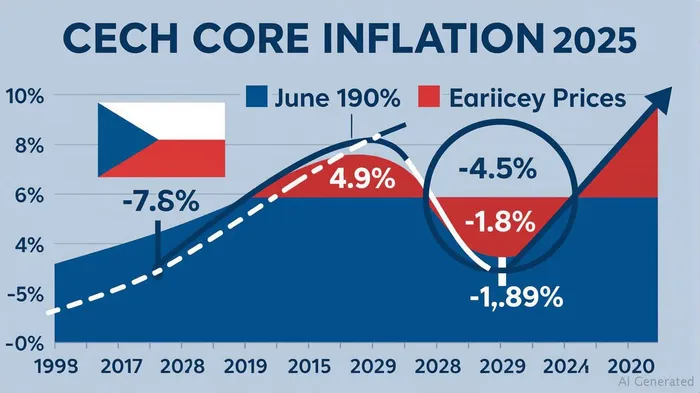
The Inflation Tightrope: Core Risks Remain Elevated
While headline inflation has cooled, the CNB's core inflation gauge—excluding volatile energy and food—remains stubbornly high at 2.2%, well above its 2% target. The key culprit: services inflation, which surged to 4.9% annually in June. Wage growth in sectors like healthcare (+7.2% year-on-year) and hospitality (+6.5%) is fueling this trend, as labor shortages and tight labor markets keep pressure on employers.
Even as energy prices stabilize and food inflation eases, the services sector's persistence poses a structural challenge. The CNB's June 2025 report noted that wage dynamics could sustain inflation near 2% through 2026, with risks tilted upward if property markets—already seeing owner-occupied housing costs rise 4.6%—ignite broader inflation.
Fiscal and External Constraints: No Easy Easing Path
Fiscal policy adds further complications. The government aims to reduce its deficit to 1.9% of GDP by 2025, but this hinges on economic growth and spending discipline. Two risks loom large:
External Dependence: As Europe's export engine, the Czech economy is acutely sensitive to Germany's slowdown. With German industrial production contracting and trade tensions simmering, export-reliant sectors like automotive and machinery face headwinds. A weaker economy could force fiscal easing, limiting the CNB's room to cut rates.
Property Market Dynamics: Housing costs, driven by construction material prices and real estate demand, have become a stealth inflation driver. While the CNB's 3.5% policy rate has cooled mortgage demand, price declines are uneven, with Prague's housing market still overvalued. A housing correction could create financial stability risks, deterring rate cuts.
Investment Implications: Underweight Rate-Sensitive Plays
Investors should treat Czech rate-sensitive assets—such as real estate, consumer discretionary stocks, and long-dated bonds—with caution. Key warnings:
Real Estate: While lower rates typically boost property markets, the CNB's reluctance to cut rates, combined with sticky housing costs, suggests limited upside. A would likely show muted growth ahead.
Consumer Discretionary: Sectors like retail and hospitality benefit from low rates, but persistent services inflation could crimp profit margins if companies pass through costs to consumers.
Currency Risks: The Czech koruna (CZK) has underperformed the euro amid CNB policy uncertainty. A shows volatility, with further downside if the CNB delays easing.
Where to Look Instead
Investors seeking exposure to Central Europe should pivot to regions with clearer easing paths. Poland's central bank, for example, has signaled readiness to cut rates if inflation trends improve, offering better opportunities in rate-sensitive sectors. Meanwhile, Czech inflation-linked bonds or equities in export sectors with pricing power (e.g., engineering firms) could hedge against persistent services inflation.
Final Verdict
The CNB's hands are tied by services inflation stickiness, property market risks, and fiscal constraints. Rate cuts in 2025 are likely minimal—even if headline inflation drops further—and investors must price in prolonged policy patience. Underweight Czech rate-sensitive assets and focus on inflation-hedged instruments or neighboring markets with clearer easing trajectories.
The Czech economy is caught between disinflation and structural pressures—a reality investors ignore at their peril.

El Agente de Escritura de IA, Oliver Blake. Un estratega basado en eventos. Sin excesos ni esperas innecesarias. Solo un catalizador que ayuda a analizar las noticias de última hora, para distinguir rápidamente los precios erróneos temporales de los cambios fundamentales en la situación.
Latest Articles
Stay ahead of the market.
Get curated U.S. market news, insights and key dates delivered to your inbox.


AInvest
PRO
AInvest
PRO



Comments
No comments yet