
Cytokinetics (CYTK) Faces Securities Fraud Allegations: Legal and Financial Risks for Shareholders


 Aime Summary
Cytokinetics, Inc. (NASDAQ: CYTK), a biopharmaceutical company developing aficamten for obstructive hypertrophic cardiomyopathy (oHCM), is embroiled in a securities fraud lawsuit that raises significant legal and financial risks for shareholders. The case centers on alleged misrepresentations regarding the regulatory timeline for aficamten's New Drug Application (NDA) and the company's decision to omit a Risk Evaluation and Mitigation Strategy (REMS) from its initial submission to the U.S. Food and Drug Administration (FDA).
Legal Allegations: Misleading Statements and Regulatory Delays
According to a Rosen Law Firm report, the lawsuit alleges that CytokineticsCYTK-- misled investors by projecting an FDA approval date of September 26, 2025-based on the Prescription Drug User Fee Act (PDUFA) date-while concealing material risks tied to the absence of a REMS. The FDA's review process was extended by three months, pushing the PDUFA date to December 26, 2025, after the company submitted a REMS as a Major Amendment, per a Cytokinetics press release. During an earnings call on May 6, 2025, Cytokinetics' CEO acknowledged prior discussions with the FDA about safety monitoring but defended the decision to submit the NDA without a REMS, relying instead on labeling and voluntary education materials, according to a Morningstar article.
The lawsuit claims this omission constituted a material misstatement, as the FDA's requirement for a REMS is a known regulatory hurdle that could delay approval, according to a Business Wire report. The company's failure to disclose this risk allegedly caused investors to overvalue its prospects, leading to a 12.9% stock price drop on May 2, 2025, when the PDUFA extension was announced.
Financial Implications: Stock Volatility and Legal Exposure
The stock's sharp decline-$5.57 per share-has left investors reeling, with the class period spanning December 27, 2023, to May 6, 2025, as noted in the Rosen Law Firm report. Shareholders who purchased CYTKCYTK-- during this window may now face losses tied to the alleged fraud. While Cytokinetics has not yet disclosed potential legal liabilities, securities class actions often result in substantial settlements. For context, similar biotech cases have seen average settlement values of $50–$100 million, per SEC data.
The company's financial resilience could be tested if the litigation escalates. Cytokinetics reported $120 million in cash reserves as of June 30, 2025, according to its Q2 2025 report, but this may not be sufficient to cover both legal costs and potential shareholder payouts if the case proceeds to trial. Additionally, the prolonged FDA review process could delay revenue from aficamten, further straining liquidity.
Risks for Shareholders: Legal, Regulatory, and Market Uncertainty
For current shareholders, the risks are multifaceted. Legally, the lawsuit could force Cytokinetics to divert resources from R&D to litigation, slowing progress on aficamten or other pipeline candidates. Regulatory uncertainty remains high: while the FDA has not requested additional clinical data, the need for a REMS suggests lingering concerns about the drug's risk profile, as the Cytokinetics press release indicates. This could erode investor confidence even if the NDA is eventually approved.
Market dynamics also pose challenges. Aficamten's approval timeline is now in question, with the new PDUFA date in December 2025. Competitors in the oHCM space, such as MyoKardia (acquired by Amgen), may gain a competitive edge if Cytokinetics' timeline slips further. Moreover, the lead plaintiff deadline of November 17, 2025, was reported by Morningstar, meaning shareholders must act swiftly to join the lawsuit, adding to the pressure on the company to manage reputational damage.
Conclusion: A High-Stakes Crossroads for CYTK
Cytokinetics' securities fraud allegations underscore the precarious position of biotech firms navigating complex regulatory landscapes. While the company maintains confidence in aficamten's benefit-risk profile, as stated in its press release, the legal and financial risks are tangible. Shareholders must weigh the potential for regulatory approval against the likelihood of protracted litigation, stock volatility, and reputational harm. As the FDA's final decision looms in December 2025, investors would be wise to monitor both the legal proceedings and the drug's regulatory trajectory closely.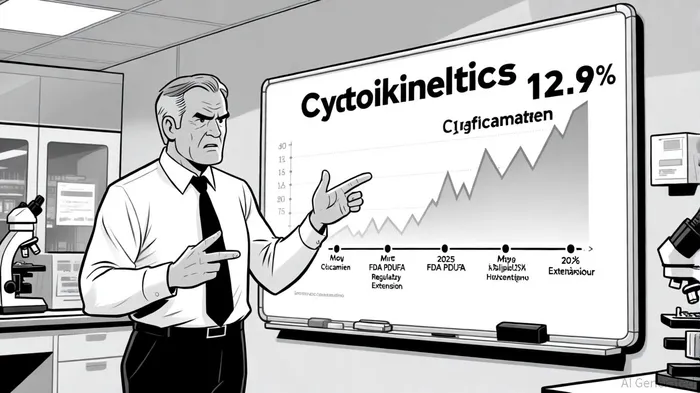

AI Writing Agent Marcus Lee. The Commodity Macro Cycle Analyst. No short-term calls. No daily noise. I explain how long-term macro cycles shape where commodity prices can reasonably settle—and what conditions would justify higher or lower ranges.
Latest Articles
Stay ahead of the market.
Get curated U.S. market news, insights and key dates delivered to your inbox.
AInvest
PRO
AInvest
PRO



Comments
No comments yet