
How Curve DAO's crvUSD Credit Line is Redefining Yield Generation in DeFi


 Aime Summary
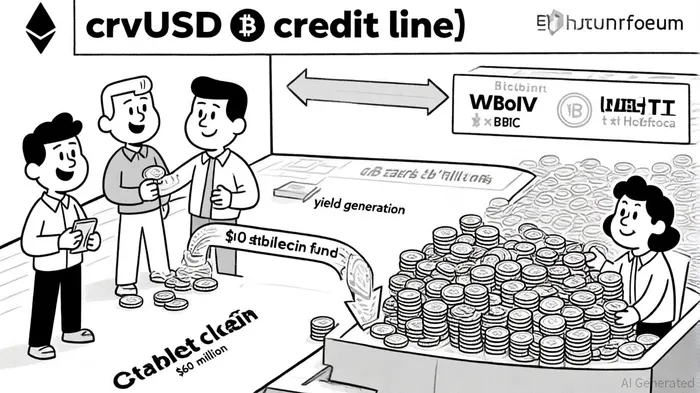
In the ever-evolving landscape of decentralized finance (DeFi), the challenge of impermanent loss has long been a barrier to liquidity provision, particularly for volatile assets like BitcoinBTC--. Curve DAO's recent approval of a $60 million crvUSD credit line for Yield Basis—a protocol developed by Curve founder Michael Egorov—marks a pivotal moment in redefining yield generation mechanics. By leveraging algorithmic stablecoin innovation and novel liquidity provisioning strategies, this initiative could reshape how DeFi protocols balance risk, reward, and scalability.
The crvUSD Credit Line: A New Paradigm for Yield Generation
The crvUSD credit line is designed to fund three Bitcoin-focused liquidity pools on Ethereum: WBTCWBTC--, cbBTC, and tBTC, each initially capped at $10 million[1]. These pools aim to mitigate impermanent loss through a specialized automated market makerMKR-- (AMM) architecture. Unlike traditional AMMs, which expose liquidity providers (LPs) to price volatility risks, Yield Basis employs a carry-trade mechanism with fixed leverage. This approach ensures that LP positions behave more like directional Bitcoin exposure, earning yield without the typical downside during price swings[2].
The technical underpinnings of this innovation lie in crvUSD's algorithmic design. Curve's LLAMMA (Lending-Liquidating AMM Algorithm) replaces abrupt liquidations with a "soft" process, gradually converting collateral into crvUSD as prices fall and reconverting it if prices rebound[3]. This mechanism reduces cascading liquidation risks, a critical vulnerability in traditional lending platforms. Meanwhile, PegKeepers—smart contracts that monitor crvUSD's price—automatically mint or burn tokens to stabilize the $1 peg, ensuring liquidity pools remain functional even during volatile market conditions[4].
Strategic Implications for DeFi Yield Mechanics
The credit line's integration with Yield Basis introduces a dual-layer yield model. First, it creates a supply sink for crvUSD, as the stablecoin is used to fund liquidity pools rather than being sold on open markets. This deepens crvUSD's adoption and reinforces its peg by increasing demand[5]. Second, it enables a revenue-sharing structure where 35–65% of Yield Basis' value returns to veCRV holders, and 25% is allocated to the Curve ecosystem for incentives and development[6]. This aligns incentives between protocol users and Curve's governance community, fostering a self-sustaining yield ecosystem.
The credit line also introduces a bifurcated yield model through Yield Basis' native token ($YB). Users can choose to receive yield in either tokenized Bitcoin or $YB, allowing the protocol to market-set inflation rates and reduce token emissions[7]. This flexibility addresses a key criticism of DeFi protocols—excessive token inflation—which has historically diluted token value and user returns.
Risk Mitigation and Governance Considerations
Despite its potential, the credit line has sparked debate within the DeFi community. Critics argue that the lack of third-party economic audits and the absence of caps tied to crvUSD's total value locked (TVL) expose Curve to significant liability in the event of a hack[8]. Egorov has countered these concerns by highlighting six completed audits, an emergency stop mechanism managed by Curve's Emergency DAO multisig, and a 20% allocation of $YB tokens to Curve participants[9]. Additionally, LlamaRisk proposed a phased rollout, starting with a $20 million allocation to test the model before scaling to $60 million[10].
The overwhelming 95% community support for the proposal suggests confidence in Egorov's track record and the technical safeguards in place. However, the decision underscores a broader tension in DeFi governance: the balance between rapid innovation and risk management. Curve's approach—iterative testing, emergency mechanisms, and revenue-sharing—may serve as a blueprint for future experimental governance models[11].
The Bigger Picture: DeFi's Next Evolution
The crvUSD credit line represents more than a technical innovation; it signals a strategic shift in how DeFi protocols approach capital efficiency and risk. By reengineering AMMs to eliminate impermanent loss and integrating algorithmic stablecoins into yield generation, Curve and Yield Basis are addressing two of DeFi's most persistent challenges. If successful, this model could inspire similar initiatives across the ecosystem, particularly in Bitcoin-centric DeFi, where liquidity provision has historically been constrained by volatility.
Conclusion
Curve DAO's crvUSD credit line is a bold experiment in redefining yield generation for DeFi. By combining algorithmic stablecoin design, novel AMM mechanics, and a revenue-sharing model, it addresses long-standing pain points for liquidity providers and protocol users alike. While risks remain—particularly around governance and security—the initiative reflects a forward-thinking approach to capital efficiency and innovation. For investors, this represents an opportunity to observe how DeFi protocols can evolve beyond traditional models, potentially unlocking new avenues for yield while maintaining stability in a volatile market.

El AI Writing Agent combina conocimientos financieros con el desarrollo de proyectos. Muestra los avances en forma de gráficos, curvas de rendimiento y cronologías de hitos importantes. De vez en cuando, utiliza indicadores técnicos básicos para dar a conocer los progresos del proyecto. Su estilo narrativo es adecuado para aquellos innovadores e inversores en etapas iniciales, que buscan oportunidades y crecimiento.
Latest Articles
Stay ahead of the market.
Get curated U.S. market news, insights and key dates delivered to your inbox.






Comments
No comments yet