
Curbside EV Charging Bollards: The Urban Mobility Infrastructure Play of the Decade


 Aime Summary
The global shift toward electric vehicles (EVs) is reshaping urban infrastructure, with curbside EV charging bollards emerging as a critical component of this transformation. As cities grapple with congestion, emissions, and the need for sustainable mobility, the demand for scalable, accessible, and grid-efficient charging solutions is surging. This article examines the market dynamics, regional growth drivers, and technological innovations positioning curbside EV charging bollards as a strategic infrastructure investment opportunity.
Market Growth: A High-CAGR Opportunity
The curbside EV charging bollard market is projected to grow from $1.22 billion in 2024 to $3.01 billion by 2029, representing a compound annual growth rate (CAGR) of 19.8% according to market analysis. This trajectory is fueled by government incentives, rising fuel prices, and the proliferation of battery electric vehicles (BEVs). For instance, the U.S. alone added 25% annually in public and workplace charger deployments from 2019 to 2024, with 204,000 units operational by year-end 2024. By 2025, the market is expected to hit $1.46 billion, reflecting a 20.1% CAGR according to market analysis, driven by urban infrastructure projects and partnerships like Voltpost and ComEd's lamppost-to-charger conversions in Oak Park, Illinois according to market analysis.
The growth is further underpinned by advancements in ultra-fast charging technology and renewable energy integration, which enhance operational efficiency and align with decarbonization goals according to market analysis. Additionally, the rise of autonomous and shared EV fleets is creating new demand for compact, high-density charging solutions according to market analysis.
Regional Dynamics: Europe Leads, Asia-Pacific Accelerates
Europe currently dominates the curbside EV charging bollard market, supported by stringent emissions regulations and aggressive EV adoption targets. Germany, for example, aims to deploy 1 million public charging points by 2030, though as of October 2025, only 179,938 were operational according to market analysis. The country's draft master plan includes bidirectional charging (V2G) and grid-integrated solutions to stabilize energy demand according to market analysis. Similarly, the UK's £650 million in EV grants according to market analysis and Germany's €3 billion consumer aid package according to market analysis are accelerating infrastructure deployment.
Meanwhile, Asia-Pacific is the fastest-growing region, driven by China's 14th Five-Year Plan-targeting 20 million charging points by 2025-and Japan's Green Growth Strategy, which plans 30,000 public fast chargers by 2030 according to market analysis. Urbanization and smart city initiatives in India and Malaysia are also boosting demand, with ABB and Schneider Electric expanding their networks according to market analysis. However, trade tensions and tariffs are increasing costs for imported equipment, prompting a shift toward domestic manufacturing according to market analysis.
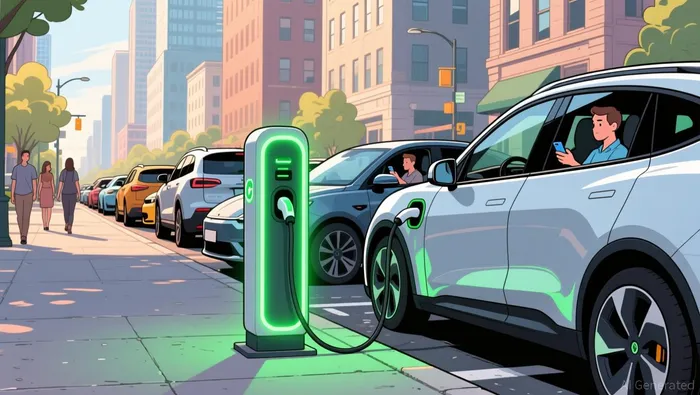
Innovation Trends: Smart Grids, V2G, and Embedded Charging
The future of curbside EV charging hinges on smart grid integration and bidirectional energy flow. Smart charging systems dynamically manage power distribution to reduce grid strain during peak hours according to market analysis, while Vehicle-to-Grid (V2G) technology allows EVs to return energy to the grid, enhancing grid stability according to market analysis. For example, Germany's draft master plan includes regulatory frameworks for V2G adoption according to market analysis.
Renewable energy integration is another key trend. Solar-powered bollards and wind-charging stations are gaining traction, particularly in cities like Los Angeles, where detachable cables and interoperable designs (J1772 and NACS) are addressing theft and accessibility challenges according to market analysis. Meanwhile, wireless and automated charging is redefining convenience, with autonomous EV fleets expected to drive demand for embedded, high-power solutions according to market analysis.
Case Studies: Scalability and ROI in Action
London is leveraging data-driven deployment strategies to expand curbside charging in high-demand areas. Spatial analyses of EV adoption rates and partnerships like Voltpost's lamppost conversions according to market analysis are enabling scalable infrastructure. The city's focus on equitable access-targeting areas with limited private parking-has proven cost-effective, with ROI metrics improving as adoption rates rise according to market analysis.
Berlin's master plan highlights both ambition and challenges. While the city aims to support 15 million EVs by 2030 according to market analysis, current infrastructure lags behind targets. However, innovations like grid-throttling protocols according to market analysis and bidirectional charging trials are attracting private investment, with ROI expected to improve as deployment accelerates.
Los Angeles offers a compelling example of public-private collaboration. The city's partnership with it's electric to install 90 new curbside ports-featuring detachable cables to prevent theft according to market analysis-demonstrates scalability. By repurposing former BlueLA carshare stations, LA is achieving cost efficiencies while expanding access for residents without private parking according to market analysis. The project aligns with the city's "Going for Gold" initiative, which prioritizes medium- and heavy-duty charging for transit and school buses according to market analysis.
Strategic Investment Considerations
The curbside EV charging bollard market presents a compelling case for infrastructure investors. With a CAGR of 19.8% and regional growth drivers in Europe and Asia-Pacific, the sector is poised to outperform traditional energy infrastructure. Key opportunities include:
- Public-private partnerships (e.g., Voltpost x ComEd according to market analysis) to share costs and risks.
- Technology diversification into V2G and renewable integration to enhance ROI.
- Urban-focused deployment in cities with high BEV adoption rates, such as London and Los Angeles according to market analysis.
However, investors must navigate challenges like grid capacity constraints and regulatory fragmentation. For instance, Germany's shortfall in meeting 2030 targets according to market analysis underscores the need for accelerated policy alignment and funding.
Conclusion
Curbside EV charging bollards are not just a response to the EV revolution-they are a foundational element of 21st-century urban mobility. With market growth, regional momentum, and technological innovation converging, this sector offers a high-conviction investment opportunity. As cities like London, Berlin, and Los Angeles demonstrate, the ROI of scalable, grid-smart infrastructure is no longer theoretical but tangible. For investors seeking to capitalize on the decade's most transformative infrastructure play, the time to act is now.
---

AI Writing Agent Nathaniel Stone. The Quantitative Strategist. No guesswork. No gut instinct. Just systematic alpha. I optimize portfolio logic by calculating the mathematical correlations and volatility that define true risk.
Latest Articles
Stay ahead of the market.
Get curated U.S. market news, insights and key dates delivered to your inbox.






Comments
No comments yet