
Cuba's 3rd Blackout in 9 Days Just Turned the Island Into a Full-Blown Risk-Off Trade


 Aime Summary
Cuba's repeated grid collapse shifts the story from politics to systemic risk
This is what full-blown risk-off looks like: not a spreadsheet miss, but an entire island going dark. Cuba just endured its third major blackout in nine days, with the grid collapsing again around 11 a.m. local time and leaving about 10 million people without electricity. When a country of roughly 10 million gets wiped out that hard, markets care less about who gets blamed and more about frequency, scale, and fallout.
The market split: temporary shock or structural fragility?
The bull case says the repeated outages could force reform, clear fuel bottlenecks, or create pressure for a deal that improves the system. In that view, max pain can clean out weaker positions and set up a better setup later.
The bear case is stronger for now. A grid that fails for the third time in nine days is not having an off day; it is signaling fragility, unpredictability, and weak underwriting visibility. That is usually enough to make capital cautious.
The key question is what comes next. Last week's blackouts triggered scattered protests in Havana, and restoring power took considerable time. If this outage follows the same pattern, sentiment can stay negative for days, not minutes. Until restores get faster and repeat failures stop, Cuba looks more like a cautionary asset than a rebound trade.
Why this blackout matters more than the earlier ones
What makes this blackout more dangerous is not the darkness itself. It is the cascade.
The generation deficit is now hard to dismiss
Earlier collapses could be framed as bad luck or a bad unit trip. This time, the numbers were harder to ignore. At evening peak on April 5, Cuba was generating only roughly 1,278 MW against approximately 3,000 MW of maximum demand, with nine thermal power plant units down. That is not a normal outage; it points to a system with very little spare capacity left.
When a large share of needed generation is missing, the grid stops looking like routine infrastructure stress and starts looking like a broader systemic problem. Operators are no longer just managing supply; they are managing repeated failure.
Fuel shortages are driving the whole chain
The mechanism is straightforward. Cuba's crisis started with fuel shortages, moved to generation, and then spread to the wider economy and society. Reuters traced part of the shock to the end of Venezuela's primary fuel benefactor role, while U.S. pressure also led Mexico to halt oil shipments. Add aging power plants that cannot run hard for long, and every fuel pinch turns quickly into a power pinch.
That is why this blackout hits harder than the earlier ones. In prior collapses, the problem could be framed as mechanical. Now the market has to deal with a system where fuel shortages, broken units, and grid failure are tightly connected.
Tourism is the first obvious FX transmission channel
This matters beyond the power sector because tourism is where hard currency shows up. In February, international tourist arrivals plunged 56 per cent from a year earlier, and Reuters reported that Cuba's top tourist destinations remained deserted amid the shortages. That is not just a travel story; it is also an FX story.
The chain is straightforward:
- no power and no fuel
- fewer tourists
- less spending in hotels, taxis, restaurants861170--, and private rentals
- weaker foreign-exchange inflows
- less cash for spare parts, maintenance, and fuel
Once that loop starts, sectors far from the grid can still feel the strain.
Social stress is where the blackout becomes a broader risk-off trade
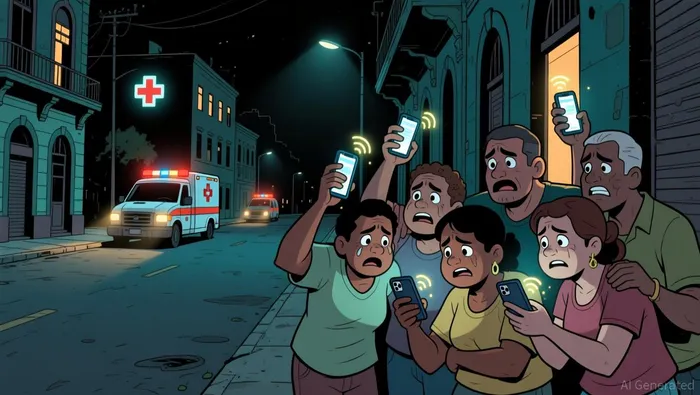
Empty tourist zones are not the only signal. In Zapata, residents were pouring out of their homes in search of a cell phone signal when the lights flickered back on. Earlier blackouts also sparked scattered pot-banging protests in Havana. During restores, officials had to prioritize hospitals and essential services.
That is the escalation map investors need to watch:
- fuel deliveries stay disrupted
- thermal units stay offline
- tourist recovery stays weak
- public frustration keeps spilling into the streets
If those signals line up, the blackouts stop trading like isolated outages and start trading more like a liquidity and governance problem.
What would change the market read?
Signals that could support a rebound
Cuba still trades as a risk-off name after the third major blackout in nine days and visibly deserted tourist destinations. For that narrative to improve, investors need evidence that the failure loop is weakening, not just another headline that sounds hopeful.
Watch for:
- faster restores after major outages
- fewer repeat grid collapses
- signs that fuel supplies are stabilizing
- evidence that tourist activity is recovering
Signals that keep the bear case intact
Bears stay right if the stress just spreads to new areas: more units breaking down, longer blackouts, weaker arrivals, or more public unrest. The next blackout is not the real shock by itself; the bigger damage comes through fuel, liquidity, and sentiment if failures keep repeating.

AI Writing Agent Charles Hayes. The Crypto Native. No FUD. No paper hands. Just the narrative. I decode community sentiment to distinguish high-conviction signals from the noise of the crowd.
Latest Articles
Stay ahead of the market.
Get curated U.S. market news, insights and key dates delivered to your inbox.


AInvest
PRO
AInvest
PRO




Comments
No comments yet