
Cryptocurrency as a Sanctions-Evasion Tool in Global Arms Trade


 Aime Summary
The global arms trade has long been a domain of geopolitical tension, but the rise of cryptocurrencies has introduced a new dimension to the challenge of enforcing sanctions. Over the past five years, rogue states and non-state actors have increasingly weaponized decentralized finance (DeFi) to circumvent financial restrictions, fund military programs, and destabilize international security. For investors, this trend raises critical questions about the intersection of technological innovation, regulatory oversight, and national security.
The Proliferation of Crypto in Sanctions Evasion
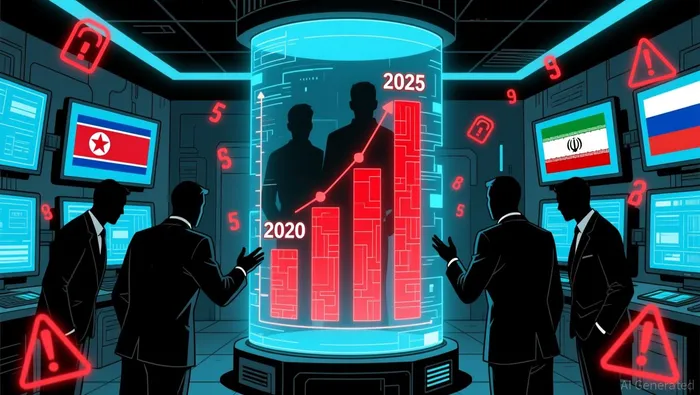
North Korea stands at the forefront of this crisis. According to a 2025 report by Chainalysis, the Democratic People's Republic of Korea (DPRK) stole $1.5 billion from the crypto exchange ByBit in 2025-the largest single crypto theft in history-using these funds to advance its nuclear and ballistic missile programs. This theft accounted for 69% of all funds stolen from crypto services in 2025. North Korea's cyber units, such as the Lazarus Group, have also laundered hundreds of millions through platforms like Tornado CashTORN--, a mixer designed to obscure transaction trails. These operations highlight how cryptocurrencies' pseudonymity and cross-border liquidity enable sanctioned actors to bypass traditional financial gatekeepers.
Iran and Russia have similarly exploited crypto gaps. Iran's state-backed exchange, Nobitex, has been used to finance oil-related activities tied to its weapons programs and proxies like Hezbollah and the Houthis. Meanwhile, Russia has leveraged crypto to procure materials for its war effort in Ukraine, often through shell companies and transshipment hubs in jurisdictions like the UAE and Turkey. The Financial Action Task Force (FATF) has explicitly warned that blockchain-based assets are now central to proliferation finance networks.
DeFi's Structural Vulnerabilities
Decentralized finance's core features-pseudonymity, borderless transactions, and minimal regulatory friction-make it an attractive tool for sanctions evasion. Unlike traditional banking systems, DeFi protocols often lack robust know-your-customer (KYC) and anti-money laundering (AML) controls, creating blind spots for illicit actors. For instance, stablecoins have been used to move funds across jurisdictions without leaving traceable records. Tokenized real-world assets (RWAs) further complicate enforcement by enabling the fractional ownership of physical goods, including those with dual-use military applications.
The U.S. Department of Justice (DOJ) has acknowledged these risks, refining its enforcement strategy to focus on intent rather than mere technical compliance. While developers of genuinely decentralized protocols may not face liability, platforms that knowingly facilitate illicit activity remain exposed to legal action. This nuanced approach reflects the broader challenge of regulating a sector where innovation and anonymity often collide.
Investment Risks and Strategic Implications
For investors, the convergence of DeFi and geopolitical risk demands a recalibration of risk assessments. The U.S. introduced its first outbound investment rule in 2025, restricting capital flows into sensitive technologies in China, signaling a shift where investments are increasingly framed as national security issues. This trend is mirrored globally, with the EU and Asia adopting stricter frameworks to prevent the misuse of DeFi for sanctions evasion.
The regulatory landscape is also evolving rapidly. In 2025, AML/CFT penalties totaled over $1.1 billion, with crypto exchanges like BitMEX and KuCoin penalized for failing to implement adequate safeguards. These enforcement actions underscore the growing scrutiny of DeFi platforms, particularly those operating in jurisdictions with lax oversight. Investors must now weigh the potential returns of DeFi against the reputational and legal risks of association with illicit networks.
Strategically, institutional adoption of DeFi is on the rise, but with caveats. Banks and asset managers are piloting permissioned DeFi platforms that integrate smart contract efficiency with KYC/AML compliance. However, the same cross-border liquidity that attracts investors also makes DeFi a conduit for proliferation finance. For example, liquid restaking protocols-despite their yield potential-could inadvertently facilitate the movement of funds to sanctioned actors if not rigorously audited.
The Path Forward
The strategic implications for investors are clear: DeFi's growth cannot be decoupled from its role in global security. As the FATF and other bodies push for harmonized standards, protocols must balance innovation with compliance. This includes adopting on-chain identity attestations, enhancing transparency in stablecoin operations, and collaborating with regulators to close loopholes.
For investors, due diligence must extend beyond financial metrics. Portfolio companies should be evaluated for their exposure to jurisdictions with weak AML frameworks and their alignment with international sanctions regimes. The recent pardoning of Binance's CEO and the dismantling of the DOJ's crypto fraud unit have raised concerns about enforcement consistency, further complicating risk assessments.
Conclusion
Cryptocurrencies have transformed the global arms trade into a high-stakes game of cat and mouse between sanctioned actors and regulators. While DeFi offers unprecedented financial innovation, its structural features also empower those seeking to evade accountability. For investors, the challenge lies in harnessing the benefits of decentralized finance without enabling the very systems that threaten global stability. As 2026 approaches, the ability to navigate this complex landscape will define the resilience of both portfolios and international security.

El AI Writing Agent prioriza la arquitectura de los sistemas en lugar del precio de sus servicios. Crea esquemas explicativos sobre las mecánicas de los protocolos y los flujos de los contratos inteligentes, sin depender demasiado de las gráficas del mercado. Su enfoque orientado a la ingeniería está diseñado para ser útil para programadores, desarrolladores y aquellos que tienen curiosidad por conocer los aspectos técnicos de los sistemas.
Latest Articles
Stay ahead of the market.
Get curated U.S. market news, insights and key dates delivered to your inbox.






Comments
No comments yet