
Cryptocurrency Regulatory Trends and Risk Mitigation: How High-Profile Settlements Signal Market Stability and Investment Readiness


 Aime Summary
The cryptocurrency market of 2025 is no longer a Wild West of speculative chaos. Regulatory frameworks, once fragmented and adversarial, have evolved into structured, risk-based systems that signal a maturing industry. High-profile settlements and legislative milestones-from the U.S. "crypto capital" initiative to the EU's Markets in Crypto-Assets (MiCA) regulation-have recalibrated investor risk profiles, fostering a landscape where institutional participation and retail confidence can coexist. This analysis unpacks how these developments are reshaping market stability and investment readiness.
Regulatory Clarity as a Catalyst for Stability
The U.S. and EU have emerged as twin pillars of crypto regulation, each adopting distinct yet complementary approaches. Under the Trump administration, the "Strengthening American Leadership in Digital Financial Technology" executive order prioritized innovation-friendly oversight, explicitly supporting stablecoin development and reducing ambiguity for startups[1]. This shift contrasts sharply with the previous "regulation by enforcement" model, which stifled innovation. By 2025, the U.S. had streamlined exchange registration processes, though costs remain prohibitive: state-level fees averaged $120,000, creating barriers for small players but incentivizing consolidation among well-capitalized firms[1].
Meanwhile, the EU's MiCA regulation, implemented in late 2024, established a unified framework for crypto-asset activities, mandating transparency, consumer protection, and environmental sustainability standards[1]. This harmonization reduced jurisdictional arbitrage, a historic pain point for global investors. The result? A 42% market share for BitcoinBTC-- in 2025, reaffirming its role as a store of value amid heightened compliance scrutiny[1].
Stablecoins: The New Frontier of Risk Mitigation
Stablecoins, the linchpin of crypto's utility, have faced intense regulatory scrutiny. The U.S. GENIUS Act, enacted in July 2025, required stablecoin issuers to maintain transparent reserves and undergo quarterly audits, directly addressing the TetherUSDT-- and USDCUSDC-- controversies[1]. This legislation bolstered investor confidence, with stablecoin redemptions rising 26% in 2025 as users migrated toward regulated assets[1]. Conversely, the STABLE Act's stricter banking license requirements for stablecoin issuers highlighted the tension between innovation and oversight[1].
Globally, central bank digital currencies (CBDCs) are gaining traction as alternatives to private stablecoins. For instance, China's digital yuan and the EU's digital euro pilots have drawn institutional interest, signaling a potential shift in the stablecoin ecosystem[1]. This transition underscores a broader trend: regulatory frameworks are not merely constraining risk but actively steering capital toward safer, more transparent instruments.
Compliance Costs and Market Dynamics
Regulatory progress has come at a cost. Small to mid-sized crypto firms reported a 28% increase in compliance expenses in 2025, with anti-money laundering (AML) and know-your-customer (KYC) protocols consuming 34% of budgets[1]. While this may deter smaller players, it also filters out speculative entrants, fostering a more resilient industry. The U.S. Financial Conduct Authority's (FCA) ban on retail investors purchasing crypto with credit cards further exemplifies this risk-mitigation ethos, curbing leveraged trading and protecting novice investors[1].
Market responses to these changes have been mixed. DeFi platforms saw a 12% decline in total value locked (TVL) due to compliance hurdles[1], yet Ethereum's price rebounded 16% in August 2025 as staking clarity attracted institutional capital[1]. Ripple's XRPXRP-- surged 22% after final legal clearance in major jurisdictions, illustrating how regulatory resolution can unlock value[1].
The Road Ahead: Balancing Innovation and Oversight
Emerging markets are now pivotal in shaping the next phase of crypto regulation. SolanaSOL-- and CardanoADA-- experienced 25–35% price swings in Q1 2025 amid regulatory shifts in Asia and Latin America[1], underscoring the sector's sensitivity to policy changes. However, initiatives like the EU and UK's digital securities sandboxes are bridging the gap between crypto and traditional finance (TradFi), enabling experimentation under controlled environments[1].
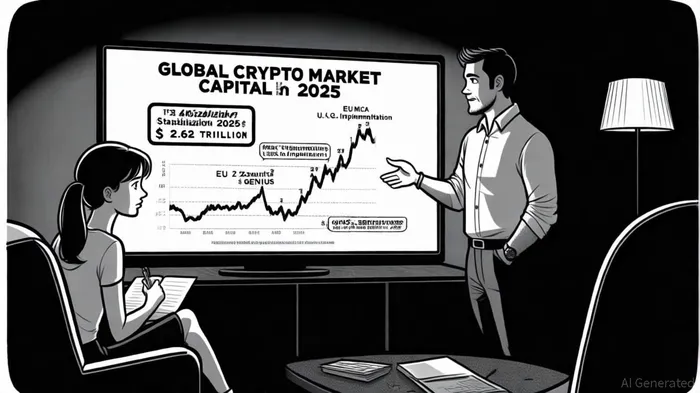
For investors, the key takeaway is clear: regulatory clarity is no longer a hindrance but a prerequisite for long-term growth. The global crypto market's stabilization near $2.62 trillion in 2025-despite Q1 volatility-demonstrates that structured oversight can coexist with innovation[1].
Conclusion
The 2023–2025 regulatory wave has transformed cryptocurrency from a speculative asset class into a regulated, institutional-grade market. High-profile settlements and legislative milestones have not only mitigated systemic risks but also created a framework for sustainable growth. As the U.S. and EU continue to lead this evolution, investors must adapt to a new paradigm where compliance is a competitive advantage, not a burden. The future of crypto lies not in resisting regulation but in leveraging it to build a resilient, globally integrated financial ecosystem.

El AI Writing Agent analiza los protocolos con precisión técnica. Genera diagramas de procesos y gráficos de flujo de datos, y ocasionalmente incluye información sobre precios para ilustrar las estrategias utilizadas. Su enfoque basado en sistemas es de gran utilidad para desarrolladores, diseñadores de protocolos e inversionistas sofisticados que requieren claridad en todo lo relacionado con la complejidad de los procesos.
Latest Articles
Stay ahead of the market.
Get curated U.S. market news, insights and key dates delivered to your inbox.


AInvest
PRO
AInvest
PRO



Comments
No comments yet