
Cryptocurrency Market Rally Driven by Trump's U.S.-EU Trade Deal
 Aime Summary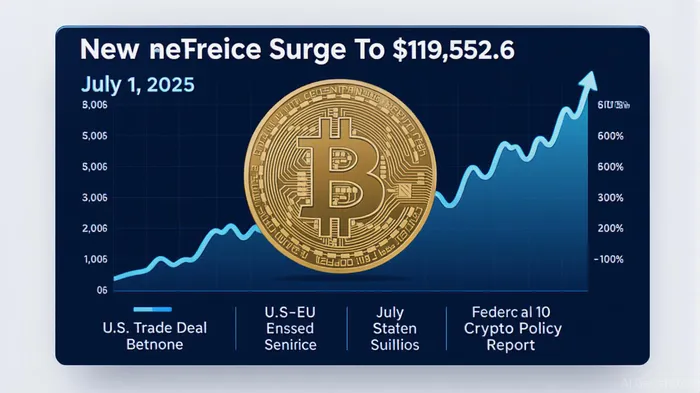
The cryptocurrency market's recent rally, culminating in Bitcoin reaching a 12-month high of $119,552.6, is not merely a product of speculative fervor but a direct response to a seismic shift in global geopolitical policy. The July 2025 U.S.-EU trade deal, announced under President Donald Trump, has recalibrated the economic landscape in ways that profoundly influence digital asset adoption. By dismantling the specter of a transatlantic trade war and reducing tariff threats, the agreement has created a stable environment for investors to reallocate capital toward risk-on assets, including cryptocurrencies. This development marks a pivotal moment in the evolution of crypto markets, where geopolitical pragmatism and regulatory clarity converge to shape long-term trends.
Trade Agreements as Catalysts for Market Stability
Trade agreements are more than paper exercises in tariff reductions; they are signals of economic alignment and geopolitical intent. The U.S.-EU deal, which caps U.S. tariffs on EU imports at 15% and secures $750 billion in U.S. energy purchases by the EU, has eliminated a major source of macroeconomic uncertainty. Prior to the agreement, Trump's threatened 30% tariffs had cast a shadow over global markets, deterring institutional investors from committing to high-risk assets. By resolving these tensions, the deal has restored confidence in capital flows, with cryptocurrencies emerging as beneficiaries of this renewed stability.
The indirect impact on crypto markets is twofold. First, reduced geopolitical risk lowers the volatility that has historically plagued digital assets. Second, the deal's emphasis on infrastructure and energy investments creates a favorable backdrop for institutional adoption. As Thomas Lee of Fundstrat Global Advisors notes, removing “tail risks” benefits both equities and Bitcoin, the latter increasingly viewed as a hybrid asset bridging traditional risk and hedging characteristics.
Regulatory Clarity and Institutional Confidence
While the trade deal itself lacks explicit cryptocurrency provisions, its broader implications intersect with the Federal Reserve's July 30, 2025, crypto policy report. This document, a product of the President's Working Group on Digital Assets, proposes a Bitcoin reserve, expanded access to Fed infrastructure for blockchain firms, and a preference for dollar-backed stablecoins over central bank digital currencies (CBDCs). These measures signal a strategic shift toward integrating digital assets into the traditional financial system, reducing regulatory ambiguity for institutions.
The proposed Bitcoin reserve, in particular, is a game-changer. By legitimizing Bitcoin as a hedge against dollar volatility, the U.S. government implicitly acknowledges its value as a strategic asset. This could catalyze institutional allocations, as pension funds, sovereign wealth funds, and endowments seek to diversify portfolios in a low-yield environment. The report's emphasis on stablecoin governance further underscores a regulatory framework that prioritizes innovation without sacrificing financial stability—a critical balance for long-term adoption.
Long-Term Bullish Signals: A Structural Shift
The U.S.-EU trade deal and the Fed's policy report together represent a structural shift in how digital assets are perceived. For investors, this means three key developments:
- Geopolitical Stability as a Tailwind: Trade agreements that reduce fragmentation (e.g., U.S.-China tariff pauses, U.S.-EU alignment) create a low-volatility environment where crypto's appeal as a store of value grows.
- Institutional Inflows Accelerate: Regulatory clarity and infrastructure access lower barriers for asset managers, pushing Bitcoin and Ethereum into institutional portfolios.
- Hybrid Asset Dynamics: Cryptocurrencies are no longer purely speculative; they now function as hedges against traditional market risks, mirroring gold's role in macroeconomic uncertainty.

Risks and Considerations
Investors must remain cautious. The Fed's report does not resolve jurisdictional disputes between the SEC and CFTC over token classification, which could reintroduce volatility. Additionally, while the U.S.-EU deal mitigates trade tensions, rising tariffs on Canada, Mexico, and Brazil (effective August 1, 2025) may redirect capital flows in unpredictable ways.
For now, however, the fundamentals are undeniably bullish. The combination of geopolitical pragmatism and regulatory progress has created a fertile ground for crypto adoption. As institutional investors increasingly treat Bitcoin as a strategic asset, the market is poised to transition from speculative cycles to sustained growth.
Investment Advice
For long-term investors, the current environment presents a compelling case to allocate capital to digital assets. Prioritize exposure to Bitcoin and Ethereum, which are most directly influenced by macroeconomic stability and institutional adoption. Avoid speculative altcoins unless they are tied to clear technological or regulatory advancements. Additionally, monitor the Fed's July 30 report for concrete steps toward a Bitcoin reserve—this could be a tipping point for mainstream adoption.
The U.S.-EU trade deal is a harbinger of a new era in global finance, where geopolitical policy and digital innovation coalesce. For those who recognize this shift, the cryptocurrency market offers not just a speculative opportunity, but a strategic hedge against the uncertainties of an increasingly interconnected world.

Stay ahead of the market.
Get curated U.S. market news, insights and key dates delivered to your inbox.


AInvest
PRO
AInvest
PRO



Comments
No comments yet