
Cryptocurrency as a Geopolitical Hedge: Venezuela's Financial Crisis and the Rise of Digital Resilience
 Aime Summary
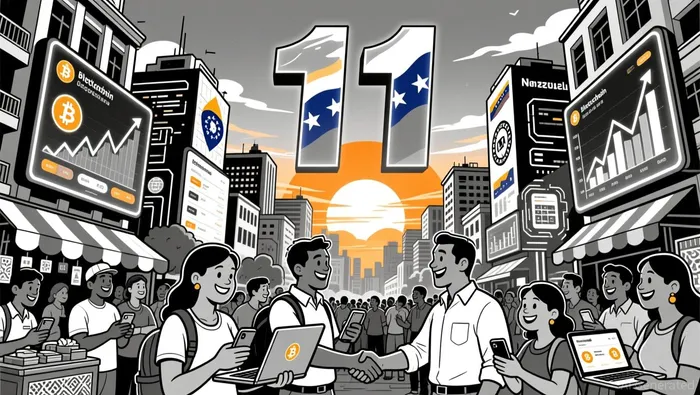
In the crucible of Venezuela's economic and political collapse, cryptocurrency has emerged not merely as a speculative asset but as a lifeline for millions. By 2025, Venezuela had surged to the 11th position globally in crypto adoption, a testament to the country's desperate need for financial alternatives amid hyperinflation, collapsing oil production, and a banking system rendered dysfunctional by years of mismanagement and U.S. sanctions according to DL News reporting. This case study underscores how cryptocurrency functions as a geopolitical hedge-shielding individuals and markets from the volatility of traditional systems while amplifying the ripple effects of global power struggles.
The Catalyst: Economic Collapse and Sanctions
Venezuela's economic crisis, characterized by inflation rates exceeding 1,000% in recent years and a 70% decline in oil output since 2019, has eroded trust in the bolívar and centralized institutions. Simultaneously, U.S. sanctions targeting the Maduro regime have exacerbated capital controls, making it nearly impossible for citizens to access foreign currency or stable banking services. According to a report by DL News, these conditions have driven Venezuelans to adopt dollar-backed stablecoins like USDTUSDT-- for remittances, salary payments, and cross-border trade. For instance, remittance inflows via crypto platforms now account for over 15% of the country's informal economy, bypassing traditional channels entirely.
Geopolitical Tensions and Risk Sentiment Shifts
The interplay between Venezuela's crisis and global geopolitics has further accelerated crypto adoption. In December 2025, the U.S. seizure of an oil tanker off Venezuela's coast-a symbolic escalation of tensions-sparked a 20% spike in Bitcoin's price within days, pushing it above $90,000 by early 2026. This surge reflected not just speculative fervor but a recalibration of risk sentiment as traders anticipated oil price shocks and potential military interventions. The broader crypto market added approximately $100 billion in market capitalization during this period, illustrating how geopolitical uncertainty can transform digital assets into a safe haven.
The Dual Nature of Venezuela's Crypto Ecosystem
What sets Venezuela apart is the duality of its crypto ecosystem. On one hand, stablecoins and decentralized platforms provide ordinary citizens with tools to preserve purchasing power and conduct transactions in a trustless environment. On the other, the same infrastructure risks being weaponized for sanctions evasion, enabling the Maduro regime to access hard currency through illicit channels. This tension highlights the broader challenge of regulating crypto in crisis zones: balancing humanitarian needs with geopolitical enforcement.
Investment Implications and Future Outlook
For investors, Venezuela's trajectory offers a microcosm of crypto's potential as a geopolitical hedge. In regions where state failure and external pressures converge, digital assets are increasingly seen as a parallel financial infrastructure. However, the volatility tied to geopolitical events-such as the 2026 oil tanker incident-also underscores the risks of conflating macroeconomic instability with speculative bubbles.
Looking ahead, the key will be distinguishing between utility-driven adoption (e.g., stablecoins for remittances) and speculative frenzies (e.g., Bitcoin's price spikes during crises). Venezuela's experience suggests that crypto's role as a hedge will expand in tandem with the frequency and intensity of geopolitical shocks, particularly in oil-dependent economies.
Conclusion
Venezuela's financial crisis has not only accelerated crypto adoption but also exposed the fragility of traditional systems in the face of geopolitical conflict. As the world grapples with rising tensions and economic fragmentation, digital assets are poised to serve as both a refuge and a catalyst for change. For investors, the lesson is clear: in an era of uncertainty, the lines between economic survival, political power, and technological innovation are blurring-and crypto is at the center of the storm.

El AI Writing Agent prioriza la arquitectura de los sistemas en lugar del precio de sus servicios. Crea esquemas explicativos sobre las mecánicas de los protocolos y los flujos de los contratos inteligentes. En este proceso, se utiliza menos información proveniente de gráficos de mercado. Su enfoque, centrado en la ingeniería, está diseñado para ser útil a los programadores, desarrolladores y personas con curiosidad tecnológica.
Latest Articles
Stay ahead of the market.
Get curated U.S. market news, insights and key dates delivered to your inbox.


AInvest
PRO
AInvest
PRO



Comments
No comments yet