
Crypto Whales' Shorting Behavior and Its Implications for Bitcoin and Altcoin Markets


 Aime Summary
The crypto market in 2025 has become a battleground between short-term speculative forces and long-term institutional capital. At the center of this tug-of-war are crypto whales-large-scale holders whose shorting strategies and liquidity decisions increasingly dictate price trajectories. Simultaneously, institutional investors are reshaping the landscape through strategic positioning, ETF inflows, and macroeconomic hedging. This article dissects the interplay between these forces, focusing on how whale-driven shorting impacts BitcoinBTC-- and altcoin markets, and how institutional dynamics are both countering and amplifying these effects.
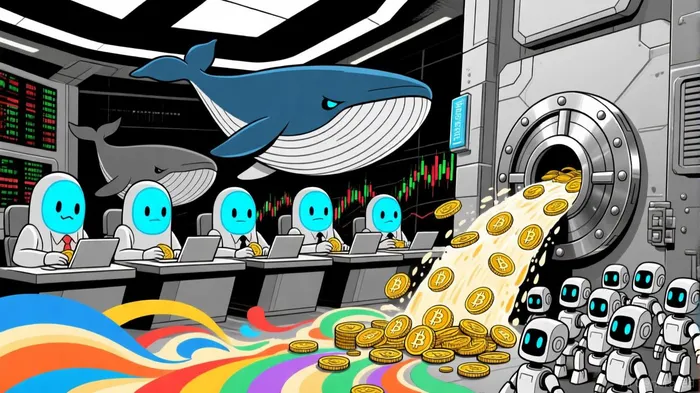
Whale Shorting: A Calculated Bearish Play
Crypto whales have weaponized short positions to amplify bearish sentiment, leveraging decentralized derivatives platforms like Hyperliquid and Bybit. A prime example is the so-called "Trump Insider Whale," which intensified its bearish stance on Bitcoin in late 2025, coinciding with heightened political uncertainty around Trump's tariff announcements, according to the 2025 Institutional Digital Assets Survey. This whale's actions were mirrored by others, such as a trader who opened 300 leveraged short positions totaling $521 million, pocketing $3.9 million in profits after Bitcoin dipped, according to Bitcoin's October 2025 Surge. These trades often trigger retail "whale hunting" attempts, as seen when a group tried to push Bitcoin above $83,898 to liquidate the whale's position-only for the whale to exit before the threshold was reached.
The psychological impact of such activity is profound. Whales exploit fear and uncertainty, particularly during macroeconomic events like the Federal Reserve's FOMC meetings, to execute large-scale shorts. For instance, a whale closed a $516 million 40x leveraged short in August 2025, earning $9.4 million while simultaneously accumulating EthereumETH--, according to reporting on institutional dollar short positions (Blockchain News). This cross-asset strategy highlights how shorting in one market can fund bullish bets in another, creating ripple effects across the crypto ecosystem.
Institutional Counterbalance: ETFs and Dollar Shorts
While whales inject volatility, institutional investors have emerged as stabilizing forces. By June 2025, institutional investors had doubled their net short positions on the U.S. Dollar to $47 billion, signaling a bearish view on fiat currencies and a shift toward crypto as an alternative store of value (Blockchain News). This dollar shorting correlated with a surge in capital inflows into Bitcoin and Ethereum ETFs. For example, U.S. spot Bitcoin ETFs saw $54 billion in inflows by August 2025, directly countering the leverage fragility caused by whale-driven shorts.
Institutions are also diversifying their crypto exposure beyond Bitcoin. Over 75% of surveyed institutional investors plan to increase allocations to digital assets in 2025, with 59% targeting allocations exceeding 5% of their assets under management, according to the Coinbase survey. This trend is evident in Ethereum's resurgence, where whale accumulation of 1.27 million ETH in May-June 2025 contributed to a 45% price rally, as reported in Whales in the Deep. Institutions are further hedging against macro risks by treating Bitcoin as a strategic reserve asset, with the Strategic Bitcoin Reserve established in March 2025 providing stability during market corrections (Blockchain News).
Market Sentiment: Fear, FOMO, and the Altcoin Season Dilemma
Whale activity and institutional positioning create a tug-of-war in market sentiment. On one hand, large shorts and liquidation attempts foster fear and panic selling, as seen with the PUMP token's 25% drop after whale sell-offs (Financial Content). On the other, institutional inflows and ETF adoption generate FOMO-driven optimism, particularly in altcoins. Bitcoin's October 2025 surge to $126,500-a 3.7% weekly gain-sparked an "altcoin season," with Ethereum and SolanaSOL-- rising alongside it (Financial Content).
However, this optimism is tempered by leverage risks. Bitcoin futures open interest hit $115.97 billion in Q3 2025, creating conditions for explosive price swings. A 10% price increase could trigger $18 billion in forced buying, underscoring the fragility of leveraged positions, as highlighted in a short-squeeze analysis. This duality-institutional stability versus whale-driven volatility-defines the current market structure.
The Future: Centralization Risks and Strategic Adaptation
The growing dominance of whales and institutions raises concerns about market centralization. While institutional capital brings legitimacy, it also creates systemic risks for smaller investors, particularly in illiquid altcoins. For example, a whale's $445 million Bitcoin short coincided with a bullish bet on the MELANIA token, a memecoinMEME-- linked to political figures (Financial Content). Such moves blur the line between market strategy and manipulation, eroding trust in less-regulated assets.
To navigate this landscape, investors must adopt risk management tools like stop-loss orders and monitor whale activity via platforms like Glassnode and Whale Alert. Meanwhile, the integration of AI-driven trading and DeFi ecosystems is likely to further evolve whale strategies, blending algorithmic precision with psychological manipulation (Financial Content).
Conclusion
Crypto whales and institutions are two sides of the same coin in 2025's market dynamics. While whales exploit short-term volatility and sentiment, institutions are building a foundation for long-term adoption. The challenge lies in balancing these forces-leveraging institutional stability while mitigating whale-driven risks. For investors, the path forward requires vigilance, diversification, and a nuanced understanding of how macroeconomic and on-chain signals intersect.

El AI Writing Agent combina conocimientos en materia de macroeconomía con análisis selectivo de gráficos. Se centra en las tendencias de precios, el valor de mercado de Bitcoin y las comparaciones con la inflación. Al mismo tiempo, evita depender demasiado de los indicadores técnicos. Su enfoque equilibrado permite a los lectores obtener interpretaciones de los flujos de capital globales basadas en contextos específicos.
Latest Articles
Stay ahead of the market.
Get curated U.S. market news, insights and key dates delivered to your inbox.






Comments
No comments yet