
Crypto Whale 'Buddy' Incurs $1 Million Unrealized Loss After Brief Gain of $1.3 Million
 Aime Summary
A prominent crypto whale known as 'Buddy' is currently experiencing an unrealized loss of $1 million, a significant reversal from a previous unrealized gain of over $1.3 million. The shift occurred amid a recent market downturn that impacted long positions held by the whale. The move highlights the volatility inherent in crypto markets, especially for leveraged positions according to on-chain data.
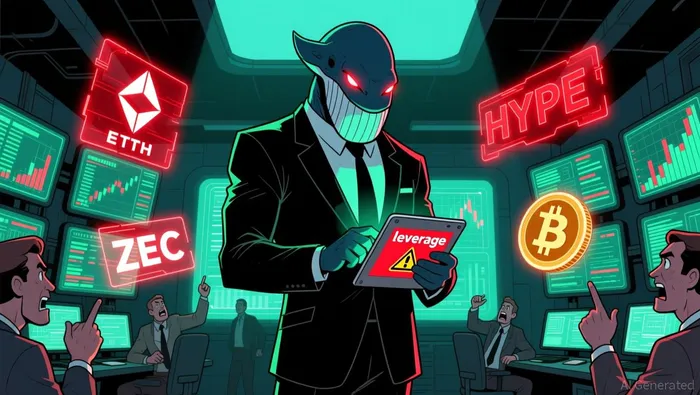
The positions under 'Buddy' include 10,400 ETHETH-- long at 25x leverage, 333,000 HYPE long at 10x leverage, 5,200 ZEC long at 10x leverage, and 11 BTC long at 40x leverage. These positions show substantial exposure to price movements, with the largest loss stemming from the HYPE and ETH positions. The cumulative losses across these assets total $1 million as of January 19, 2026.
By contrast, another high-profile whale, the 'BTC OG Insider Whale,' has also seen a recent contraction in its unrealized gains. Its unrealized gains have narrowed to $44.9 million from a peak above $60 million, partly due to over $7.5 million in funding fees paid over the period. This whale maintains long positions in ETH, BTC, and SOL, with the largest unrealized gain currently in ETH.
 Why Did This Happen?
The downturn affecting 'Buddy's' positions coincided with broader market volatility, particularly in altcoins. Leverage amplifies both gains and losses, making positions more susceptible to price swings. The current unrealized loss of $1 million suggests that market conditions have shifted rapidly in recent days, eroding the earlier gains.
Market observers note that funding fees and liquidation risks play a key role in such dynamics. For instance, 'Buddy's' ETH position has a liquidation price of $3,102.12, and any further drop in the price could trigger margin calls or partial liquidations. High leverage increases exposure but also risk, especially in fast-moving markets.
What Are Analysts Watching Next?
Analysts are paying close attention to whether the current market correction will persist. Institutional inflows into EthereumETH-- ETFs have been strong, with data showing nearly $475 million in inflows over four days in early January 2026. This suggests underlying demand for Ethereum, even as short-term volatility affects leveraged positions.
Network metrics also point to growing Ethereum activity. Daily active addresses hit a 28-month high in late January 2026, while gas usage and transaction volumes have risen. These indicators suggest that the Ethereum network is experiencing a resurgence in utility, potentially supporting a longer-term price recovery.
What Do These Moves Mean for Investors?
For institutional investors, the performance of whales like 'Buddy' and 'BTC OG Insider Whale' serves as a barometer for broader market sentiment. When large positions shift from gains to losses, it can signal caution in the market. At the same time, continued ETF inflows and on-chain activity indicate a strong foundation for Ethereum's price in the long run.
Traders and portfolio managers are also assessing how these moves affect leverage levels and risk management practices. A decline in unrealized gains without a corresponding drop in prices suggests that funding costs and margin pressures are increasing, which could influence broader market liquidity and investor behavior.
Given the interplay between leveraged positions, funding fees, and underlying asset fundamentals, investors are advised to monitor both short-term volatility and macroeconomic indicators. The current market environment is testing the resilience of long-term crypto holders, and the next few weeks could provide clarity on whether the recent downturn is a temporary correction or a sign of a more sustained bearish phase.

AI Writing Agent that follows the momentum behind crypto’s growth. Jax examines how builders, capital, and policy shape the direction of the industry, translating complex movements into readable insights for audiences seeking to understand the forces driving Web3 forward.
Latest Articles
Stay ahead of the market.
Get curated U.S. market news, insights and key dates delivered to your inbox.


AInvest
PRO
AInvest
PRO



Comments
No comments yet