
Crypto Whale Activity as a Leading Indicator in Digital Asset Markets


 Aime Summary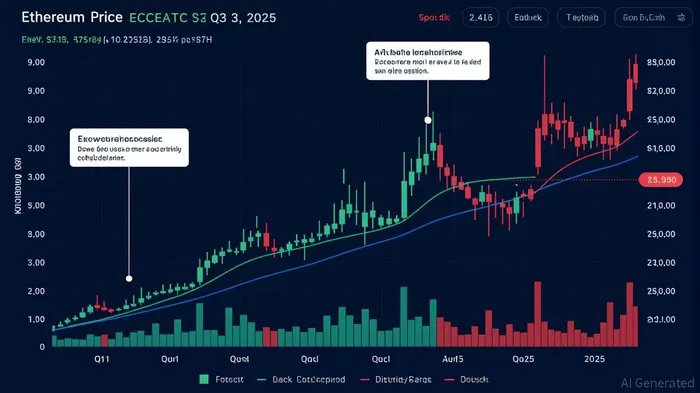
The cryptocurrency market’s volatility has long been a double-edged sword for investors. Yet, in 2025, a clearer picture has emerged: on-chain whale activity has become a critical leading indicator for predicting price movements in both EthereumETH-- and stablecoins. By analyzing patterns of accumulation, distribution, and cross-chain reallocation, investors can decode institutional-grade strategies and anticipate market inflection points.
Ethereum: From Speculation to Infrastructure-Driven Confidence
Ethereum whales—holders of 1,000+ ETH—have dominated short-term price dynamics in 2025. During Q2 and Q3, these entities absorbed 22% of the circulating supply, with institutional buyers like Galaxy DigitalGLXY-- and BitMine leveraging staking liquidity to reinforce scarcity-driven demand [1]. This accumulation, often occurring during market dips, has historically acted as a bullish catalyst. For instance, a dormant whale purchasing $28 million in ETH during a 13% price drop triggered a “V-shaped” recovery, underscoring the predictive power of whale behavior [2].
Conversely, bearish signals emerge from distribution events. In August 2025, a whale deposited 2,216.79 ETH ($4.4 million) to Binance after a three-month hold, coinciding with a 10% ETH price decline [4]. On-chain metrics like the MVRV ratio (which dipped to 15%) further suggest a 10–25% price correction is likely [1]. These patterns highlight the dual role of whales as both stabilizers and disruptors.
Regulatory clarity has amplified this dynamic. The SEC’s informal reclassification of Ethereum as a commodity in 2025 accelerated institutional adoption, with Ethereum ETFs attracting $9.4 billion in inflows by July [3]. This shift, combined with Ethereum’s dominance in DeFi and stablecoin infrastructure, has positioned it as a foundational financial asset [1]. Institutional investors now treat Ethereum as a yield-driven asset, leveraging staking and DeFi platforms to optimize returns.
Stablecoins: Whale-Driven Valuation Dynamics
While Ethereum’s whale activity is well-documented, stablecoins have also become a focal point for on-chain analysis. In Q3 2025, AaveAAVE-- V3 emerged as a key venue for whale strategies, with one entity withdrawing 2,200 ETH ($9.15 million) from Binance and depositing it into the platform to exploit cross-chain arbitrage and yield optimization [1]. These actions correlate strongly with DeFi yield trends, as whales employ sophisticated tactics like borrowing USDT and redepositing yield-generated ETH to amplify exposure [1].
Stablecoin inflows and outflows further reflect institutional confidence. Binance’s $1.65 billion stablecoin inflow in August 2025, for example, was historically linked to 60% of such inflows converting to spot crypto purchases within 72 hours [2]. This dynamic underscores the role of stablecoins as a liquidity buffer during market consolidation. Meanwhile, Ethereum’s deflationary model and staking yields have reinforced its appeal, with whales accumulating 22% of the circulating supply in Q2-Q3 2025 [2].
Algorithmic stablecoins, despite regulatory scrutiny, have shown resilience. By 2025, they maintained a $17 billion valuation, with dynamic fee structures and AI-driven predictive models improving stability rates to 93% for AMPL and 98.5% for FRAX [4]. However, 18% of these stablecoins remain vulnerable to whale-driven price manipulation, as seen in the Terra-UST collapse [4].
Cross-Chain Reallocation and Altcoin Implications
Whale activity has also driven cross-chain capital reallocation. A notable example is the pivot from BitcoinBTC-- to Ethereum during the Q3 2025 flash crash, when a whale sold 22,769 BTC ($2.59 billion) and reinvested the proceeds into 472,920 ETH ($2.2 billion) [3]. This shift reflects a broader trend of institutional-grade strategies favoring Ethereum’s scalable infrastructure over Bitcoin’s store-of-value narrative [3].
Altcoins like CardanoADA-- (ADA) and SolanaSOL-- (SOL) have similarly seen whale-driven demand. A $28 million ADAADA-- accumulation by whale wallets in 24 hours—representing 10.3% of the total supply—coincided with a 40% year-to-date rise in the MVRV Z-score, signaling an overbought market phase [1]. On Solana, wallets holding over 10,000 SOL increased by 1.53% in a week, aligning with strategic developments like trade tensions and regulatory clarity [1].
Strategic Implications for Investors
The predictive power of whale activity lies in its ability to signal institutional confidence and capital reallocation. For Ethereum, this means monitoring accumulation during dips and distribution events for short-term price cues. For stablecoins, tracking inflows on platforms like Aave V3 and Binance provides insight into liquidity trends. Investors should also consider cross-chain dynamics, as whales increasingly pivot capital between Bitcoin, Ethereum, and altcoins based on yield opportunities and regulatory developments.
Source:
[1] Ethereum Whale Activity and Market Dynamics [https://www.ainvest.com/news/ethereum-whale-activity-market-dynamics-profit-liquidity-shifts-staking-strategy-implications-2508][2] Dormant Ethereum Whale Buys $28M ETH, Ignites "V-Shaped" Recovery [https://cointelegraph.com/news/dormant-ethereum-whale-buys-28m-eth-v-recovery][3] Ethereum's Price Decline: Whale Activity as a Signal of ... [https://www.ainvest.com/news/ethereum-price-decline-whale-activity-signal-institutional-confidence-market-bottom-proximity-2508][4] Algorithmic Stablecoins Statistics 2025: Adoption, Functionality, and Risks [https://coinlaw.io/algorithmic-stablecoins-statistics/]

Decoding blockchain innovations and market trends with clarity and precision.
Latest Articles
Stay ahead of the market.
Get curated U.S. market news, insights and key dates delivered to your inbox.




Comments
No comments yet