
Crypto's Volatility Serves as Global Risk Barometer in Turbulent Trade Climate


 Aime Summary
Bybit PWM's 16.9% fund return has highlighted the crypto market's resilience amid the turbulence of "Uptober," a period marked by heightened volatility due to macroeconomic uncertainties. The exchange's performance contrasts with the broader crypto sector's recent struggles, which saw a $19.13 billion liquidation event in late October following President Donald Trump's 100% tariff threat on Chinese imports, according to a Nasdaq analysis. 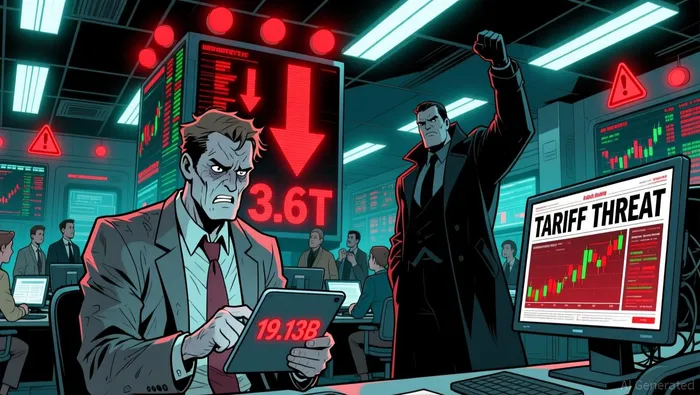 This shock underscored crypto's sensitivity to geopolitical and economic shifts, with market capitalization plummeting from $4.1 trillion to $3.6 trillion before rebounding as U.S.-China trade tensions eased, the Nasdaq analysis noted.
The crypto downturn was exacerbated by leveraged trading practices, where investors' borrowed capital amplified losses during the sharp price drop. Experts noted that such scenarios are becoming more frequent as global events—like Trump's aggressive trade policies—introduce uncertainty into markets, the Nasdaq analysis observed. "Crypto is a barometer for risk appetite," said Nic Puckrin, CEO of The Coin Bureau, adding that the sector's 24/7 trading nature makes it uniquely vulnerable to out-of-hours geopolitical announcements.
Meanwhile, traditional sectors also grappled with the ripple effects of 2025's economic landscape. Babcock & Wilcox, for instance, reported a 300% increase in operating income year-over-year to $6.5 million, driven by reduced overhead costs and rising demand for energy infrastructure tied to AI and data centers, according to a Yahoo Finance release. Similarly, A10 Networks emphasized disciplined execution to drive growth, according to an A10 Networks report, while Benchmark Electronics navigated a mixed quarterly performance across its industrial and semiconductor capital equipment segments, according to Benchmark's results. These results reflect broader trends of cost optimization and sector-specific resilience amid macroeconomic headwinds.
The interplay between traditional and crypto markets was further illustrated by Shein's projected $2 billion net income for 2025. The fast-fashion giant offset U.S. tariff impacts through price hikes and reduced advertising spending, demonstrating how businesses are adapting to trade tensions, according to an Investing.com report. This adaptability stands in contrast to crypto's current volatility, where even minor geopolitical developments can trigger cascading sell-offs.
As the market absorbs these dynamics, investors are being urged to adopt cautious strategies. "Crypto's sharp movements are a reminder to prioritize risk management," said John Paton of Kimura London & White LLP in the Nasdaq analysis. For now, Bybit's strong fund return offers a counterpoint to the sector's recent turbulence, but the path forward remains contingent on the resolution of global trade disputes and the broader economic environment.

Stay ahead of the market.
Get curated U.S. market news, insights and key dates delivered to your inbox.






Comments
No comments yet