
Crypto Treasuries Go Institutional: Ethereum Becomes a Corporate Asset Class
 Aime Summary
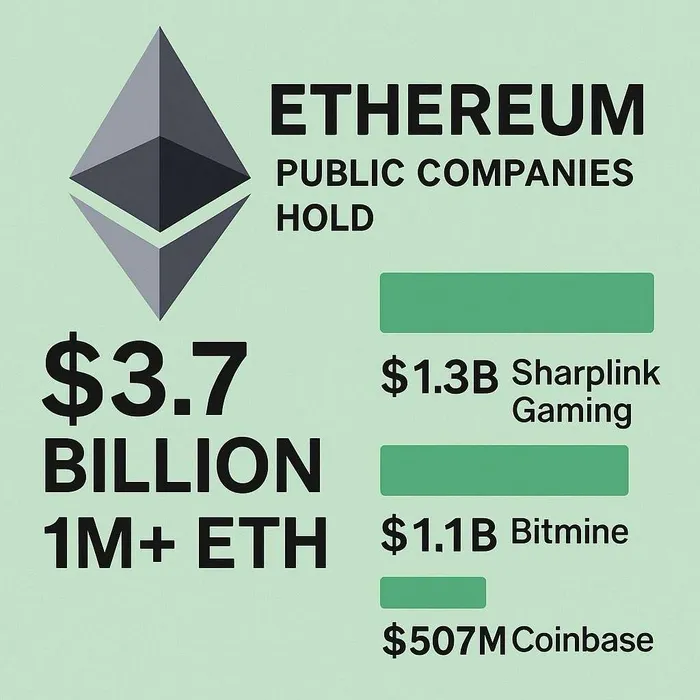
Ethereum, long overshadowed by Bitcoin in corporate balance sheets, is undergoing a paradigm shift. A growing number of publicly traded companies are allocating substantial capital to Ether (ETH), not just as a hedge against fiat debasement but as a strategic, yield-generating treasury asset. A visual analysis published by @Trade_Tracker this week illustrates this transformation with startling clarity. As of August 2025, more than a dozen publicly listed firms have reported Ethereum holdings totaling well over $3.7 billion, with valuations rising sharply from original cost bases. The accompanying graphic highlights the delta between acquisition cost and current market value — in every case, a net positive outcome.

Leaders of the Ethereum Balance Sheet
Revolution At the forefront is Sharplink GamingSBET-- (SBET), whose aggressive accumulation strategy has paid off. The firm holds $1.33 billion in ETH, up from an entry cost of $1.03 billion, representing nearly 30% in unrealized gains. Known initially for sports betting infrastructure, Sharplink has gradually redefined itself as a tech-forward Ethereum-native platform, leveraging staking and smart contracts to integrate blockchain rails into its business model. Close behind is Bitmine Inversion Technologies, a former Bitcoin miner that pivoted aggressively into ETH earlier this year. With an acquisition cost of $977 million and current holdings valued at $1.11 billion, Bitmine is pursuing what insiders describe as a “5% of supply” roadmap — a bold play to position itself as a long-term validator and infrastructure player on the Ethereum network. Coinbase (COIN), while traditionally a service provider rather than a holder, maintains over 137,000 ETH (~$507 million), both as balance sheet exposure and as part of its institutional staking division. With Ethereum now contributing meaningfully to the company’s custody and staking revenues, Coinbase is increasingly intertwined with Ethereum’s Layer-1 and Layer-2 ecosystems.
The Strategic Thesis: ETH as a Productive Asset
Unlike Bitcoin, Ethereum offers native yield through proof-of-stake validation. With staking yields currently between 3.7% and 4.2%, companies are now viewing ETH as a yield-bearing asset capable of enhancing cash efficiency. Moreover, Ethereum’s expanding utility — from stablecoin settlement to decentralized identity — makes it more than a passive store of value. It is becoming, in effect, an operational digital asset embedded in fintech workflows and digital infrastructure. Sharplink and Bitmine, for instance, are not simply parking ETH on their balance sheets; they are staking a portion, running validator nodes, and integrating smart contract logic into revenue pipelines. This marks a decisive shift from speculative exposure to utility-based treasury integration.
MicroStrategy’s Playbook, Rewritten in Solidity
What Michael Saylor pioneered with Bitcoin, a new class of CEOs and CFOs is emulating with Ethereum — albeit with more nuance. Instead of wholesale conversions of fiat cash, these companies are conducting targeted capital raises (via ATM and PIPE facilities) to systematically build ETH positions. For example, Sharplink raised $543.7 million over Q2 2025 via an at-the-market equity program to expand its ETH reserves — part of a broader thesis that Ethereum’s role in stablecoin settlement and tokenized real-world assets will anchor long-term value appreciation.
The Risks: Volatility, Regulation, and Optics
Despite the upside, the move isn’t without risk. Ethereum remains a volatile asset. Price drawdowns of 20–30% are not uncommon in intra-month cycles, exposing treasuries to mark-to-market compression. Furthermore, the regulatory environment around staking remains fluid. While the U.S. Treasury and IRS have issued provisional guidance on staking rewards taxation, final clarity is still pending — a red flag for risk-averse corporate controllers. Additionally, the optical risk of holding crypto remains material. A sudden ETH correction could impact shareholder sentiment, trigger impairments, or invite scrutiny during earnings season — especially for companies with relatively thin core cash flow buffers.
A Class of Its Own: Ethereum in the Institutional Era
What began as a marginal experiment is rapidly becoming an institutional norm. Ethereum is now the second-largest corporate crypto holding class, behind only Bitcoin, and it is growing faster in adoption velocity. Firms are not merely buying ETH for its speculative potential but are integrating it into staking operations, payment rails, and smart contract execution environments. In this new cycle, Ethereum is no longer just a blockchain. It is becoming an institutional-grade commodity, a balance sheet asset, and increasingly, a corporate utility layer. As Bitmine and Sharplink target ownership of 5% or more of ETH’s circulating supply, and others such as GameSquareGAME--, BTCS Inc.BTCS--, and KR1 Plc quietly expand their exposure, Ethereum is on course to become the default Web3 reserve asset for corporate America.

Stay ahead of the market.
Get curated U.S. market news, insights and key dates delivered to your inbox.
AInvest
PRO
AInvest
PRO



Comments
No comments yet