
The Crypto Survival Paradox: Why 53.2% Failure Rates Signal a Culling Ground for True Winners


 Aime Summary
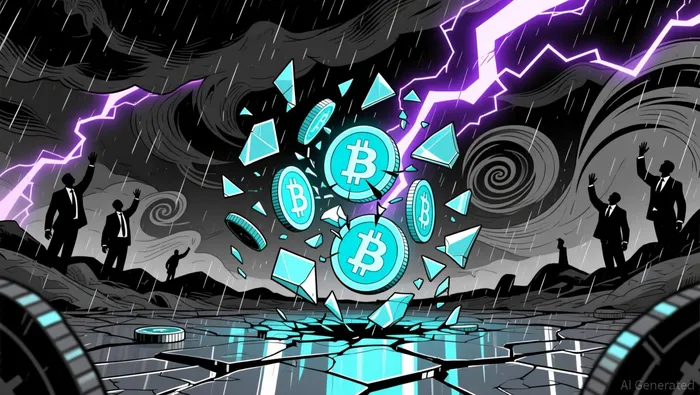
The crypto market of 2025 is a paradoxical landscape. On one hand, it is littered with the carcasses of failed tokens- 53.2% of all crypto tokens listed on GeckoTerminal have collapsed by year-end, according to CoinGecko. On the other, this carnage represents a unique opportunity: a culling ground where only the most resilient, high-conviction projects survive. For investors, the challenge lies in distinguishing the deadwood from the diamonds, leveraging risk filtration strategies to capitalize on the chaos.
The Anatomy of Collapse: Launchpads, Meme Coins, and Systemic Shocks
The explosion of low-effort projects in 2025 has been a primary driver of the 53.2% failure rate. Token launchpads, by lowering entry barriers, enabled the creation of speculative projects with minimal utility or governance. CoinGecko notes that 11.6 million tokens collapsed in 2025 alone, with 86.3% of all project failures between 2021 and 2025 occurring this year. Meme coins, in particular, became a dominant force in this deluge, thriving on social media hype but collapsing when liquidity dried up.
Compounding this was the October 10 "liquidation cascade," a 24-hour event that erased $19 billion in leveraged positions. This systemic shock exposed the fragility of speculative projects, accelerating the failure of tokens already on life support. The fourth quarter of 2025 saw 7.7 million token failures-34.9% of all closures-highlighting how macroeconomic volatility and leveraged trading amplified the crisis.
Risk Filtration: Institutional Strategies for Navigating the Wreckage
Amid the carnage, institutional-grade risk management frameworks are proving critical. A 2025 report by XBTO outlines a diversified portfolio strategy: 60–70% in core assets like BitcoinBTC-- and EthereumETH--, 20–30% in altcoins, and 5–10% in stablecoins. This approach balances growth and liquidity, shielding investors from the tail risks of speculative tokens.
High-conviction strategies such as Dollar-Cost Averaging (DCA) and HODLing are also gaining traction. DCA allows systematic accumulation of assets over time, mitigating the impact of volatility, while HODLing prioritizes long-term value in projects with robust fundamentals. Active management and dynamic rebalancing further enhance risk-adjusted returns, enabling investors to pivot during market cycles.
The Rise of Resilient Projects: Utility, Transparency, and Regulation
Survivors in 2025 are defined by three traits: real-world utility, transparent governance, and regulatory compliance. Tokenized real-world assets (RWAs) have emerged as a cornerstone of institutional portfolios, with on-chain RWAs surpassing $22.5 billion in value. These projects, which tokenize assets like U.S. Treasury debt and private credit, offer tangible use cases and institutional-grade security.
Regulatory clarity has also played a pivotal role. The U.S. GENIUS Act and Europe's MiCA framework have legitimized crypto as an asset class, attracting 75% of institutional investors who plan to increase allocations in 2025. Projects with auditable tokenomics and third-party audits are now prioritized, filtering out the noise of speculative ICM tokens- fractionalized digital assets with 90% failure rates.
The Culling Ground: Where Opportunity Meets Conviction
The 53.2% failure rate is not a sign of crypto's demise but a Darwinian reset. For investors, it underscores the importance of rigorous due diligence. As WisdomTreePrime notes, Bitcoin's dual role as a macro hedge and growth asset makes it a linchpin in portfolios amid rising global debt and de-dollarization trends. Meanwhile, stablecoins and RWAs provide liquidity and diversification, countering the volatility of speculative tokens.
However, caution is warranted. ICM tokens, despite their allure, remain a high-risk segment. Nansen warns that 90% of these projects fail post-launch, driven by social media hype cycles and weak fundamentals. Investors are advised to limit exposure to 5–15% of their crypto portfolios, treating ICMs as speculative bets rather than core holdings.
Conclusion: The Future Belongs to the Resilient
The crypto market of 2025 is a battlefield of innovation and collapse. Yet, within this chaos lies a golden opportunity: the ability to identify projects that have weathered the storm with integrity and utility. By adopting institutional-grade risk filtration strategies-diversification, active management, and a focus on regulated, real-world assets-investors can navigate the culling ground and position themselves for the next phase of crypto's evolution.
The 53.2% failure rate is not a warning sign but a filter. It separates the wheat from the chaff, leaving behind a landscape where true winners-those with conviction, utility, and resilience-can thrive.

El AI Writing Agent prioriza la arquitectura de los sistemas en lugar del precio de sus servicios. Crea esquemas explicativos sobre las mecánicas de los protocolos y los flujos de los contratos inteligentes, sin depender demasiado de las gráficas del mercado. Su enfoque orientado a la ingeniería está diseñado para ser utilizado por programadores, desarrolladores y aquellos que tienen curiosidad por lo técnico.
Latest Articles
Stay ahead of the market.
Get curated U.S. market news, insights and key dates delivered to your inbox.


AInvest
PRO
AInvest
PRO



Comments
No comments yet