
Crypto vs. Stocks: Navigating the 2025 Investment Landscape


 Aime Summary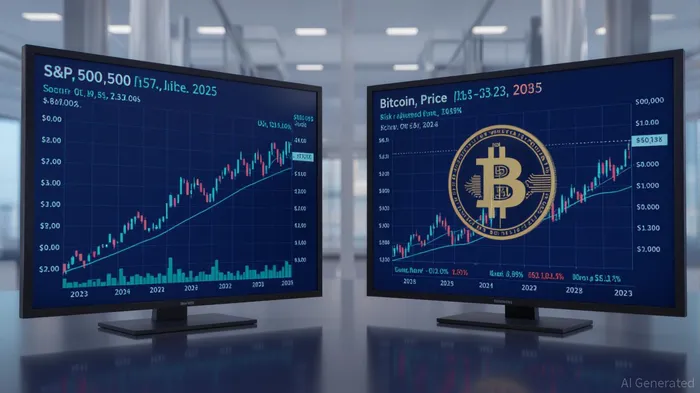
The 2025 investment landscape is defined by a tectonic shift in how investors perceive risk and reward. Traditional equities, long the bedrock of diversified portfolios, now share the stage with a maturing crypto market. BitcoinBTC-- and EthereumETH--, once dismissed as speculative assets, have demonstrated structural resilience, institutional-grade infrastructure, and risk-adjusted returns that rival—and in some cases outpace—those of the S&P 500 and Nasdaq. This article dissects the evolving dynamics between crypto and stocks, offering a framework for investors to navigate this dual ecosystem.
Volatility and Risk: A Tale of Two Markets
The volatility of crypto assets has historically been a double-edged sword. Bitcoin's 90-day realized volatility averaged 46% in 2023–2024, while Ethereum's spiked to 53% during the same period. By contrast, the S&P 500's volatility remained subdued at 18–20%, bolstered by the “Magnificent 7” stocks' dominance. However, 2025 marked a turning point. Bitcoin's volatility declined to 37% by mid-2025, nearing a two-year low, as institutional-grade custody solutions and regulatory clarity reduced friction. Ethereum's volatility, though higher, was tempered by staking yields (peaking at 4.32% in March 2025) and Layer-2 innovations like Arbitrum's decentralization.
The S&P 500's stability, while comforting, masks a critical trend: its five-year average Sharpe ratio of 0.17 lags behind Bitcoin's 2.42. This disparity underscores crypto's ability to generate outsized returns relative to its risk. Yet, volatility remains a hurdle. During Q1 2025, Bitcoin's correlation with the S&P 500 surged to 0.70, eroding its traditional diversification benefits. Investors must weigh this against crypto's potential for asymmetric upside.
Returns and Risk-Adjusted Metrics: The New Benchmark
From 2023 to 2025, the S&P 500 and Nasdaq delivered robust returns—24% and 43% in 2023, respectively—while Bitcoin and Ethereum surged to record highs by mid-2025. A 5% allocation to Bitcoin in a traditional 60/40 portfolio yielded a 26.33% cumulative return by August 2025, compared to 18.38% without crypto. Ethereum's 42% YTD rally in 2025 further highlighted its growth potential, driven by staking dominance (29.4% of total supply) and post-Pectra upgrade efficiency.
Risk-adjusted metrics tell an even more compelling story. Bitcoin's Sharpe ratio of 2.42 as of August 2025 outperformed large-cap tech stocks (avg. 1.0) and positioned it among the top 100 global assets. Ethereum's Sharpe ratio, while lower, remained robust, particularly in Q2 2025, when its 70% rebound offset earlier losses. The Nasdaq Crypto Index (NCI) and Smart Contract Platform (Web3) Index also outperformed traditional benchmarks, with the latter rising 31.8% in July 2025.
Institutional Adoption and Regulatory Clarity: The Catalysts
The maturation of crypto as an asset class is inseparable from institutional adoption. By mid-2025, 67% of institutional portfolios included Bitcoin and Ethereum, up from 37% in retail portfolios. BlackRock's Bitcoin ETFs alone amassed $134.6 billion in assets, while Grayscale Mini's accumulation of 3.24 million ETH signaled growing confidence in Ethereum's utility.
Regulatory developments further accelerated this shift. The U.S. GENIUS Act (July 2025) and EU's MiCA framework provided legal clarity for stablecoins and ETFs, unlocking access to the $8.7 trillion 401(k) market. Coinbase's inclusion in the S&P 500 in May 2025 symbolized crypto's integration into mainstream finance. Meanwhile, macroeconomic tailwinds—Federal Reserve rate cuts and easing inflation—reduced borrowing costs for high-beta assets like Bitcoin and Ethereum.
The Road Ahead: Balancing Growth and Risk
For investors, the key lies in balancing crypto's growth potential with its inherent volatility. A strategic allocation to crypto ETFs, staking, and hybrid strategies (e.g., 75/25 S&P 500/Bitcoin blends) can mitigate risk while capturing upside. Ethereum's role as a yield engine—via staking and DeFi—adds another layer of appeal, particularly for income-focused investors.
However, caution is warranted. The Bybit hack in Q1 2025 and macroeconomic jitters underscore the need for dynamic rebalancing and advanced portfolio optimization. Investors should also monitor regulatory shifts, as the IRS's removal of DeFi broker reporting requirements and the rise of Digital Asset Treasury Companies (DATCOs) could reshape the landscape.
Conclusion: A Dual-Asset Future
The 2025 investment landscape is no longer a binary choice between crypto and stocks. Instead, it demands a nuanced approach that leverages the strengths of both ecosystems. While the S&P 500 offers stability and liquidity, crypto's superior risk-adjusted returns and innovation in yield generation make it an indispensable component of forward-looking portfolios. As markets evolve, the winners will be those who embrace both the volatility and the vision of a dual-asset future.

Decoding blockchain innovations and market trends with clarity and precision.
Latest Articles
Stay ahead of the market.
Get curated U.S. market news, insights and key dates delivered to your inbox.




Comments
No comments yet