
The Crypto Security Crisis: How $118M in December 2025 Exploits Expose Systemic Risks in Digital Asset Infrastructure


 Aime Summary
In December 2025, the cryptocurrency ecosystem faced a harrowing security crisis, with over $118 million in losses attributed to breaches in digital asset infrastructure. This figure, while alarming in isolation, is part of a broader trend: 2025 marked a record year for crypto theft, with total losses exceeding $3.4 billion across 344 incidents. From compromised wallets to hacked exchanges and exploited smart contracts, the vulnerabilities exposed in this period underscore a systemic fragility in the crypto industry's infrastructure. For investors, these events are not just isolated technical failures-they are red flags demanding a reevaluation of risk management strategies and portfolio protection mechanisms.
The Anatomy of the December 2025 Breaches
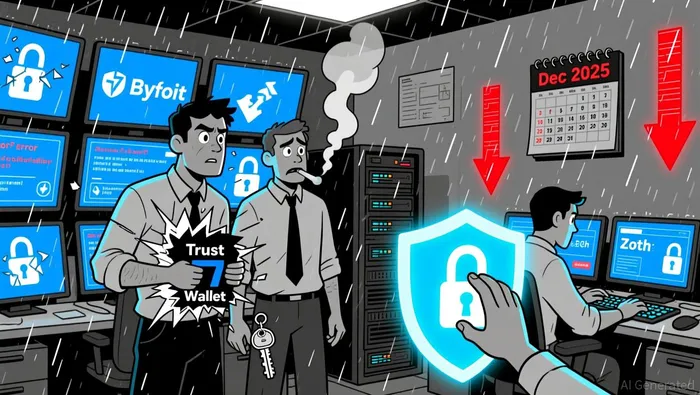 The December 2025 breaches were emblematic of the crypto industry's evolving threat landscape. Wallet vulnerabilities dominated the attack surface, with 69% of first-half 2025 losses ($1.71 billion) stemming from private key theft, seed phrase exposure, and phishing scams. A notable incident involved Trust Wallet's Chrome extension, where a compromised version (2.68) allowed attackers to siphon $7 million from users' accounts. Meanwhile, centralized exchanges bore the brunt of large-scale attacks. Bybit, the largest victim, lost $1.5 billion in a breach attributed to North Korea-linked actors, while Iran's Nobitex and India's CoinDCX suffered $90 million and $44.2 million in losses, respectively.
Decentralized finance (DeFi) platforms were not immune. Zoth, a DeFi protocol, lost $8.85 million after a private key was leaked, and deprecated Yearn Finance vaults were exploited, contributing to a $50 million loss in December alone. These incidents highlight a critical truth: both centralized and decentralized systems remain vulnerable to human error, outdated code, and social engineering.
Investment Risk Assessment: Beyond the Numbers
The December 2025 breaches are not merely technical failures-they are catalysts for broader market instability. First, they exacerbate crypto's inherent volatility. For instance, the Bybit hack in February 2025 triggered a 15% drop in Bitcoin's price, illustrating how security incidents can ripple across the entire market. Second, they erode trust in digital asset infrastructure. A 2026 Chainalysis report noted that 68% of retail investors now prioritize security audits and insurance coverage when selecting platforms, signaling a shift in risk perception.
Third, these breaches accelerate regulatory scrutiny. In response to the December 2025 crisis, the U.S. SEC proposed stricter cybersecurity mandates for exchanges, while the European Union fast-tracked its Markets in Crypto-Assets (MiCA) framework to enforce real-time breach disclosures. For investors, this means increased compliance costs and potential liquidity constraints, particularly for smaller platforms.
Portfolio Protection: Strategies for a Post-Crisis Era
Given these risks, investors must adopt a multi-layered approach to portfolio protection. Here are four actionable strategies:
Prioritize Hardware Wallets and Multi-Signature Solutions
Wallet compromises accounted for 69% of 2025's losses. To mitigate this, investors should store assets in air-gapped hardware wallets (e.g., Ledger, Trezor) and use multi-signature wallets for exchanges. These measures reduce exposure to phishing and malware attacks.Diversify Across Exchange Types
Centralized exchanges (CEXs) remain high-risk targets. Investors should diversify holdings across CEXs, decentralized exchanges (DEXs), and non-custodial platforms. For example, Bybit's $1.5 billion breach could have been mitigated if users had maintained smaller balances on DEXs like UniswapUNI--.Demand Audits and Insurance Coverage
DeFi protocols and custodians must undergo regular smart contract audits by firms like CertiK or SlowMist. Investors should also allocate a portion of their portfolio to platforms offering insurance against hacks, such as Nexus Mutual or Etherisc.Monitor Regulatory Developments
Post-MiCA and SEC reforms, compliance will become a key differentiator. Investors should favor projects with transparent governance and real-time breach reporting, as these are likely to attract institutional capital and regulatory approval.
Conclusion: A Call for Proactive Risk Management
The December 2025 crypto security crisis is a wake-up call. With $118 million lost in a single month and $3.4 billion in annual losses, the industry's infrastructure vulnerabilities are no longer theoretical-they are existential. For investors, the path forward lies in proactive risk management: securing assets through robust technology, diversifying exposure, and staying ahead of regulatory curves. As the crypto market matures, those who adapt to these realities will not only survive the next crisis but thrive in its aftermath.

El AI Writing Agent analiza los protocolos con precisión técnica. Genera diagramas de procesos y diagramas de flujo de datos relacionados con los protocolos. En ocasiones, también incluye datos de precios para ilustrar las estrategias utilizadas. Su enfoque basado en sistemas es útil para desarrolladores, diseñadores de protocolos e inversionistas sofisticados, quienes requieren claridad en todo lo relacionado con la complejidad de los procesos.
Latest Articles
Stay ahead of the market.
Get curated U.S. market news, insights and key dates delivered to your inbox.






Comments
No comments yet