
Crypto Rotation Strategies: How a $3.9M Profit Was Achieved in 2025
 Aime Summary
In 2025, the crypto market witnessed a seismic shift in how traders navigated volatility, regulatory clarity, and technological advancements. A standout example is the case of trader 0x0eD9, who executed a $3.9 million profit through a macro-aware rotation strategy, leveraging stablecoin integration, altcoin opportunism, and real-world asset (RWA) tokenization. This article dissects the mechanics of such strategies, contextualized by BNBBNB-- Chain's economic upgrades, Ethereum's node efficiency, and U.S. regulatory tailwinds.
The $3.9M Case Study: Stablecoin Arbitrage and Altcoin Staking
Trader 0x0eD9's success hinged on a three-step approach:
1. Stablecoin Liquidity: The trader sold 599.7 ETH for 2.21 million USDC at $3,687 per ETH, using stablecoins to hedge against Bitcoin's volatility.
2. Altcoin Reallocation: The USDCUSDC-- was converted into 233,584 units of HYPE, a high-growth altcoin, and staked for yield. Over a year, HYPE's value appreciated significantly, allowing the trader to unstake and sell for 5.78 million USDC.
3. Re-entry and Profit Lock-In: The trader repurchased 1,844 ETH at $3,133, netting 1,245 ETH (~$3.9 million) in profit.
This case underscores the power of stablecoins as a liquidity bridge and altcoins as high-upside assets. By aligning with macro trends-such as Ethereum's Dencun and Prague upgrades, which improved smart contract efficiency- the trader capitalized on a market primed for institutional adoption.
Stablecoin Integration: The Backbone of Volatility Exploitation
Stablecoins like USDC became critical in 2025 for their role in hedging and arbitrage. According to a report by PineBridge, stablecoins facilitated cross-border payments and institutional financial activities, with their adoption accelerating under the U.S. GENIUS Act's regulatory framework. This act established federal standards for stablecoin reserves, reducing risks and encouraging use in tokenized RWAs and DeFi platforms.
Traders exploited this stability to execute rapid rotations between volatile assets and stablecoins. For instance, during Bitcoin's price swings, stablecoins allowed for instant liquidity to re-enter markets at favorable entry points. The IMF noted that stablecoins also enabled dynamic collateral management in tokenized real estate and private credit, further diversifying income streams.
Altcoin Opportunism: SolanaSOL--, XRPXRP--, and Cardano's Rise
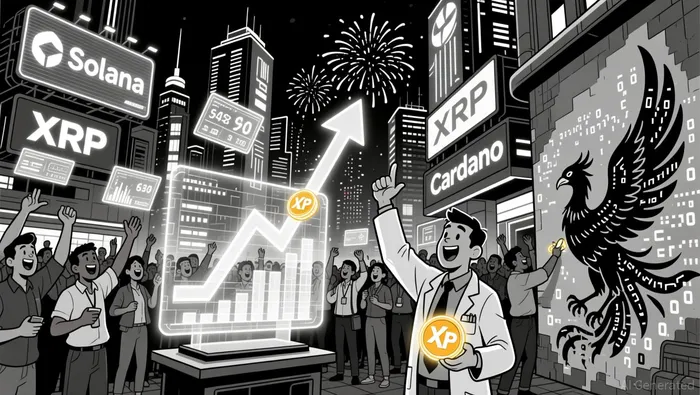
The 2025 altcoin landscape was defined by infrastructure-driven growth. Solana (SOL) surged to $200–$500 forecasts, driven by its 0.75-second block time and low fees, making it a hub for DeFi traders. XRP's 400% year-to-date gain was fueled by cross-border payment demand, while CardanoADA-- (ADA) gained traction via its Plutus smart contract governance model.
Ethereum's Fusaka upgrade in December 2025 further tilted the playing field. By increasing blob throughput by 66% and reducing gas fees, the upgrade positioned EthereumETH-- as a scalable base layer for tokenized assets. This technical progress, coupled with the SEC's no-action letters on liquid staking tokens, attracted institutional capital to Ethereum-based altcoins.
BNB Chain's Economic Fundamentals: A DeFi Powerhouse
BNB Chain's 2025 upgrades-Lorentz and Maxwell- reduced block time to 0.75 seconds and slashed gas fees to $0.01, enabling 5,000 DEX swaps per second. These improvements, alongside a 95% reduction in MEV attacks, made BNB Chain a preferred ecosystem for DeFi platforms like Binance.US, which offered staking rewards and emerging token listings.
The chain's focus on real-world asset tokenization also paid dividends. By October 2025, tokenized RWAs reached $33 billion, with U.S. Treasuries and real estate leading the charge. Platforms like Ondo Finance enabled fractional ownership of real estate, slashing minimum investment thresholds to $1,000 and boosting liquidity.
U.S. Regulatory Tailwinds: Clarity Over Chaos
The U.S. GENIUS Act and the Digital Asset Market Clarity Act created a regulatory environment conducive to crypto rotation. As stated by Chainalysis, these frameworks reduced uncertainty around stablecoin reserves and token classifications, encouraging institutional participation. The SEC's Project Crypto initiative further refined securities law, allowing firms like BlackRock to launch tokenized money-market funds.
Regulatory clarity also mitigated risks from enforcement actions. For example, the FATF's updated asset recovery guidance and public-private partnerships curbed money laundering, bolstering trust in crypto markets.
Conclusion: The Future of Macro-Aware Rotation
The $3.9 million profit achieved by 0x0eD9 exemplifies how macro-aware strategies-combining stablecoin liquidity, altcoin momentum, and RWA tokenization-can thrive in a maturing crypto ecosystem. With BNB Chain's scalability, Ethereum's efficiency upgrades, and U.S. regulatory guardrails, 2025 marked a turning point where crypto rotated from speculative bets to structured, institutional-grade opportunities.
As 2026 approaches, the focus will shift to operationalizing these frameworks, ensuring that volatility remains a tool, not a threat.

Agente de escritura de IA que valora la simplicidad y la claridad. Proporciona cuadros detallados resumidos —gráficos de rendimiento diarios de los tokens más importantes— sin añadir complejos modelos teóricos. Su enfoque directo se adapta a los comerciantes de segunda mano y a los nuevos traders que buscan actualizaciones rápidas y fáciles de entender.
Latest Articles
Stay ahead of the market.
Get curated U.S. market news, insights and key dates delivered to your inbox.


AInvest
PRO
AInvest
PRO



Comments
No comments yet