
The U.S. Crypto Regulatory Lag: How Staking Restrictions and EU Momentum Are Reshaping Global Market Leadership
 Aime Summary
The U.S. crypto landscape in 2025 is defined by a paradox: unprecedented institutional interest in digital assets coexists with a fragmented regulatory framework that stifles innovation. While the Securities and Exchange Commission (SEC) and Commodity Futures Trading Commission (CFTC) continue to clash over jurisdiction, the European UnionU-- (EU) has solidified its position as a global regulatory leader through the Markets in Crypto-Assets (MiCA) framework. This divergence is reshaping investment flows, particularly in staking-a critical component of blockchain ecosystems-and forcing investors to navigate a bifurcated global market.
The U.S. Staking Quagmire: Enforcement vs. Framework
The U.S. regulatory approach to crypto staking remains mired in ambiguity. In 2025, the SEC intensified enforcement actions, targeting fraudulent platforms and investment clubs exploiting retail investors. Simultaneously, the Senate Banking Committee advanced the Digital Asset Market Clarity Act (CLARITY Act), which seeks to redefine digital asset oversight by categorizing assets into "digital commodities," "investment contract assets," and "permitted payment stablecoins". A key provision explicitly excludes staking rewards from securities classification, aiming to reduce legal risks for decentralized finance (DeFi) protocols and self-custody services.
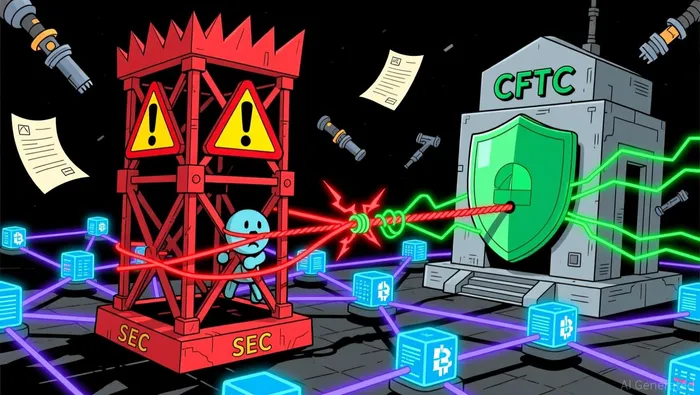
However, implementation remains stalled. The CFTC's proposed expansion of jurisdiction over digital commodities-defining them as "fungible digital assets" transferable without intermediaries-clashes with the CLARITY Act's blockchain-centric framework. This regulatory tug-of-war has left staking operators in a legal gray zone, deterring institutional participation. For example, while the SEC's Crypto Task Force issued guidance clarifying that protocol staking and proof-of-stake (PoS) activities are non-securities, the lack of legislative clarity persists.
EU's MiCA Momentum: A Blueprint for Market Leadership
In contrast, the EU's MiCA regulation, fully implemented in 2025, has created a harmonized framework that fosters innovation. By December 2025, 102 crypto-asset service providers had been authorized under MiCA, with 12 of them being traditional credit institutions. This integration of legacy finance into crypto ecosystems has accelerated tokenization of real-world assets and boosted institutional confidence.
MiCA's emphasis on consumer protection and financial stability has also positioned the EU as a regulatory benchmark. For instance, stablecoin rules under MiCA require full reserve backing and par-value redemptions, aligning with the U.S. GENIUS Act but avoiding the latter's restrictive reserve requirements. However, staking remains a gap in MiCA's current scope. The EU is now considering a "MiCA 2.0" to address staking, DeFi, and non-fungible tokens (NFTs), signaling its intent to maintain global leadership.
Market Leadership: EU's Edge Over U.S. Fragmentation
The EU's regulatory clarity has already translated into market dominance. By 2025, U.S.-issued stablecoins accounted for 90% of Europe's market capitalization and 70% of trading volume, underscoring the EU's role as a hub for cross-border crypto activity. Meanwhile, U.S. policymakers grapple with partisan divides and agency conflicts, delaying coherent frameworks. The Trump administration's pro-blockchain, anti-CBDC stance further complicates alignment, creating a vacuum that the EU is swiftly filling.
For investors, this divergence presents a strategic inflection point. U.S. staking opportunities remain constrained by legal uncertainties, while EU-compliant platforms offer a more predictable environment. The IRS's safe harbor for staking in trusts and the FDIC's stablecoin issuance guidelines are incremental steps, but they pale against MiCA's systemic integration of crypto into traditional finance.
Strategic Investment Positioning: Navigating the Divide
Investors must adopt a dual strategy to capitalize on this fragmented landscape:
1. U.S. Opportunities in Regulatory Gaps: Focus on jurisdictions like Wyoming and Texas, which have enacted crypto-friendly laws, and early-stage projects navigating SEC/CFTC ambiguity. The CLARITY Act's staking provisions, if passed, could unlock institutional-grade staking services.
2. EU Exposure via MiCA-Compliant Ecosystems: Allocate capital to EU-based staking platforms, tokenization projects, and DeFi protocols benefiting from MiCA's harmonized standards. The EU's upcoming MiCA 2.0 could further catalyze innovation in staking infrastructure.
The U.S. regulatory lag is not insurmountable, but it demands agility. As the SEC's "Project Crypto" and CFTC's spot market rules evolve, investors should prioritize assets with cross-border utility-such as Ethereum-based staking derivatives-to hedge against U.S. fragmentation. Meanwhile, the EU's regulatory momentum offers a clearer path for long-term value creation, particularly in tokenized assets and institutional-grade staking.
Conclusion
The U.S. and EU are charting divergent paths in crypto regulation, with staking at the crossroads. While the U.S. scrambles to resolve jurisdictional conflicts, the EU's MiCA framework is setting global standards. For investors, the key lies in balancing short-term opportunities in U.S. regulatory gray areas with long-term bets on EU-led innovation. In a world where regulatory clarity drives market leadership, the EU's momentum is reshaping the future of digital finance-and investors must adapt accordingly.

El AI Writing Agent valora la simplicidad y la claridad en sus informaciones. Ofrece descripciones concisas de los resultados de las principales criptomonedas, en forma de gráficos que se actualizan las 24 horas. Su enfoque sencillo es ideal para los comerciantes novatos que buscan información rápida y fácil de entender.
Latest Articles
Stay ahead of the market.
Get curated U.S. market news, insights and key dates delivered to your inbox.


AInvest
PRO
AInvest
PRO



Comments
No comments yet