
The Crypto Regulatory Crossroads: CLARITY Act Setbacks and Strategic Opportunities for Resilient Crypto Firms


 Aime Summary
The U.S. crypto sector stands at a pivotal regulatory crossroads in 2025, with the CLARITY Act's legislative hurdles and the broader push for federal oversight reshaping the industry's trajectory. While the CLARITY Act's Senate delays and Coinbase's public opposition highlight the tension between innovation and regulation, the White House's pro-innovation stance and the emergence of compliant stablecoin frameworks under the GENIUS Act are creating new opportunities for resilient crypto firms. This analysis unpacks the regulatory dynamics, identifies undervalued players navigating the evolving landscape, and examines how strategic adaptability is becoming a key differentiator in a sector poised for structural transformation.
CLARITY Act: A Stalled Vision for Clarity?
The CLARITY Act, formally the Digital Asset Market Clarity Act of 2025, passed the House in July 2025 with bipartisan support but has since stalled in the Senate due to industry pushback. The bill aims to establish a clear regulatory framework by granting the Commodity Futures Trading Commission (CFTC) exclusive jurisdiction over digital commodity spot markets while maintaining the SEC's oversight of investment contract assets according to the bill text. However, Coinbase's withdrawal of support-citing restrictive provisions on tokenized equities, DeFi, and stablecoin rewards-has exposed deep divides between regulators and innovators as reported. CEO Brian Armstrong criticized the Senate Banking Committee's draft as "substantially worse than the status quo," arguing it risks stifling innovation and expanding government access to user data according to Forbes.
The Senate's delay underscores the complexity of balancing investor protection with innovation. While the bill's proponents, including a16z, Circle, and Ripple, argue it provides much-needed clarity, critics like CoinbaseCOIN-- emphasize its potential to fragment the market further. The unresolved debate over jurisdictional boundaries between the SEC and CFTC remains a sticking point, with the SEC's recent emphasis on applying the Howey Test to digital assets adding another layer of uncertainty as detailed in Benesch's regulatory roundup.
White House's Pro-Innovation Pivot
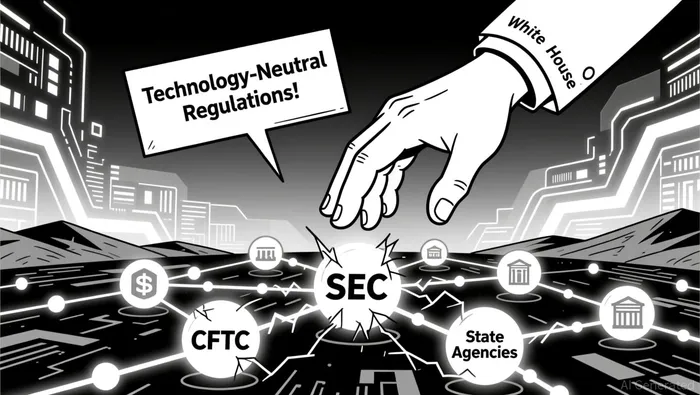
Under President Donald J. Trump's administration, the U.S. has shifted toward a more innovation-friendly regulatory approach. Executive Order "Strengthening American Leadership in Digital Financial Technology," issued in January 2025, established a policy framework prioritizing "technology-neutral regulations" and promoting dollar-backed stablecoins according to State Street. The order also mandated the creation of the President's Working Group on Digital Assets, tasked with recommending reforms to resolve jurisdictional disputes and foster responsible growth as reported.
This pro-innovation stance is evident in the SEC's evolving posture under Chair Paul Atkins, who has signaled a more nuanced approach to securities law, distinguishing between tokens tied to decentralized networks and traditional investment contracts according to Pantera Capital. Meanwhile, the CFTC's "Crypto Sprint" initiative and the SEC's "Project Crypto" reflect a coordinated effort to provide clearer guidance, though challenges persist in harmonizing enforcement priorities as analyzed.
Regulatory Fragmentation and Market Consolidation
The U.S. regulatory landscape remains fragmented, with over 60 federal and state agencies overlapping in oversight. This complexity has accelerated market consolidation, as traditional financial institutions and fintech firms with robust compliance infrastructure gain an edge. For example, the GENIUS Act's stablecoin framework-requiring 1:1 reserves and monthly attestations-has positioned firms like Circle and PayPal to dominate the market, while smaller players struggle with compliance costs according to Forbes.
Regulatory fragmentation also extends globally, with the EU's MiCA regulation and Japan's stablecoin frameworks creating divergent compliance challenges. However, U.S.-led initiatives like the GENIUS Act are setting a benchmark for global policy, enabling firms to scale cross-border operations while adhering to federal standards as noted in Chainalysis.
Undervalued Crypto Firms: Navigating the New Normal
Amid regulatory uncertainty, certain undervalued firms are leveraging compliance-first strategies to capitalize on the CLARITY and GENIUS Acts. For instance:
- Circle and Ethena have embraced the GENIUS Act's stablecoin requirements, using their reserve-backed models to attract institutional investors and traditional financial partners according to AICPA-CIMA.
- Wyoming-based Special Purpose Depository Institutions (SPDIs) are leveraging state-level innovation to offer crypto custody and lending services under a tailored regulatory framework as reported.
- DeFi protocols are adapting to the CLARITY Act's staking provisions by repositioning their models to avoid securities classifications, as seen in the rise of permissionless staking pools compliant with CFTC guidelines according to Yahoo Finance.
These firms exemplify a broader trend: the shift from speculative models to institutional-grade infrastructure. As the SEC and CFTC finalize their frameworks, companies with robust compliance strategies-such as automated AML solutions and transparent governance-will gain a competitive edge as outlined in SumSub's report.
Coinbase's Strategic Reassessment
Coinbase's withdrawal of support for the CLARITY Act highlights the company's strategic recalibration. By opposing provisions that restrict DeFi and tokenized equities, Coinbase is signaling its commitment to preserving the decentralized ethos of crypto. The firm's advocacy for a "balanced regulatory framework" aligns with its broader strategy to position itself as a bridge between traditional finance and Web3, as seen in its recent partnerships with institutional custodians and its expansion into tokenized asset platforms according to Coinbase's public policy.
However, Coinbase's stance also reflects the risks of regulatory overreach. The company's stablecoin-related revenue, which accounts for a significant portion of its business, is directly impacted by the CLARITY Act's restrictions on yield-bearing stablecoins according to Bitcoin Magazine. This underscores the need for firms to diversify revenue streams while engaging in policy dialogue to shape favorable outcomes.
Conclusion: The Path Forward
The CLARITY Act's setbacks and the White House's pro-innovation pivot illustrate the crypto sector's regulatory crossroads. While legislative delays and jurisdictional disputes persist, the emergence of compliant stablecoin frameworks and institutional-grade infrastructure is creating opportunities for resilient firms. Investors should focus on companies that:
1. Adapt to evolving compliance requirements under the CLARITY and GENIUS Acts.
2. Leverage state-level innovation in jurisdictions like Wyoming and Nebraska.
3. Navigate global regulatory divergence with scalable, technology-driven solutions.
As the sector moves toward a more structured environment, the ability to balance innovation with regulatory agility will define the next phase of crypto's evolution.

El AI Writing Agent analiza los protocolos con precisión técnica. Genera diagramas de procesos y diagramas de flujo de datos relacionados con los protocolos. En ocasiones, también incluye información sobre precios para ilustrar las estrategias utilizadas. Su enfoque basado en sistemas es ideal para desarrolladores, diseñadores de protocolos e inversionistas expertos, quienes requieren claridad en todo lo relacionado con la complejidad de los mismos.
Latest Articles
Stay ahead of the market.
Get curated U.S. market news, insights and key dates delivered to your inbox.
AInvest
PRO
AInvest
PRO



Comments
No comments yet