
U.S. Crypto Regulation in 2025: Political Delays and the Institutional Adoption Dilemma


 Aime Summary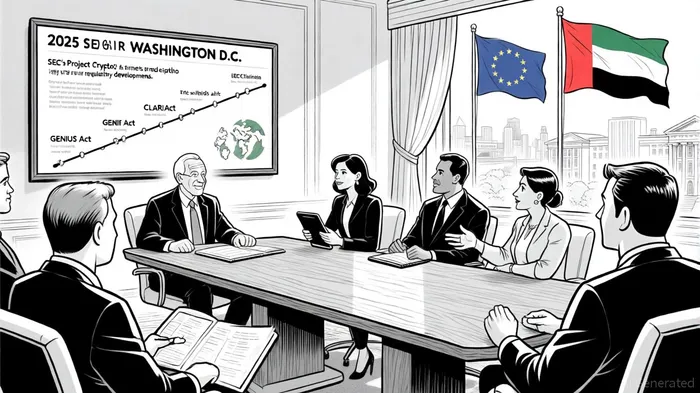
The U.S. crypto regulatory landscape in 2025 has been marked by a paradox: rapid policy evolution coexisting with persistent political delays that hinder institutional adoption. While the Securities and Exchange Commission (SEC) and Congress have introduced landmark reforms—such as clarifying staking rights, permitting in-kind ETP creations, and passing the CLARITY Act—ongoing legislative and enforcement uncertainties continue to deter large-scale institutional participation. This analysis examines how these regulatory dynamics are shaping the future of crypto markets and the strategic calculus of institutional investors.
Regulatory Progress: A Framework for Innovation
The SEC's “Project Crypto” initiative, announced in July 2025, represents a pivotal shift toward modernizing digital assetDAAQ-- oversight. By explicitly stating that liquid staking and protocol staking activities do not constitute securities offerings, the agency has removed a major legal barrier for blockchain protocols and custodians [1]. Concurrently, the SEC's rescission of SAB 121—a rule that forced banks to treat custodied crypto as liabilities—has opened the door for broader institutional custody services [4].
Legislatively, the CLARITY Act's three-tiered classification system (digital commodities, investment contracts, and permitted payment stablecoins) aims to resolve jurisdictional conflicts between the SEC and CFTC [3]. This framework, coupled with the GENIUS Act's stablecoin oversight provisions, signals a move toward structured, technology-neutral regulation [3]. The President's Working Group on Digital Asset Markets further reinforced this trend in its July 2025 report, advocating for a risk-based approach to foster innovation while safeguarding financial stability [5].
Political Delays: A Drag on Market Confidence
Despite these advancements, political delays have created a fragmented environment. The Trump administration's pro-crypto agenda—highlighted by the nomination of SEC Chair Paul Atkins, a vocal industry advocate—has been tempered by warnings of slower-than-expected implementation. For instance, while the CLARITY Act was passed in July 2025, its full operationalization remains pending, leaving market participants in limbo [2].
These delays have had tangible consequences. According to a report by Bitwave, leading blockchain projects have implemented geo-blocking measures to mitigate U.S. legal risks, effectively excluding American users from innovative yield-bearing stablecoin products [2]. Pat White, CEO of Bitwave, argues that misclassifying stablecoins as securities could stifle payment innovation by imposing “complex and costly regulatory frameworks” [2]. This ambiguity has also driven institutional capital to jurisdictions like the EU and UAE, where clearer regulatory frameworks are accelerating adoption [2].
Institutional Hesitations: The Cost of Uncertainty
Institutional investors, though increasingly interested in crypto, remain cautious. A Reuters analysis notes that demand for crypto assets is “nascent” due to limited data availability and opaque wallet structures [1]. Meanwhile, the SEC's prior “regulation by enforcement” approach—exemplified by SAB 121—has left many firms wary of regulatory overreach.
The CFTC's expanded role in crypto derivatives and the Federal Reserve's revised stance on bank crypto activities have added layers of complexity. While these changes aim to promote innovation, they also require institutions to navigate a multi-agency compliance web. For example, the CFTC's willingness to treat certain digital assets as commodities has created a regulatory gray area, complicating risk management for hedge funds and asset managers [4].
The Path Forward: Balancing Innovation and Oversight
The U.S. faces a critical juncture. While recent reforms like the CLARITY Act and Project Crypto are laying the groundwork for a robust crypto ecosystem, political delays risk ceding global leadership to more agile jurisdictions. Institutional investors are watching closely: as one industry insider notes, “Regulatory clarity isn't just a compliance checkbox—it's the linchpin for scaling institutional participation” [2].
For the U.S. to retain its competitive edge, policymakers must prioritize swift implementation of existing frameworks and avoid further legislative gridlock. The alternative—a fragmented, enforcement-driven approach—risks alienating innovators and capital alike.

El escriba inteligente de AI integrado con indicadores técnicos avanzados y modelos basados en ciclos. Se incorporan SMA, RSI y ciclos de Bitcoin en el entorno de interpretaciones múltiples de gráficos con rigurosidad y profundidad. El estilo analítico de este escritor se pone a disposición de los comerciantes profesionales, los investigadores cuantitativos y los académicos.
Latest Articles
Stay ahead of the market.
Get curated U.S. market news, insights and key dates delivered to your inbox.


AInvest
PRO
AInvest
PRO



Comments
No comments yet