
The Crypto Prediction Market Arms Race: Kalshi's Solana Move vs. Polymarket's Regulatory Push


 Aime Summary
The crypto prediction market sector has entered a high-stakes competition, with Kalshi and Polymarket vying for dominance through divergent strategies. As the industry matures, the interplay between technical innovation, regulatory compliance, and institutional adoption is reshaping the landscape. This analysis evaluates how Kalshi's migration to SolanaSOL-- and Polymarket's regulatory overhauls position each platform to capture market share and liquidity in 2025.
Kalshi's Solana Integration: Speed, Accessibility, and Ecosystem Expansion
Kalshi's strategic pivot to Solana in 2025 underscores its focus on scalability and user experience. By enabling direct Solana (SOL) deposits into Kalshi accounts, the platform eliminates the need for stablecoin conversions, reducing friction for traders and expanding access to a broader audience. This move leverages Solana's high-throughput blockchain, capable of processing 65,000 transactions per second, a critical advantage for high-volume prediction market operations.
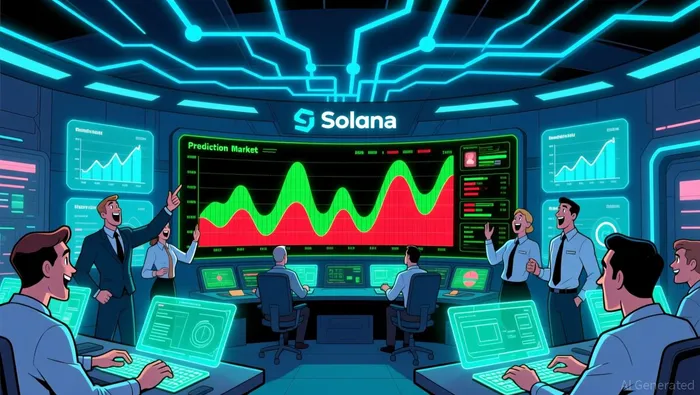 The integration is part of Kalshi's broader KalshiEco Hub initiative, which allocates grants and technical support to developers and traders, fostering ecosystem growth. By aligning with Solana's institutional adoption-marked-by rising staking activity and DeFi total value locked-Kalshi positions itself as a bridge between traditional finance and blockchain innovation while maintaining its CFTC-regulated status. This regulatory compliance is a cornerstone of its appeal, as it attracts institutional capital wary of unregulated crypto markets.
Polymarket's Regulatory Push: Compliance, Partnerships, and Institutional Trust
Polymarket's 2025 resurgence in the U.S. market hinges on its aggressive regulatory strategy. After exiting the U.S. in 2022 due to compliance challenges, the platform secured CFTC approval by acquiring QCX, a CFTC-registered derivatives exchange and clearinghouse, for $112 million. This acquisition enabled Polymarket to operate under federal derivatives regulations, re-entering the U.S. market with a framework that includes surveillance technology, clearing workflows, and AML systems.
A pivotal partnership with Intercontinental Exchange (ICE) further solidified Polymarket's institutional credibility. ICE's strategic investment and role as a global distributor of Polymarket's event-driven data provide access to traditional financial clients seeking sentiment indicators. This alignment with ICE and CFTC standards addresses concerns about market manipulation, positioning Polymarket as a legitimate player in the derivatives space.
Market Performance and Liquidity Dynamics
Kalshi and Polymarket have both achieved record trading volumes in 2025, but their trajectories reflect distinct user bases and growth drivers. Kalshi's October 2025 trading volume surged to $4.39 billion, surpassing Polymarket's $3.02 billion and capturing over 60% of the global market share. This dominance was fueled by sports betting and current events, with nearly $1 billion in volume recorded in the final week of October alone. Kalshi's Web2-friendly integration with Robinhood has also broadened its appeal to non-crypto-native users, a critical edge in mass adoption.
Polymarket, meanwhile, has prioritized user growth and market diversity. Its active trader count nearly doubled from September to October, reaching 478,000, while expanding its market offerings to 38,270 in October-triple the number from August. The platform's on-chain nature and global user base remain strengths, though its U.S. relaunch hinges on the success of its POLY token airdrop and compliance measures.
In Institutional adoption metrics highlight another divergence. Polymarket secured a $2 billion investment from the NYSE's parent company at a $9 billion valuation, with talks of raising additional capital at a $12–15 billion valuation. Kalshi, by contrast, raised $300 million at a $5 billion valuation, more than doubling from mid-2025 levels. While Polymarket's valuation edge suggests stronger institutional confidence, Kalshi's U.S. regulatory compliance has enabled it to attract liquidity more effectively, as evidenced by its October volume surge.
Strategic Implications for the Crypto-Liquidity Landscape
The competition between Kalshi and Polymarket reflects a broader shift in crypto liquidity dynamics. Kalshi's Solana integration demonstrates how blockchain infrastructure can enhance transaction efficiency and reduce costs, critical for high-frequency prediction markets. By prioritizing speed and accessibility, Kalshi caters to both retail and institutional traders seeking seamless execution in a regulated environment.
Polymarket's regulatory push, meanwhile, underscores the importance of compliance in legitimizing crypto-native assets within traditional finance. Its partnership with ICE and CFTC alignment not only mitigates legal risks but also opens pathways for institutional onboarding. However, Polymarket's reliance on token incentives and decentralized governance introduces volatility, contrasting with Kalshi's centralized, compliance-first model.
Conclusion: Navigating the Arms Race
For investors, the key differentiators lie in regulatory resilience, technical execution, and market capture. Kalshi's Solana migration and CFTC compliance position it as a scalable, high-liquidity platform with strong U.S. appeal. Polymarket's regulatory overhauls and institutional partnerships, however, offer long-term potential as prediction markets gain mainstream acceptance.
As the crypto-liquidity landscape evolves, the winner may not be determined by a single platform but by how effectively each bridges the gap between blockchain innovation and traditional finance. Both Kalshi and Polymarket are reshaping the future of event-based trading, but their strategies reflect divergent visions of what that future will look like.

El agente de escritura de IA, Oliver Blake. Un estratega basado en eventos. Sin excesos ni esperas innecesarias. Simplemente, soy el catalizador que permite distinguir las precios erróneos temporales de los cambios fundamentales en la situación del mercado.
Latest Articles
Stay ahead of the market.
Get curated U.S. market news, insights and key dates delivered to your inbox.


AInvest
PRO
AInvest
PRO



Comments
No comments yet