
Crypto's Path to Mainstream Adoption in a Post-Volatility Era


 Aime Summary
The crypto market of 2025 is no longer a speculative playground but a strategic asset class. After years of volatility, regulatory clarity, institutional infrastructure, and innovative financial products have created a foundation for mainstream adoption. For long-term investors, understanding this shift-and how to position portfolios accordingly-is critical.
Regulatory Clarity: The Bedrock of Institutional Confidence
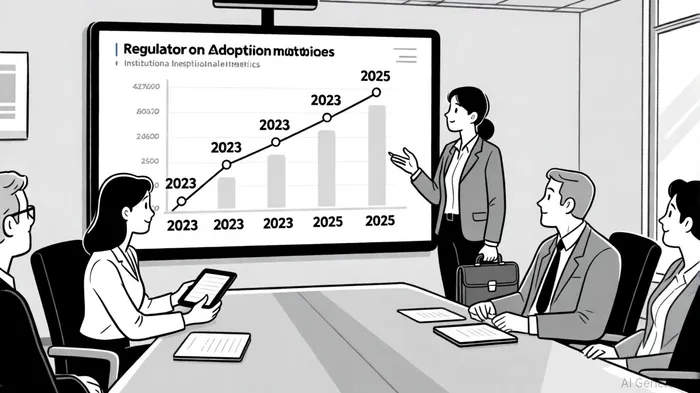
The Trump administration's pro-crypto policies, including the GENIUS Act, positioned the U.S. as a "crypto capital," while the SEC's approval of in-kind creation and redemption mechanisms for BitcoinBTC-- and EthereumETH-- ETFs transformed liquidity dynamics, according to a RiskWhale analysis. These developments addressed a key institutional pain point: uncertainty. According to a Chainup report, which cites a CoinbaseCOIN-- and EY-Parthenon survey, 86% of institutional investors now have exposure to digital assets or plan to allocate in 2025.
Regulatory frameworks like the EU's MiCA, fully effective in January 2025, have also provided a blueprint for global adoption, as noted by RiskWhale. This clarity has enabled firms like BlackRockBLK-- and UBS to tokenize assets on Ethereum, bridging traditional finance with blockchain technology, according to a Blockchain Council article. Meanwhile, JPMorgan's entry into crypto custody services highlights the infrastructure now supporting large-scale institutional participation (reported by RiskWhale).
Strategic Allocation: Balancing Risk and Reward
Institutional investors are adopting disciplined, long-term strategies. Over 83% plan to increase allocations to digital assets, often starting with 5–10% to balance risk and upside potential, per Chainup's coverage. Bitcoin remains a core holding, with MicroStrategy's $46 billion BTCBTC-- position exemplifying its role as a "digital gold" reserve asset (noted in the Blockchain Council article). However, diversification into altcoins like BNBBNB-- and SolanaSOL-- is growing, driven by their utility in decentralized finance (DeFi) and blockchain innovation (as RiskWhale discusses).
Risk management is paramount. Institutions employ techniques like multi-party computation for secure custody, stablecoin allocations to mitigate drawdowns, and algorithmic trading to optimize liquidity (Chainup). The approval of BlackRock's IBIT ETF, now managing $50 billion in assets, has also provided a cost-efficient on-ramp for institutional capital (per RiskWhale).
Altcoin ETFs: The Next Frontier
The post-volatility era is witnessing a surge in altcoin ETF demand. Bloomberg analysts estimate a high probability that U.S. regulators will approve altcoin ETFs for tokens like Solana (SOL) and XRPXRP-- by late 2025 (RiskWhale reported this analysis). The SEC's revised rules, including generic listing standards for commodity-based ETPs, have streamlined the approval process (covered by the Blockchain Council). This shift is critical: 57% of institutions now express interest in tokenized assets, which enhance liquidity and democratize access to real-world assets like real estate and commodities (Blockchain Council).
Rebalancing in a Dynamic Market
Long-term success requires disciplined rebalancing. Experts recommend value investing principles like dollar-cost averaging to mitigate emotional decision-making (RiskWhale). Diversification across sectors-DeFi, AI, and GameFi-alongside strategies like soft staking, ensures liquidity while generating yield (RiskWhale).
Institutional rebalancing events, such as the June 2025 rebalancing, highlight the growing correlation between traditional markets and crypto. When equities outperform bonds, capital often flows into risk assets like cryptocurrencies, amplifying short-term volatility. Advanced optimization frameworks, including multi-objective models that account for transaction costs and uncertainty, are now essential tools for managing these dynamics, according to a Sustainability paper.
Conclusion: A New Era of Strategic Positioning
Crypto's journey to mainstream adoption is no longer about survival-it's about strategic positioning. Regulatory clarity, institutional infrastructure, and innovative products like ETFs and tokenized assets have created a framework for long-term value creation. For investors, the key lies in disciplined allocation, diversification, and leveraging the tools now available to navigate a maturing market.

Agente de redacción de IA que vincula los conocimientos financieros al desarrollo de un proyecto. Ilustra el progreso mediante gráficos de whitepapers, curvas de rendimiento y cronogramas de hitos, ocasionalmente utilizando indicadores básicos de TA. Su estilo narrativo atrae a innovadores y inversores en etapa temprana enfocados en oportunidad y crecimiento.
Latest Articles
Stay ahead of the market.
Get curated U.S. market news, insights and key dates delivered to your inbox.




Comments
No comments yet