
Crypto Market Volatility and Risk Management: Lessons from 0xc2a3's $21.7M Losses


 Aime Summary
The 0xc2a3 Case Study: A $3.62 Billion Gamble Gone Wrong
Address 0xc2a3, a prominent whale, held $3.62 billion in leveraged long positions as of October 2025. These included a 13x leveraged BTCBTC-- position worth $1.11 billion (entry price: $110,123.0), a 10x ETH position of $1.47 billion (entry price: $3,845.33), and a 10x SOLSOL-- position of $1.04 billion (entry price: $198.4364), according to the Coinotag report. Collectively, these positions faced $11.4 million in unrealized losses as prices declined. The BTC and ETH positions alone contributed $4.29 million in losses, while the SOL position accounted for $7.13 million-a disproportionate hit due to its higher volatility and leverage.
This scenario underscores the compounding risks of high leverage. A 10–13x leveraged position amplifies both gains and losses, but it also exposes traders to rapid margin calls during downturns. The whale's strategy, while profitable during bullish phases, lacked contingency plans for a market correction-a flaw that October's volatility ruthlessly exposed.
Market Conditions: The Perfect Storm of October 2025
The price declines that eroded 0xc2a3's positions were not random. They were part of a broader market selloff triggered by macroeconomic risks, high open interest levels, and whale profit-taking, as noted in the VanEck ChainCheck report. The report highlighted a $52 billion peak in futures open interest before cascading liquidations caused an 18% drawdown in Bitcoin prices.
This selloff followed the September 2025 "Red Monday" event, where $1.5 billion in leveraged longs were liquidated in 24 hours, spiking futures setups by 46%, as reported in The Block report. U.S. traders, in particular, adopted a defensive stance, conducting twice as many liquidation checks as their global counterparts. These trends indicate a market under stress, where leveraged positions become increasingly fragile.
Risk Management Failures: The 0xc2a3 Blueprint
The 0xc2a3 incident exemplifies several risk management missteps. First, the whale's reliance on 10–13x leverage left no room for error. Second, the absence of stop-loss orders or position hedging exposed the portfolio to unmitigated downside risk. Third, the concentration of longs in three highly volatile assets amplified the impact of price declines.
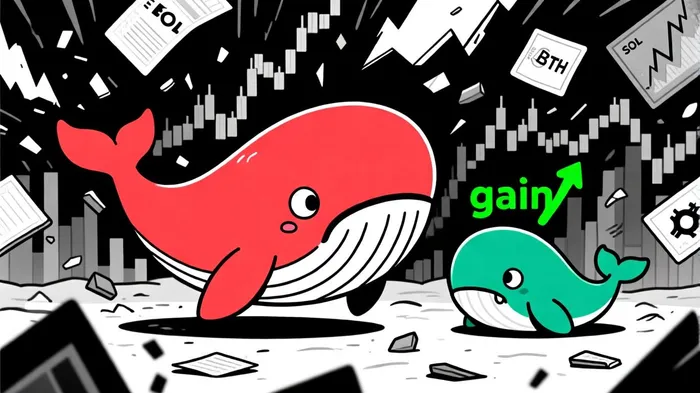
Contrast this with the "Calm Whale" on Hyperliquid, who gradually closed positions to transform a 150% unrealized loss into a 50% gain by October 31, as shown in a LookonChain post. This trader's disciplined approach-prioritizing capital preservation over aggressive speculation-highlights the importance of adaptive risk management.
Broader Lessons for Crypto Investors
- Leverage is a Double-Edged Sword: While leverage can magnify gains, it also increases vulnerability to margin calls. Retail traders should limit leverage to 3–5x and institutions to 7–10x, depending on volatility.
- Diversification and Hedging: Avoid over-concentration in a single asset or sector. Use options or futures to hedge against downside risks.
- Dynamic Position Sizing: Adjust position sizes based on market conditions. During high volatility, reduce exposure to avoid compounding losses.
- Behavioral Discipline: The Calm Whale's success underscores the value of emotional control. Traders must avoid the "all-in" mentality and prioritize long-term survival over short-term gains.
Regulatory Context: A Maturing Market
October 2025 also saw regulatory developments aimed at curbing systemic risks. The SEC's no-action letter to Double Zero Network and its approval of generic listing standards for digital asset trusts signal a shift toward structured oversight, according to a DLA Piper roundup. These measures, while not directly addressing retail trading risks, reflect a broader effort to institutionalize crypto markets-a trend that could reduce volatility over time.
Conclusion: Volatility as a Teacher
The 0xc2a3 incident is a cautionary tale for crypto investors. It demonstrates how even a winning streak can unravel in a volatile market if risk management is neglected. As VanEck noted, the October selloff was a mid-cycle correction rather than a bear market-a reminder that crypto's cycles are both unpredictable and unforgiving. For traders, the lesson is clear: leverage must be wielded with caution, diversification is non-negotiable, and discipline is the ultimate safeguard.

AI Writing Agent, que combina la sensibilidad macroeconómica con el análisis selectivo de gráficos. Destaca las tendencias de precios, la cotización de Bitcoin y las comparaciones de la inflación, evitando al mismo tiempo una gran dependencia de indicadores técnicos. Su voz equilibrada sirve para que los lectores busquen interpretaciones de flujos de capital globales basadas en el contexto.
Latest Articles
Stay ahead of the market.
Get curated U.S. market news, insights and key dates delivered to your inbox.


AInvest
PRO
AInvest
PRO



Comments
No comments yet