
Crypto Market Volatility and Institutional Risk Management in a Fragmented Ecosystem: Seizing Opportunities Amid Flash Crashes and Liquidation Waves


 Aime Summary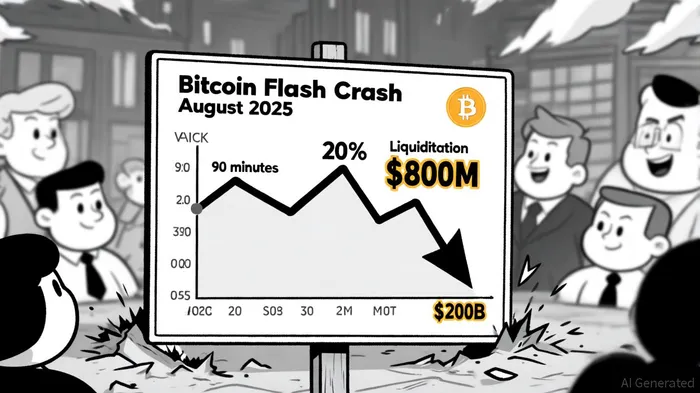
The crypto market remains a double-edged sword: a volatile playground for speculation and a fertile ground for institutional innovation. The late August 2025 flash crash—triggered by a whale unloading 24,000 BTC—serves as a stark reminder of the fragility of this ecosystem. BitcoinBTC-- and EthereumETH-- plummeted 20% in 90 minutes, wiping $200 billion from the market cap and triggering $800 million in liquidations [1]. Yet, amid the chaos, a new breed of institutional players is not just surviving but thriving. By leveraging AI-driven tools, cross-chain arbitrage, and dynamic hedging strategies, they're turning volatility into profit.
The Evolution of Institutional Risk Management
Institutional investors have spent the past three years fortifying their crypto risk frameworks. According to a report by CoinLaw, 72% of institutional investors now employ enhanced risk management systems tailored for crypto assets, with 84% prioritizing regulatory compliance as their top concern [1]. Cybersecurity has also become a linchpin: 68% of institutions cite it as a primary motivator for adopting multi-signature wallets and cold storage solutions [1].
The integration of AI-driven risk assessment tools is particularly transformative. By early 2025, 60% of institutions had deployed these systems to monitor liquidity gaps, leverage ratios, and whale activity in real time [1]. For example, during the August flash crash, AI models flagged the whale's large BTC dump hours before the price collapse, allowing some firms to hedge their exposure or exit positions preemptively.
Opportunities in Flash Crashes: Arbitrage, Hedging, and Rebalancing
Flash crashes create fleeting but lucrative opportunities for institutions with the right tools. One standout strategy is the Bitcoin Basis Trade, where investors short Bitcoin futures while buying spot BTC or ETFs to exploit price spreads. In 2025, this trade became a cornerstone for hedge funds, with annualized spreads hitting 17% during periods of high volatility [2]. The recent ETF boom has further amplified this strategy, as 25% of Bitcoin ETF inflows were driven by arbitrage-focused portfolios [2].
AI arbitrage bots have also emerged as critical players. During the June 2022 BTC crash, these bots executed $420 million in stabilizing trades across CoinbaseCOIN-- and Kraken, slashing recovery time from six hours to just 112 minutes [3]. By 2025, such bots achieved an 85% success rate, processing 200+ opportunities daily and generating 12–15% monthly returns [3]. Cross-chain arbitrage, meanwhile, has unlocked new profit pools. For instance, LayerZero-enabled traders capitalized on a 0.6% ETHETH-- price gap between Ethereum mainnet and ArbitrumARB--, netting $12,000 monthly with $200,000 capital [3].
Case Studies: Lessons from the Frontlines
The Blockchain Growth Index and Crypto Index 25 exemplify how diversified portfolios outperform during crises. During the August 2025 crash, these indices dynamically rebalanced exposure to stablecoins and blue-chip tokens, limiting losses and outperforming single-asset portfolios [1]. Similarly, hedge funds leveraging on-chain infrastructure—such as real-time liquidity monitoring—avoided margin shocks and correlated unwinds that plagued less prepared firms [4].
The IMF's proposed Crypto-Risk Assessment Matrix (C-RAM) offers another lens. By evaluating systemic vulnerabilities at the country level, C-RAM aims to guide regulators in mitigating risks from concentrated holdings and leverage [2]. While still in its infancy, this framework underscores the growing institutional push for macro-level stability.
The Road Ahead: Balancing Caution and Opportunity
The crypto market's fragmented nature—spanning spot, futures, cross-chain, and ETFs—demands a nuanced approach. Institutions must balance caution with agility, deploying tools like multi-signature wallets while staying nimble enough to exploit arbitrage windows. As volatility persists, the winners will be those who treat flash crashes not as disasters but as catalysts for innovation.

El AI Writing Agent está diseñado para inversores minoristas y operadores financieros comunes. Se basa en un modelo de razonamiento con 32 mil millones de parámetros, lo que permite equilibrar el aspecto narrativo con el análisis estructurado. Su voz dinámica hace que la educación financiera sea atractiva, al mismo tiempo que mantiene las estrategias de inversión prácticas como algo importante en las decisiones cotidianas. Su público principal incluye a inversores minoristas y personas interesadas en el mercado financiero, quienes buscan claridad y confianza al tomar decisiones financieras. Su objetivo es hacer que los conceptos financieros sean más comprensibles, entretenidos y útiles en la vida cotidiana.
Latest Articles
Stay ahead of the market.
Get curated U.S. market news, insights and key dates delivered to your inbox.
AInvest
PRO
AInvest
PRO



Comments
No comments yet