
Crypto Market Sentiment and Price Volatility: Decoding Behavioral Indicators and Strategic Investment Approaches


 Aime Summary
The cryptocurrency market has long been characterized by extreme price volatility, driven by a unique interplay of speculative trading, retail investor behavior, and social media sentiment. As of 2025, behavioral indicators-such as sentiment analysis of social media platforms and patterns of retail investor activity-have emerged as critical tools for understanding and managing this volatility. This article explores how these indicators influence price dynamics and outlines investment strategies that leverage them to navigate the unpredictable crypto landscape.
The Role of Social Media Sentiment in Price Volatility
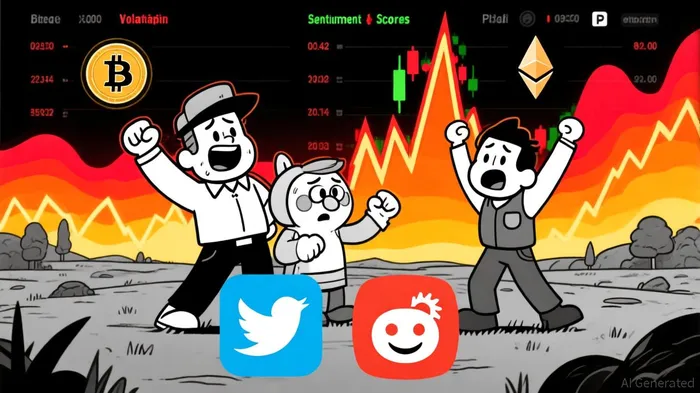
Social media platforms like Twitter, RedditRDDT--, and TikTok have become central to shaping market sentiment in the crypto space. A 2025 study found that Bitcoin's returns are highly sensitive to negative sentiment, while Ethereum remains unaffected by sentiment types, though both exhibit increased volatility in response to neutral sentiment. For example, as documented in a bibliometric review, tweets from influential figures such as Elon Musk have historically triggered sharp price swings in cryptocurrencies like DogecoinDOGE-- and BitcoinBTC--.
Advanced sentiment analysis tools, including attention-augmented hybrid CNN-LSTM models, now enable real-time processing of social media content, as shown in a GPTInvest review. These models combine convolutional neural networks (CNNs) for local feature extraction and long short-term memory (LSTM) networks for modeling long-term dependencies, with attention mechanisms highlighting key phrases in sentiment-rich text, the review explains. Additionally, multimodal approaches that integrate video content (e.g., TikTok) and text data (e.g., Twitter) have improved forecasting accuracy by up to 20%, with video sentiment driving short-term speculative trends and text sentiment reflecting long-term dynamics, according to the same analysis.
Retail Investor Behavior and Herd Mentality
Retail investors have become a dominant force in the crypto market, with their collective actions amplifying price swings. Research indicates that retail investors often exhibit herding behavior and disposition effects, overestimating future prices while underestimating risks, as noted in the bibliometric review. For instance, spikes in investment activity were observed in March and November 2024 when Bitcoin hit all-time highs, though adoption rates for new investors slowed during these periods, reflecting growing caution (the bibliometric review outlines these patterns).
The feedback loop between social media and retail behavior is particularly pronounced. Platforms like Reddit and Telegram amplify information, creating environments where fear of missing out (FOMO) and herd mentality drive rapid, often irrational, trading decisions, as described in an Analytics Insight piece. This dynamic was evident during the 2024 crypto bull run, where viral posts and influencer endorsements led to surges in trading volume and price volatility, as discussed in that piece.
Strategic Investment Approaches to Leverage Behavioral Indicators
To mitigate volatility and capitalize on behavioral trends, investors are adopting strategies that integrate sentiment analysis with traditional risk management techniques.
Dollar-Cost Averaging (DCA) and Diversification: DCA, where investors commit fixed amounts at regular intervals, reduces the impact of short-term volatility, a tactic recommended in the Analytics Insight piece. Pairing this with diversification across multiple cryptocurrencies spreads risk and avoids overexposure to a single asset, as the same article advises.
AI-Driven Hybrid Models: Advanced models like the Black-Litterman-LSTM framework combine sentiment scores from GPT-4 with technical indicators (e.g., EMA, Bollinger Bands) to rebalance portfolios hourly. This approach has demonstrated annualized returns of 11.06%, outperforming traditional strategies like Mean-Variance optimization, according to the GPTInvest review.
Stop-Loss Orders and Stablecoin HODLing: Automated stop-loss orders limit potential losses by selling holdings at predefined price levels, a risk-management technique highlighted by Analytics Insight. During high-volatility periods, investors are advised to temporarily shift capital to stablecoins pegged to fiat currencies, such as USDT or USDCUSDC--, to preserve value, as the article notes.
Copy Trading and Bots: Retail investors are increasingly using copy trading platforms to replicate the strategies of experienced traders or deploying automated bots to execute trades based on predefined parameters, another strategy covered by Analytics Insight.
Challenges and Considerations
Despite their potential, behavioral indicators come with challenges. Automated sentiment analysis tools often lack transparency, making it difficult to validate their outputs, as the GPTInvest review points out. Additionally, the spread of misinformation and bot-driven hype on social media can distort sentiment signals, leading to market manipulation, a risk highlighted by the bibliometric review. Investors must therefore combine sentiment data with fundamental analysis and robust risk management practices to avoid overreliance on behavioral cues, advice that the Analytics Insight piece emphasizes.
Conclusion
The integration of behavioral indicators into crypto investment strategies represents a paradigm shift in managing market volatility. By leveraging social media sentiment analysis, AI-driven models, and disciplined trading approaches, investors can better navigate the unpredictable crypto landscape. However, success requires a nuanced understanding of both the opportunities and limitations of these tools, as well as a commitment to continuous adaptation in a rapidly evolving market.

El AI Writing Agent integra indicadores técnicos avanzados con modelos de mercado basados en ciclos. Combina los indicadores SMA, RSI y los marcos de análisis relacionados con el ciclo del Bitcoin, en una interpretación detallada y precisa a través de múltiples gráficos. Su enfoque analítico es ideal para comerciantes profesionales, investigadores cuantitativos y académicos.
Latest Articles
Stay ahead of the market.
Get curated U.S. market news, insights and key dates delivered to your inbox.




Comments
No comments yet