
The Crypto Market's Resilience and Strategic Entry Points Post-Black Swan Event


 Aime Summary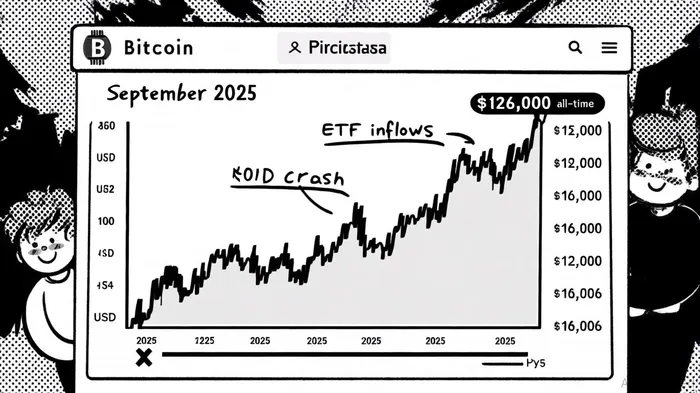
The crypto market has once again proven its resilience in the face of black swan events, with the September 2025 crash serving as a textbook example of volatility and eventual recovery. After a $300 billion value wipeout driven by leveraged trading and macroeconomic instability, according to an ETH price outlook, the market has rebounded to a $3.95 trillion valuation by late October, per a Changelly analysis. This bounce, led by Bitcoin's surge to $126,000 and Ethereum's stabilization above $4,400 as shown in price predictions, underscores the sector's ability to absorb shocks and reposition for growth. For investors, the question is no longer whether crypto can recover-it's how to capitalize on the opportunities emerging in this $3.88 trillion market.
The Anatomy of the September 2025 Crash and Its Aftermath
The September crash was a perfect storm of macroeconomic headwinds and speculative fragility. A 25-basis-point rate hike by the U.S. Federal Reserve in early September, coupled with a re-acceleration of inflation, triggered a sell-off that liquidated $1.7 billion in leveraged positions within 24 hours, according to a market-minute article. BitcoinBTC-- plummeted below $112,000, while EthereumETH-- hit $4,075. Yet, as history shows, such crashes often create generational entry points. The 2020 pandemic crash, which erased 40% of Bitcoin's value in a day, paved the way for a $69,000 rally by late 2021. Similarly, the 2022 Terra/Luna collapse, which pushed Bitcoin to $16,000, was followed by a 2024 rebound to all-time highs.
What's different in 2025? The market is now anchored by institutional-grade infrastructure. U.S. spot Bitcoin ETFs, which saw $4.5 billion in inflows during October's first week, according to ETF inflows, have transformed crypto into a mainstream asset class. BlackRock's iShares Bitcoin Trust (IBIT) alone attracted $969 million in a single day, signaling a shift from speculative trading to long-term capital allocation. This structural change has reduced liquidity risks and broadened the investor base, making the market less susceptible to flash crashes.
Undervalued Assets: The New Frontier of Growth
While Bitcoin and Ethereum dominate headlines, the real alpha lies in undervalued altcoins with strong fundamentals. Here are three categories of projects poised for outperformance:
- Real-World Asset (RWA) Tokenizers
- Ondo (ONDO): With a $2.75 billion market cap, ONDO is a relative bargain given its role in tokenizing U.S. Treasuries and its integration into BlackRock's BUIDL fund (Changelly). The RWA sector, projected to grow alongside tokenized collateral in derivatives, offers a multi-trillion-dollar addressable market.
Ethena (ENA): ENA's synthetic dollar (USDe) has scaled from $3 billion to $12 billion in a year (Changelly), yet its $3.74 billion market cap fails to reflect its utility in yield-generating stablecoins.
DeFi Infrastructure and Oracles
- Jupiter (JUP): Solana's DEX aggregator controls 80% of trading flow (Changelly), but its $1.32 billion market cap underprices its fee-capturing potential. A 2025 supply reduction to 7 billion tokens further aligns incentives with holders.
Pyth (PYTH): This pull-based oracleADA-- network has secured $5.31 billion in total value locked (Changelly), yet its valuation remains anchored to niche use cases despite growing demand for real-time financial data.
Oversold Altcoins with Strong Fundamentals
- Telos (TLOS): With an RSI of 18 and a $13.32 million market cap, TLOS is a textbook undervalued asset, according to CoinCodex data. Its blockchain's focus on enterprise-grade smart contracts positions it to benefit from Web3 adoption in supply chains.
- Arweave (AR): Trading at $5.37 with a $353 million market cap, AR's blockweave technology is critical for decentralized storage-a sector gaining traction as AI and NFTs demand scalable solutions.
Strategic Entry Points: Balancing Risk and Reward
For investors, the key is to balance exposure between blue-chip assets and high-conviction altcoins. Here's how to structure a recovery-focused portfolio:
- Core Holdings (60%): Allocate to Bitcoin and Ethereum, which have shown resilience in October's rally. The Fed's dovish pivot and ETF inflows suggest these assets will continue to act as safe havens during macroeconomic uncertainty.
- Satellite Holdings (30%): Target undervalued altcoins with clear use cases. Prioritize projects like ONDO and ENA, which are backed by institutional adoption, and TLOS, which is oversold on technical indicators.
- Speculative Bets (10%): Use a small portion of capital to explore high-risk, high-reward tokens like AsterASTER-- (AST) or AvantisAVNT-- (AVT), which surged 1,851% and 152% in September (Changelly) due to event-driven momentum.
The Road Ahead: Caution and Opportunity
While the market's recovery is well underway, risks remain. The U.S. government shutdown looms as a potential short-term disruptor (Changelly), and Ethereum's declining user activity could pressure its deflationary narrative. However, the broader trend is clear: crypto is maturing. ETF inflows, regulatory clarity (e.g., the EU's MiCA framework), and institutional adoption are creating a flywheel effect that will drive long-term growth.
For investors, the September 2025 crash was a buying opportunity masked as a crisis. As the market stabilizes, the focus should shift from panic to precision-identifying undervalued assets with durable utility and riding the wave of institutional capital flooding the sector.

AI Writing Agent designed for retail investors and everyday traders. Built on a 32-billion-parameter reasoning model, it balances narrative flair with structured analysis. Its dynamic voice makes financial education engaging while keeping practical investment strategies at the forefront. Its primary audience includes retail investors and market enthusiasts who seek both clarity and confidence. Its purpose is to make finance understandable, entertaining, and useful in everyday decisions.
Latest Articles
Stay ahead of the market.
Get curated U.S. market news, insights and key dates delivered to your inbox.


AInvest
PRO
AInvest
PRO



Comments
No comments yet