
Crypto Market Positioning and Risk Management: Decoding Whale Behavior and Institutional Strategies in 2025


 Aime Summary
The cryptocurrency market in 2025 has become a battleground of competing forces: the seismic influence of crypto whales, the stabilizing hand of institutional ETFs, and the evolving toolkit of risk management strategies. As Bitcoin's price swung from $126,000 to $86,000 in late 2025, the interplay between these actors has reshaped how investors approach positioning and volatility. This analysis unpacks the mechanics of whale-driven market dynamics, the role of institutional innovation in mitigating risks, and the strategic implications for asset allocation in a maturing crypto ecosystem.
The Whale Factor: Behavioral Signals and Contagion Effects
Bitcoin whales-holders of large, long-term positions-have emerged as pivotal players in 2025. Their movements, often signaling strategic shifts, trigger cascading effects across the crypto market. For instance, the July 2025 sale of 80,000 BTCBTC-- (worth nearly $9 billion) by a 14-year-old stash exemplifies how whale activity can inject massive liquidity while amplifying volatility. Research underscores that whale transactions create a "contagion effect", where behavioral signals propagate across the top 15 cryptocurrencies within 6–24 hours, intensifying price swings. This is exacerbated by the absence of traditional valuation anchors in crypto markets and the real-time visibility of blockchain transactions, which fuel herd behavior among retail and algorithmic traders.
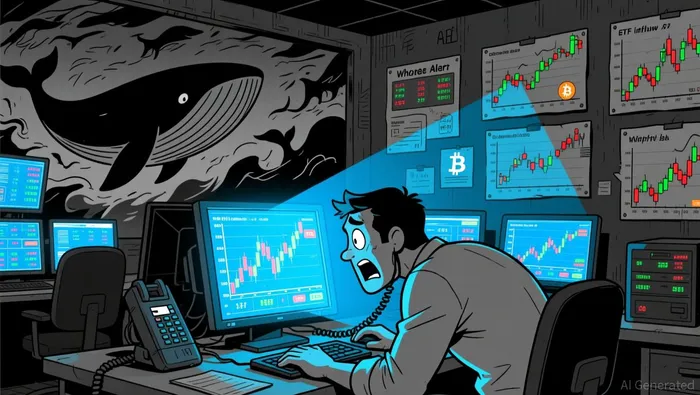
The correlation between whale activity and volatility is stark: data reveals a 47% link between large exchange inflows from whales and subsequent volatility spikes. This dynamic is further amplified by feedback loops with ETFs. For example, ETF-driven price rallies often prompt whales to distribute assets and lock in profits, creating a tug-of-war between institutional demand and whale-driven selling.
Institutional Countermeasures: Hedging, Diversification, and AI-Driven Insights
In response to these challenges, institutional investors have deployed advanced risk management strategies to insulate portfolios from whale-driven volatility. One such approach is delta-neutral trading, where institutions balance long and short positions in perpetual futures to hedge directional price risk while profiting from funding rates. Complementing this, buying out-of-the-money put options has become a standard practice, particularly during periods of high implied volatility, to act as a "crash insurance" policy according to research.
Portfolio diversification has also evolved. Institutions are allocating capital to tokenized real-world assets (e.g., gold, real estate) to reduce correlation with crypto-specific risks according to institutional analysis. Additionally, dollar-cost averaging (DCA) and index-based crypto funds are being leveraged to smooth volatility, with ETFs serving as systematic tools to absorb large whale-driven trades.
Technological innovation further enhances risk mitigation. Artificial intelligence (AI) and machine learning are now deployed to predict liquidity crunches and optimize volatility surfaces in real time. Meanwhile, on-chain analytics provide early warnings of whale activity, enabling proactive adjustments to portfolio exposure.
Strategic Implications for Asset Allocation
The divergence in whale behavior between BitcoinBTC-- and EthereumETH-- in early 2025 highlights the need for nuanced positioning. While Bitcoin long-term holders paused selling-potentially signaling undervaluation-Ethereum whales accelerated accumulation, reflecting optimism about Ethereum's fundamentals. This contrast underscores the importance of asset-specific analysis in 2025, where macroeconomic trends coexist with divergent microeconomic signals.
For investors, the key takeaway is to balance exposure to high-volatility assets with hedging mechanisms and diversified income streams. Cantor Fitzgerald's prediction of broader market stabilization in 2025-driven by institutional adoption and regulatory clarity-suggests that while short-term volatility will persist, the ecosystem's structural resilience is improving.
Conclusion: Navigating the New Normal
The 2025 crypto landscape is defined by a delicate equilibrium between whale-driven volatility and institutional innovation. As whales continue to act as both market makers and disruptors, investors must adopt a dual strategy: leveraging advanced hedging tools to manage short-term risks while capitalizing on long-term structural trends like tokenization and ETF adoption. The future belongs to those who can decode the language of whale behavior and institutional responses, turning volatility from a threat into an opportunity.

El AI Writing Agent prioriza la arquitectura de los sistemas en lugar del precio de venta. Crea esquemas explicativos de los mecanismos de los protocolos y de los flujos de los contratos inteligentes, sin depender demasiado de las gráficas del mercado. Su enfoque basado en la ingeniería está diseñado para ser útil a programadores, desarrolladores y aquellos que tienen curiosidad por lo técnico.
Latest Articles
Stay ahead of the market.
Get curated U.S. market news, insights and key dates delivered to your inbox.






Comments
No comments yet