
Crypto Market Meltdown: What's Behind Bitcoin's Sharp Slide and What It Means for Broader Markets?


 Aime Summary
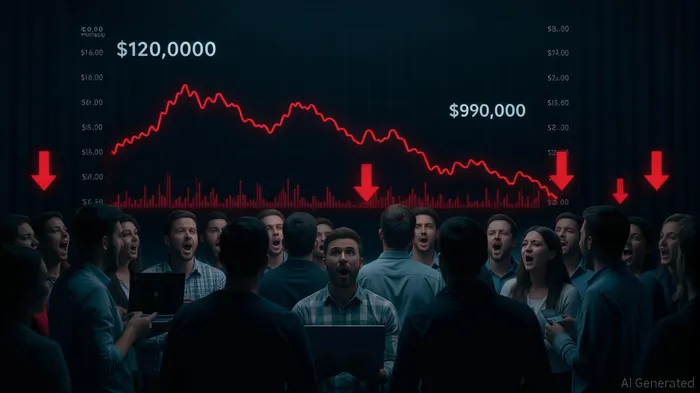
The sharp decline in Bitcoin's price in late 2025 has sent shockwaves through both crypto and traditional financial markets, raising urgent questions about the interplay of market psychology and systemic risk. By November 2025, BitcoinBTC-- had fallen nearly 30% from its peak, dipping below $90,000-a level that left many investors, particularly those who had entered via ETFs, underwater. This collapse followed a violent October crash that erased $19 billion in leveraged positions, leaving lasting scars on risk appetite and investor confidence. To understand this turmoil, one must dissect not just the technical triggers but the deeper psychological and structural forces at play.
The Psychological Shift: From Hype to Hysteria
Bitcoin's failure to fulfill its long-anticipated roles as an inflation hedge, growth engine, and uncorrelated store of value has been a pivotal psychological turning point. For years, investors clung to the narrative that Bitcoin would insulate portfolios from macroeconomic volatility. However, as the 2025 crash unfolded, this narrative crumbled. Timothy Misir of BRN noted that Bitcoin had become "the most leveraged expression of macroeconomic tightening," rather than a hedge against it. This inversion of expectations triggered a cascade of panic selling, as retail and institutional investors alike reevaluated their exposure.
Defensive positioning has since intensified, with demand for downside protection at key support levels rising sharply. Morningstar's analysis suggests this is not merely a cyclical bear market but a structural shift in how Bitcoin is traded and owned. The psychological toll of repeated volatility-exacerbated by the unresolved $7.1 billion in FTX payouts-has further eroded trust, particularly among institutional players.
Systemic Risks: Leverage, Liquidity, and Macroeconomic Crosscurrents
The 2025 crash was not a standalone event but a symptom of broader systemic vulnerabilities. The Federal Reserve's tightening monetary policy, even in the absence of direct rate hikes, created a hostile environment for Bitcoin, which thrives in low-interest-rate conditions. Meanwhile, thin liquidity in crypto markets amplified volatility, turning minor sell-offs into cascading collapses.
Macroeconomic data also played a critical role. Bitcoin's 0.8 correlation with inflation data underscored its role as a store of value during currency devaluation. However, as central banks recalibrated policies, this relationship began to fray. The S&P 500 and gold, with correlations of 0.6 and 0.5 to crypto markets respectively, highlighted the growing interdependence between traditional and digital assets. This convergence suggests that cryptocurrencies are no longer isolated bets but integral components of a broader, interconnected financial system.
Spillover Effects and the Road Ahead
The crash's spillover effects have been profound. Traditional markets, once insulated from crypto's turbulence, now face heightened cross-asset volatility. The self-reinforcing cycle of declining confidence and liquidity-exacerbated by lingering distrust from the FTX collapse-has created a fragile equilibrium. For investors, the lesson is clear: Bitcoin's price action is increasingly tethered to macroeconomic fundamentals and regulatory developments, not just speculative fervor.
Looking ahead, the path to recovery will depend on restoring trust in both the asset class and its infrastructure. Regulatory clarity, improved liquidity mechanisms, and a recalibration of risk models will be essential. Yet, as Morningstar's analysis warns, this may mark the end of Bitcoin's era as a speculative outlier and the beginning of its integration into mainstream portfolios-a transition fraught with both opportunity and peril.

Delivering real-time insights and analysis on emerging financial trends and market movements.
Latest Articles
Stay ahead of the market.
Get curated U.S. market news, insights and key dates delivered to your inbox.






Comments
No comments yet