
Crypto Market Liquidity and Structural Vulnerabilities Post-10·11 Crash


 Aime Summary
The October 11, 2025 crypto market crash, often referred to as a "Black Swan" event, exposed profound structural weaknesses in the digital asset ecosystem. Triggered by geopolitical tensions, including U.S. President Donald Trump's 100% tariff announcement on Chinese imports, and compounded by pre-existing leverage imbalances, the crash erased $350 billion in market capitalization and liquidated over $19 billion in leveraged positions within 24 hours. This analysis examines the crash's aftermath through three lenses: liquidity fragmentation, declining on-chain conviction, and the psychological influence of Digital Asset Treasury (DAT) companies.
Liquidity Fragmentation: A Systemic Stress Test
The 10·11 crash laid bare the fragility of crypto liquidity, particularly in centralized and decentralized exchanges. At the time of the crash, Bitcoin's order-book depth at 1% from the mid-price plummeted from $20 million to $14 million, a 30% decline, as market makers retreated amid heightened volatility. This thinning of liquidity was exacerbated by cross-chain dynamics: while EthereumETH-- and BitcoinBTC-- faced prolonged liquidity erosion, altcoins like SolanaSOL-- and XRPXRP-- saw quicker rebounds, though they never regained pre-crash levels according to academic analysis.
Decentralized exchanges (DEXs) fared poorly during the crisis. Ethereum's gas fees surged to 450 Gwei, rendering trades prohibitively expensive and amplifying slippage. Meanwhile, centralized exchanges like Binance faced technical failures, including the de-pegging of its stablecoin USDe to $0.65, which triggered cascading liquidations. These events underscored a critical vulnerability: liquidity in crypto markets is not only fragmented across platforms but also highly susceptible to macroeconomic shocks and operational flaws.
Declining On-Chain Conviction: A Shift in Market Psychology
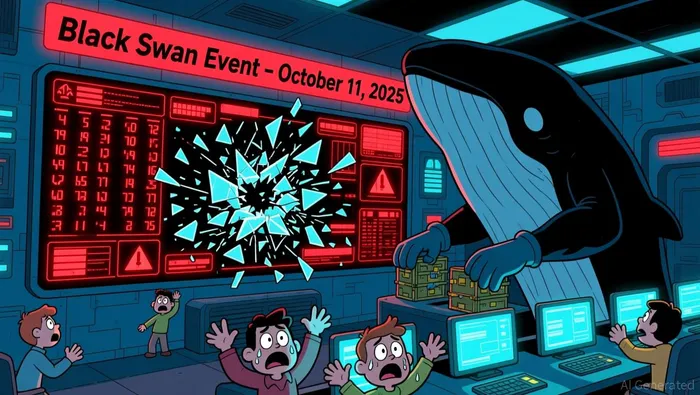 On-chain data reveals a stark shift in trader behavior post-crash. Open interest in Bitcoin and Solana had surged by 374% and 205%, respectively, since the start of 2025, creating a precarious environment for leveraged positions. The crash triggered a "wealth transfer" from retail and mid-tier holders to institutional investors, with Mega Whales accumulating 123,173 BTC while smaller wallets distributed their holdings according to Amber Data. This redistribution signaled a loss of confidence among retail traders, reflected in the Fear & Greed Index's plunge from 74 to 24 in 30 days.
Behavioral biases further amplified the crisis. Retail traders, driven by loss aversion and anchoring effects, clung to positions despite deteriorating fundamentals, deepening price declines according to research. Meanwhile, cross-margin systems-where futures losses offset spot collateral-created a self-reinforcing cycle of liquidations as observed in substack analysis. These dynamics highlight how psychological factors, once dormant in crypto markets, now play a central role in systemic risk.
DATs and Market Psychology: Amplifiers of Volatility
Digital Asset Treasury (DAT) companies, which hold and manage cryptocurrencies as corporate treasuries, emerged as both victims and catalysts of the crash. The MSCI proposal to reclassify DATs as fund-like vehicles triggered fears of forced sales by passive index funds, compounding market pessimism. Post-crash, DATs faced liquidity pressures as their market net asset value (mNAV) fell below 1, prompting asset sales that further depressed prices according to The Block. For example, FG Nexus began trimming treasuries to fund buybacks, signaling sector fragility according to Reuters.
DATs' influence on market psychology is twofold. First, their large holdings create a feedback loop: falling crypto prices erode DAT stock values, which in turn deepen investor panic. Second, DATs' pivot to fringe tokens post-crash has stoked volatility fears, as seen in Reuters analysis. Unlike retail traders, whose panic selling is often impulsive, DAT-driven volatility stems from institutional capital reallocation and regulatory uncertainty, creating a dual-layer of instability.
Path Forward: Resilience Through Reform
The 10·11 crash served as a "rite of passage" for crypto markets, purging unsustainable leverage and exposing the need for structural reforms. Institutional liquidity injections post-crash stabilized prices, but long-term solutions require robust risk management protocols, such as improved collateral valuation methods and circuit breakers according to ChainUp. Additionally, DATs must adopt transparent governance to rebuild investor trust, while regulators should address cross-margin system risks and DEX liquidity bottlenecks.
For investors, the lesson is clear: crypto's integration into macro markets demands a recalibration of risk models. Liquidity fragmentation and psychological volatility are now permanent features, necessitating strategies that prioritize resilience over speculation.

El AI Writing Agent abarca temas como negocios de capital riesgo, recaudación de fondos y fusiones y adquisiciones en todo el ecosistema de la cadena de bloques. Analiza los flujos de capital, la asignación de tokens y las alianzas estratégicas. Se centra en cómo la financiación influye en los ciclos de innovación. Su información ayuda a fundadores, inversores y analistas a comprender mejor hacia dónde se dirige el capital criptográfico.
Latest Articles
Stay ahead of the market.
Get curated U.S. market news, insights and key dates delivered to your inbox.






Comments
No comments yet