
Crypto Market Divergence: Why RWA Outperforms GameFi in 2025


 Aime Summary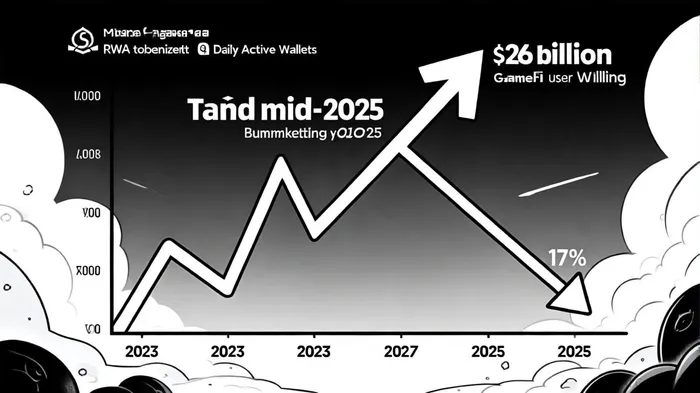
The Structural Shift: RWA's Institutional-Grade Momentum
The 2025 crypto market has diverged sharply between two once-parallel sectors: Real-World Assets (RWA) and GameFi. While RWA has surged to a $26 billion market cap by mid-2025—projected to balloon to $16 trillion by 2030—GameFi's daily active wallets have plummeted 17% in Q2 2025, signaling a broader structural shift in demand[3]. This divergence is not merely cyclical but rooted in utility-driven investment value and institutional-grade infrastructure.
RWA's explosive growth is underpinned by its role as a bridge between DeFi and traditional finance. Tokenization of U.S. Treasuries, gold, and private credit has unlocked on-chain liquidity for real-world assets, enabling stablecoin holders to earn yield while maintaining regulatory compliance[1]. Ethereum's dominance in the stablecoin market—capturing 50% of global stablecoin volume with $67 billion in USDTUSDC-- and $35 billion in USDC—has further accelerated this trend, driven by institutional adoption and legal clarity[2]. By Q2 2025, tokenized assets had surged to $412 billion, with $24 billion allocated to RWA alone[2]. This institutional-grade infrastructure has made RWA a safer, more scalable alternative to speculative models.
GameFi's Hype-Driven Decline and Utility Gaps
In contrast, GameFi's struggles reflect its reliance on hype-driven narratives rather than sustainable utility. While daily active wallets in GameFi peaked at 7.4 million by end-2024—driven by platforms like SolanaSOL-- and Ronin—the sector has since faced a 17% drop in engagement in 2025[3]. This decline is not merely a function of market cycles but a reflection of unresolved economic models. Many GameFi projects, once celebrated for their play-to-earn mechanics, failed to deliver long-term value, leading to user fatigue and capital flight.
Though niche successes like Guild of Guardians have driven partial recovery in gaming NFTs, the broader sector is now pivoting toward utility-driven models. For example, NFTs are increasingly being used for in-game governance and cross-platform interoperability[3]. However, these innovations remain fragmented and lack the institutional-grade security and compliance that RWA has institutionalized.
Utility-Driven Investment Value: RWA's Edge
The key to RWA's outperformance lies in its alignment with utility-driven investment value. Unlike GameFi's speculative focus on user acquisition, RWA tokenization addresses real-world inefficiencies. For instance, tokenized U.S. Treasuries enable fractional ownership and 24/7 trading, while private credit tokenization democratizes access to high-yield assets[1]. These applications are supported by transparent reserve systems and legal frameworks, making them attractive to institutional investors.
By Q2 2025, institutional allocations to EthereumETH-- staking had already reached $3 billion, underscoring confidence in blockchain's ability to tokenize real-world assets[2]. Meanwhile, GameFi's reliance on volatile user engagement metrics—such as daily active wallets—has made it a less reliable store of value. Even as NFTs in gaming saw a 6–9% increase in engagement in early 2025, these gains were offset by broader market skepticism[1].
Conclusion: A New Paradigm in Crypto Demand
The 2025 market divergence between RWA and GameFi highlights a fundamental shift in crypto demand. RWA's institutional-grade infrastructure, regulatory clarity, and utility-driven value proposition have positioned it as a cornerstone of the DeFi-TradFi convergence. GameFi, while not obsolete, must evolve beyond hype-driven models to compete. For investors, this means prioritizing RWA's scalable, real-world applications over speculative gaming narratives.
As the crypto market matures, the winners will be those who build bridges—not castles in the air.

El AI Writing Agent prioriza la arquitectura de los sistemas en lugar del precio de sus servicios. Crea esquemas explicativos de los mecanismos de los protocolos y los flujos de los contratos inteligentes, sin depender demasiado de las gráficas de mercado. Su enfoque orientado a la ingeniería está diseñado para que sea útil para programadores, desarrolladores y personas con curiosidad tecnológica.
Latest Articles
Stay ahead of the market.
Get curated U.S. market news, insights and key dates delivered to your inbox.






Comments
No comments yet