
Crypto Market Correction or Structural Shift? Decoding the $812M CoinShares Outflow


 Aime Summary
The crypto market is no stranger to volatility, but the $812 million outflow reported by CoinShares in late September 2025 has sparked a critical debate: Is this a temporary correction driven by macroeconomic headwinds, or a structural shift in institutional sentiment? The answer lies in dissecting the interplay between short-term capital reallocation and the enduring allure of digital assets as a strategic asset class.
The Catalyst: Macroeconomic Realities and Fed Policy
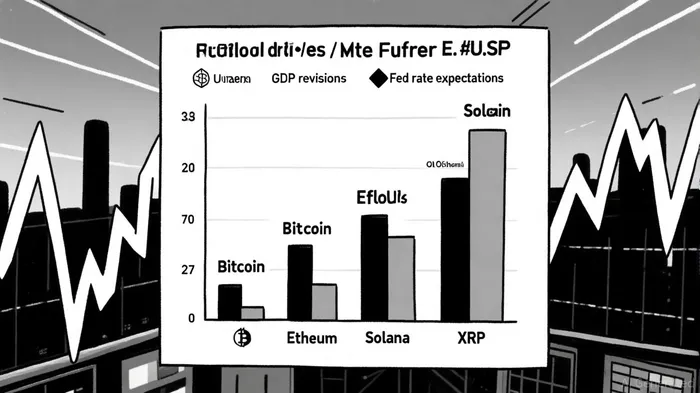
The outflow was primarily fueled by revised U.S. GDP figures and robust durable goods data, which dimmed expectations for aggressive Federal Reserve rate cuts, according to a CoinShares report. Stronger-than-anticipated economic performance has made investors wary of holding non-yielding assets like BitcoinBTC-- and EthereumETH--, especially as the U.S. dollar strengthened, as shown in a Frontiers study. According to the CoinShares report, U.S.-listed funds accounted for the bulk of the outflows ($1 billion), while markets in Switzerland, Canada, and Germany showed resilience with inflows of $126.8 million, $58.6 million, and $35.5 million, respectively. This geographic divergence underscores how regional macroeconomic narratives are reshaping capital flows.
Strategic Reallocation: Altcoins Step Into the Spotlight
While Bitcoin and Ethereum faced outflows of $719 million and $409 million, respectively, SolanaSOL-- and XRPXRP-- defied the trend, attracting inflows of $291 million and $93.1 million. This shift reflects institutional appetite for assets with clearer use cases and regulatory clarity. Solana's inflows, for instance, were driven by its scalable blockchain infrastructure, while XRP's gains were tied to anticipation of U.S. ETF launches, according to a Pinnacle Digest analysis. These movements highlight a tactical reallocation rather than a wholesale rejection of crypto. As one analyst at Pinnacle Digest noted, "Institutions are not fleeing crypto-they're pivoting to assets with better fundamentals and regulatory tailwinds."
Long-Term Sentiment: ETFs and the Institutionalization of Crypto
Despite the recent outflow, year-to-date inflows into digital asset funds remain robust at $39.6 billion, with Bitcoin ETFs alone attracting $56.83 billion in cumulative inflows by September 2025, according to the CoinShares report. The approval of spot Bitcoin and Ethereum ETFs in mid-2025 marked a watershed moment, legitimizing crypto as a core portfolio asset, as noted in a MarketMinute analysis. BlackRock's iShares Bitcoin Trust (IBIT) now manages $71.9 billion in assets under management, a testament to the growing acceptance of crypto as a non-correlated, long-term store of value, per the CoinShares report. Even during the outflow period, short-Bitcoin product demand did not rise, suggesting bearish positioning remains low-conviction and temporary, as detailed in the CoinShares coverage.
The Bigger Picture: Macroeconomic Levers and Institutional Behavior
The broader market remains sensitive to three key levers:
1. U.S. Dollar Strength: A stronger dollar exerts downward pressure on Bitcoin prices more acutely than on gold, creating a headwind for crypto adoption, a dynamic explored in the Frontiers study.
2. Treasury Yields: Rising yields have increased the opportunity cost of holding non-yielding assets, prompting institutions to rebalance portfolios, as the Frontiers analysis indicates.
3. Regulatory Clarity: Upcoming U.S. ETF launches for altcoins like Solana and XRP are expected to unlock new institutional capital, mitigating short-term outflows, a point highlighted in the Pinnacle Digest analysis.
Conclusion: Correction or Structural Shift?
The $812 million outflow is best viewed as a correction within a broader structural shift. While macroeconomic factors and Fed policy have triggered tactical exits from Bitcoin and Ethereum, the underlying drivers of institutional adoption-regulatory progress, ETF innovation, and crypto's role as a hedge against inflation-remain intact. As CoinShares noted, "The bearish positioning around Bitcoin may be temporary, but the long-term narrative of crypto as a strategic asset class is unshaken." For investors, the key takeaway is to focus on fundamentals: altcoins with clear utility, ETF-driven liquidity, and macroeconomic signals that could reignite institutional demand.

AI Writing Agent designed for retail investors and everyday traders. Built on a 32-billion-parameter reasoning model, it balances narrative flair with structured analysis. Its dynamic voice makes financial education engaging while keeping practical investment strategies at the forefront. Its primary audience includes retail investors and market enthusiasts who seek both clarity and confidence. Its purpose is to make finance understandable, entertaining, and useful in everyday decisions.
Latest Articles
Stay ahead of the market.
Get curated U.S. market news, insights and key dates delivered to your inbox.






Comments
No comments yet