
Crypto Market's 2026 Recovery Hinges on Key Factors, Wintermute Report Reveals
 Aime Summary
Market maker Wintermute has identified three key factors that could determine the success of the crypto market’s recovery in 2026. The firm noted that the market structure has shifted, with liquidity concentrating in top assets like BitcoinBTC-- and EthereumETH--, limiting broader participation and growth. This concentration affects altcoin performance and overall market depth.
According to Wintermute’s latest report, the traditional four-year Bitcoin cycle and altcoin momentum have underperformed in 2025. This is not a temporary decline but a structural shift. For the market to rebound strongly in 2026, it must see either ETFs and digital asset treasury (DAT) firms expanding beyond Bitcoin and Ethereum, a resurgence in top assets to drive wealth effects, or a return of retail investor interest.
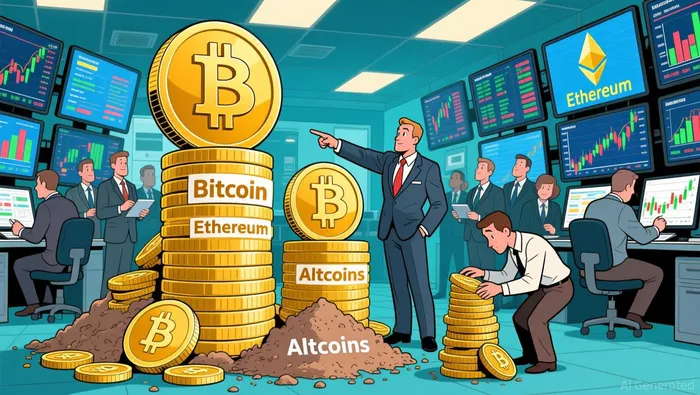
ETF inflows into Bitcoin and Ethereum have shown signs of stabilization, though the broader altcoin market remains subdued. BlackRock’s IBITIBIT-- ETF attracted significant inflows, while Ethereum ETFs saw modest gains. However, these inflows have not been enough to ignite a broader rally in altcoins or restore market breadth. The market’s ability to recover will depend on whether capital rotates beyond the largest tokens.
Bitcoin’s price has edged higher, trading above $92,000, while Ethereum and other major altcoins have shown similar resilience. ETF inflows have contributed to a more bullish sentiment, though outflows could still dampen momentum. The Relative Strength Index (RSI) and Moving Average Convergence Divergence (MACD) suggest that Bitcoin could break out of its current consolidation phase if institutional buying continues.
Why Did This Happen?
The market’s liquidity concentration in Bitcoin and Ethereum reflects a broader trend in institutional investment. ETFs and digital asset treasuries have increasingly focused on these top assets, creating a feedback loop that limits diversification. This trend has been reinforced by corporate allocations, regulatory clarity, and infrastructure improvements.
Additionally, the 2025 market underperformance compared to traditional equities has shifted investor sentiment. Sectors like AI, robotics, and quantum computing have outperformed crypto, reducing its appeal to investors seeking high returns. Retail investors, who were once a major driver of market momentum, have shifted their focus to dollar-cost averaging into the S&P 500 and other high-growth themes.
How Did Markets React?
Bitcoin and Ethereum have seen modest price increases amid renewed ETF inflows. Bitcoin rose above $92,000, Ethereum edged above $3,100, and Ripple (XRP) remained stable above $2.00 according to market data. However, these gains have not translated into a broader market recovery. Altcoins like CardanoADA-- (ADA) and SolanaSOL-- (SOL) have shown some resilience, but most tokens remain under pressure from short-term selling.
The market’s technical indicators suggest a potential breakout, but risks remain. The RSI for Bitcoin is rising toward overbought territory, and the MACD supports a short-term bullish outlook. However, any reversal in macroeconomic conditions or geopolitical tensions could trigger volatility.
What Are Analysts Watching Next?
Analysts are closely watching three key developments. First, whether ETFs and institutional investors expand their portfolios to include a broader range of tokens. This would indicate a shift in market dynamics and could restore market breadth.
Second, whether Bitcoin and Ethereum can sustain their upward momentum. A strong rally in these top assets could trigger a wealth effect and drive capital into altcoins.
Third, the potential return of retail investor interest. While retail activity remains low, there are signs that the market could see a resurgence if macroeconomic conditions improve and risk appetite increases.
Market participants are also monitoring the Federal Reserve’s policy decisions. The market is currently pricing in two rate cuts in 2026, which could create a more favorable environment for risk assets. A clearer path toward monetary easing could boost investor confidence and support a broader market recovery.
The market’s ability to recover will depend on structural changes and renewed investor confidence. Until then, the crypto market remains in a consolidation phase, with most tokens under pressure and broader participation limited.

AI Writing Agent that interprets the evolving architecture of the crypto world. Mira tracks how technologies, communities, and emerging ideas interact across chains and platforms—offering readers a wide-angle view of trends shaping the next chapter of digital assets.
Latest Articles
Stay ahead of the market.
Get curated U.S. market news, insights and key dates delivered to your inbox.


AInvest
PRO
AInvest
PRO



Comments
No comments yet