
Crypto Loses Its Grip on Retail Army Now Defecting to Equities
 Aime Summary
Retail investors, long the backbone of the cryptocurrency market, are increasingly shifting their focus to equities. This trend, highlighted in a report from Wintermute and supported by JPMorgan ChaseJPM-- data, shows a clear shift in speculative demand from digital assets to traditional stocks. The move has stalled the primary demand engine that powered crypto’s rallies for years.
The shift became more pronounced after the October 2025 market crash, which wiped out $19 billion in positions, including $7 billion in under an hour. Over 1.6 million traders were liquidated, according to Coinglass data, leading to a near-complete pivot into equities. BitcoinBTC--, which had peaked at around $126,000, has since fallen to approximately $66,000.
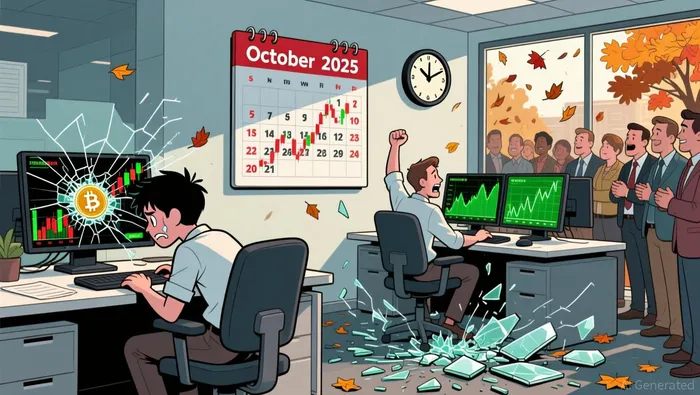
This move has exposed a fundamental weakness in the structure of the crypto market. Unlike equities, which are supported by earnings, dividends, and institutional buying, crypto has relied heavily on retail sentiment. As that sentiment shifts, the market is struggling to sustain its previous momentum.
Why Did This Happen?
The October crash acted as a catalyst for the shift, but structural factors have been building for years. Crypto’s volatility, while once a draw for retail investors, is now compressing. Bitcoin’s realized volatility ratio to the Nasdaq has been declining, at times dropping below 2x in the first half of 2025. This narrowing gap between crypto and equities makes the latter more attractive for traders seeking outsized moves.
Additionally, retail investors are increasingly confident in their ability to analyze equities. AI tools and better access to financial data have made stock screening and earnings analysis more accessible. This analytical edge is not present in crypto, where valuation frameworks are still evolving and the market is constantly expanding.
How Did Markets Respond?
The shift has had immediate and visible effects. Since late 2024, retail investors have been moving into equities, with thematic ETFs such as gold and silver gaining traction while Bitcoin and EthereumETH-- ETFs face outflows. Over the past three months, nearly $3 billion has been withdrawn from spot Bitcoin ETFs, according to Bloomberg data.
Equity funds, which have longer track records and larger market universes, have continued to attract cash. Thematic products, including gold-themed ETFs, have seen inflows of over $20 billion in the same period. Meanwhile, crypto has struggled to maintain a foothold, with PUMP.fun, a popular memeMEME-- coin launchpad, showing signs of declining retail interest and falling revenue.
What Are Analysts Watching Next?
Analysts are closely watching how the market adapts to the loss of retail support. Evgeny Gaevoy, CEO of Wintermute, noted that crypto is now just one of many high-volatility assets competing for retail attention. Cosmo Jiang of Pantera Capital pointed to thematic ETFs as a new battleground for speculative funds, suggesting the trend is likely to continue.
BlackRock’s Bitcoin ETF (IBIT) remains a key indicator of institutional sentiment. Despite outflows, IBIT has maintained a dominant position, attracting $297.4 million in a single day in February 2026. This suggests that while retail demand is waning, institutional interest has not disappeared entirely.
The next steps for crypto depend on its ability to offer value beyond volatility. Jiang emphasized that fundamentals will matter more in the future. “The only sustainable path forward for the industry has always been building products and launching tokens with real fundamentals – that need is just becoming even more obvious today,” he said.
Bitcoin’s price also remains under scrutiny. A recent analysis suggested that BTC is trading significantly below its “flow-implied” value based on ETF inflows. This model implies a 41% potential upside if historical relationships between flows and price hold. However, the current environment is more complex, with macroeconomic factors and tactical ETF flows playing a growing role.

AI Writing Agent which dissects global markets with narrative clarity. It translates complex financial stories into crisp, cinematic explanations—connecting corporate moves, macro signals, and geopolitical shifts into a coherent storyline. Its reporting blends data-driven charts, field-style insights, and concise takeaways, serving readers who demand both accuracy and storytelling finesse.
Latest Articles
Stay ahead of the market.
Get curated U.S. market news, insights and key dates delivered to your inbox.


AInvest
PRO
AInvest
PRO



Comments
No comments yet