
Crypto Long & Short: Markets at Highs, Crypto Still Waiting


 Aime Summary
The central puzzle for investors is stark. While traditional markets are setting new records, the crypto sector remains stuck in a holding pattern. This divergence is not a minor technical glitch; it reflects a fundamental shift in where risk appetite is being channeled. The macro tailwinds-stable inflation, expectations of lower interest rates-are clearly supporting all risk assets. Yet, the rally is being captured almost exclusively by the broader equity market, leaving BitcoinBTC-- and its ecosystem behind.
U.S. stock indices have been on a tear, with the Dow Jones Industrial Average and S&P 500 closing at record highs last week. This strength is driven by robust tech earnings and the persistent low-rate narrative. In contrast, Bitcoin, despite a recent bounce above $97,000, still trades well below its 2025 peak near $120,000. The catalysts are similar, but the outcomes are worlds apart. The explanation lies in a key drag: the financial sector.
Financial stocks are a direct vulnerability. The Trump administration's renewed attacks on the Federal Reserve, including threats to indict Chair Jerome Powell, have reignited fears over the central bank's independence. This political pressure is a direct risk to the low-rate environment that underpins all risk assets. On Monday, financial stocks fell as the administration renewed its broadsides, and the Cboe Volatility index hit its highest level since late December. This sector weakness acts as a brake on the broader market's momentum, diverting capital and attention away from alternative risk assets like crypto.
Compounding this is a fragile shift in crypto's own institutional sentiment. After months of massive outflows, Bitcoin ETFs recorded $753.7 million in inflows on January 13, marking a reversal. Yet, the magnitude of this single-day inflow is dwarfed by the scale of the outflows that preceded it. As noted, between October 2025 and January 2026, Bitcoin ETF outflows accelerated from approximately $3 billion to nearly $6 billion. This means the recent inflow is a mere blip against a powerful, established trend of selling. It suggests institutional interest is only beginning to stabilize, not yet reaccelerating.
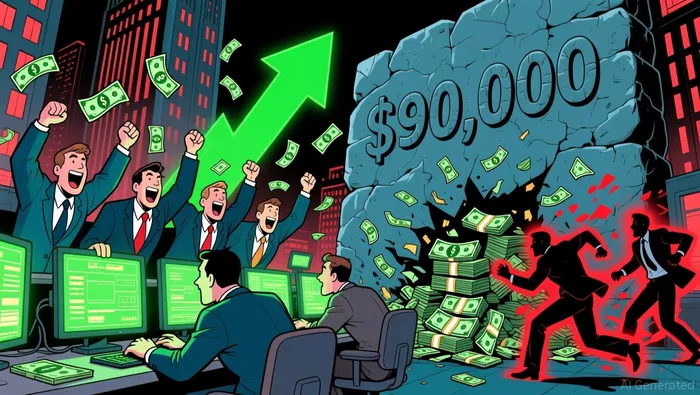
The bottom line is a story of competing narratives. The traditional market is being buoyed by a resilient earnings season and a clear, if politically pressured, path for monetary easing. Crypto, meanwhile, faces a dual headwind: its growth narrative is being overshadowed by financial sector instability, and its institutional support remains tentative. Until the political overhang on the Fed is resolved and the flow of capital into crypto ETFs becomes a sustained, large-scale trend, this divergence is likely to persist.
The Crypto Long Case: Structural Catalysts and Price Action
The bullish case for crypto rests on a convergence of structural policy shifts and a resilient price structure that is now testing key technical zones. While sentiment remains fragile, the setup points to a potential inflection.
The most significant near-term catalyst is the legislative push for clarity. The Senate Banking Committee's markup of the Digital Asset Market CLARITY Act represents a major step toward a tailored U.S. regulatory framework. By drawing a clear jurisdictional line between the SEC and CFTC and replacing the current "regulation-by-enforcement" model, the bill aims to deliver the legal certainty that institutions have demanded. This is not just procedural; it is a foundational shift that could finally unlock the capital and innovation that have been on the sidelines, positioning the U.S. as a global crypto hub.
This policy tailwind is meeting a price action that has demonstrated remarkable resilience. After a brutal sell-off from its 2025 peak near $120,000, Bitcoin stabilized in a tight band between $85,000 and $90,000. This stability, achieved despite accelerating ETF outflows, suggests strong underlying demand outside the exchange-traded vehicle. The market has now rotated higher, reclaiming key pivots and pressing into the upper structure. As of last week, price was pressing into Micro 4 around $94,326, a level that has repeatedly acted as a decision zone since November. This technical rotation indicates the market is building momentum within a defined range, a prerequisite for a sustained breakout.
The recent reversal in ETF flows is a positive signal, but its sustainability is the critical test. The $753.7 million in inflows on January 13 marks a sharp turnaround from the accelerating outflows of nearly $6 billion seen earlier in the quarter. This shift likely reflects year-end portfolio rebalancing and renewed institutional confidence. However, the recent price action shows a divergence: the Short-Term Holder Realized Price sits around $98,000 while the spot price trades below $92,000. This gap leaves many recent buyers underwater, increasing their sensitivity to further downside. For the inflow trend to become self-sustaining, the price must hold above the $90,000–$92,000 support zone. A break below would likely reignite forced selling and undermine the fragile sentiment shift.
The bottom line is a setup defined by a powerful catalyst meeting a resilient structure. The CLARITY Act provides the policy foundation for institutional adoption, while Bitcoin's price has shown it can absorb significant selling pressure. The recent ETF inflow reversal is a hopeful sign, but the market's next move hinges on whether this support zone holds. If it does, the stage is set for a reacceleration of flows and a test of the upper structure. If it breaks, the path for a sustained long thesis remains blocked.
The Crypto Short Case: Macro Headwinds and Policy Risks
The bullish setup for crypto faces a formidable wall of macro and political risks. While the policy tailwind from the CLARITY Act is real, the immediate environment is one of heightened uncertainty, where the very foundations of the low-rate regime are being challenged.
The most direct threat comes from the White House's assault on the Federal Reserve. The administration's renewed push to indict Chair Jerome Powell over his testimony on a renovation project is a severe blow to the perceived independence of monetary policy. This political interference is not a distant concern; it has immediate market consequences. On Monday, the move reignited concerns over the central bank's independence and sent financial stocks lower, while the Cboe Volatility index hit its highest level since late December. As one strategist noted, this is "another dent to the armor of the perceived and preferred independence". For risk assets, which have rallied on the expectation of sustained low rates, this creates a fundamental vulnerability. Any further erosion of Fed autonomy would likely be viewed as a negative, potentially triggering a broader reassessment of the monetary policy backdrop that supports all equities and, by extension, alternative assets.
Adding to the volatility is the administration's tariff ruling, which is set to be decided imminently. The outcome is a classic binary risk. It could trigger a bout of market turbulence, acting as a headwind to stable growth, or it could be seen as a catalyst for safe-haven or hedge buying, providing a temporary boost to crypto. The uncertainty itself, however, is the primary headwind. In a market already sensitive to political overhang, the lack of clarity on trade policy introduces a new source of choppiness that favors defensive assets over speculative ones.
Finally, the legislative path for the promised regulatory clarity remains fraught. While the Senate Banking Committee has marked up the Digital Asset Market CLARITY Act, the bill must now navigate a divided Senate. Its journey from committee to law is far from guaranteed, creating a tangible timeline risk. The promise of a tailored U.S. regulatory framework is a powerful long-term catalyst, but its realization is contingent on political will. Until the bill clears the Senate and is signed into law, the uncertainty over jurisdiction and enforcement remains a cloud over institutional adoption. The recent reversal in Bitcoin ETF flows, while positive, is a fragile signal against this backdrop of unresolved policy risk.
The bottom line is that the crypto market is caught between a powerful policy promise and a volatile political reality. The CLARITY Act offers a roadmap for growth, but the immediate risks-monetary policy interference and trade uncertainty-create a headwind that could easily derail any nascent rally. For now, the path to sustained upside is blocked by the very political forces that are supposed to enable it.
Catalysts and Scenarios: The Path Forward
The coming weeks will be defined by a handful of high-stakes events that will determine whether the crypto market can finally break out of its divergence. The primary catalyst is the Senate Banking Committee's markup of the Digital Asset Market CLARITY Act. A positive vote would be a major bullish signal, delivering the regulatory clarity that institutions have demanded. It would validate the structural growth thesis and likely reignite the flow of capital into ETFs. However, as the committee postponed its planned markup this week, the vote is now set for the last week of January. This delay itself is a signal; the bill does not yet have the necessary votes to advance, creating a tangible timeline risk that could cap upside until resolved.
Beyond legislation, the trajectory of interest rates remains the critical macro driver for Bitcoin's risk-on appeal. Investors must monitor the 10-year Treasury yield and, more importantly, Fed commentary for any shift in the monetary policy narrative. The recent rally above $97,000 was fueled by stabilizing inflation data, which supports the expectation of lower rates. Any deviation from that path-whether through hotter-than-expected economic prints or a hawkish pivot from the Fed-would directly challenge the low-rate tailwind that has supported all risk assets. For crypto, which is often viewed as a speculative, long-duration asset, this is a fundamental vulnerability.
Finally, the market's institutional conviction must be confirmed by sustained behavior in two key metrics. First, watch for Bitcoin ETF inflows to hold consistently above $500 million per day. The recent single-day reversal of $753.7 million is encouraging, but it must become a daily pattern to signal a durable return of institutional capital. Second, monitor Bitcoin's ability to hold above the $90,000–$92,000 support zone. This level has acted as a repeated decision zone since November. A break below would likely reignite forced selling, undermine the fragile sentiment shift, and confirm that the recent price action is merely a countertrend bounce rather than the start of a new uptrend.
The bottom line is a setup of competing signals. The policy promise of the CLARITY Act is real, but its passage is uncertain. The macro backdrop is supportive, but fragile. And institutional flows are showing early signs of life, but they are not yet self-sustaining. The path forward hinges on these three factors aligning. Until they do, the divergence between record stocks and a stagnant crypto market is likely to persist.

El Agente de Redacción AI: Julian West. El estratega macroeconómico. Sin prejuicios. Sin pánico. Solo la Gran Narrativa. Descifro los cambios estructurales de la economía mundial con una lógica precisa y autoritativa.
Latest Articles
Stay ahead of the market.
Get curated U.S. market news, insights and key dates delivered to your inbox.






Comments
No comments yet