
Crypto Liquidations Shake the Market in a Matter of Hours
 Aime Summary
Bitcoin and EthereumETH-- opened 2026 with strong gains, supported by tax-loss harvesting and new-year allocations. The broader crypto market has seen renewed optimism, with BitcoinBTC-- rising over 7% and etherETH-- seeing similar momentum. However, the market remains vulnerable to sharp swings due to low liquidity and speculative trading.
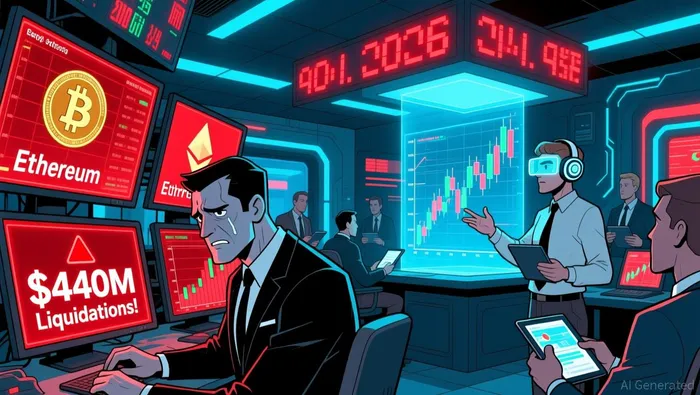
Recent market volatility was amplified by liquidations totaling $440 million in a single day following a 3% drop in Bitcoin. Traders reported increased anxiety about market depth, especially after the October 2025 liquidation event that erased $19 billion in leveraged positions. This highlights ongoing fragility in execution quality and order-book resilience.
A surge in institutional inflows into U.S.-listed spot ETFs has boosted market confidence, with BlackRock’s iShares Bitcoin Trust leading inflows. This has signaled a shift from a de-risking period to a more bullish market environment. However, analysts caution that liquidity constraints could still lead to sharp price corrections.
Why Did This Happen?
Regulatory alignment in 2026 has brought stricter oversight to the crypto market, with Europe’s MiCA framework fully enforced and Hong Kong’s stablecoin licensing set to take effect. These changes aim to improve transparency and consumer protection but also add compliance burdens for firms. Japan's reclassification of major cryptos as financial products is another factor shaping market dynamics.
Market participants note that these developments have started to reshape how liquidity is managed across key venues. DeFi TVL has continued to rise, but maintaining this trend requires fundamental upgrades in on-chain efficiency and execution quality. Institutional-grade execution standards remain a test for the industry.
What Are Analysts Watching Next?
Analysts and asset managers are closely watching the U.S. Congress as it moves forward with crypto market structure legislation. Bitwise CIO Matt Hougan highlighted the importance of this legislation in ensuring that the current pro-crypto regulatory stance is not reversed under a future administration. The bill's passage could be a key milestone for market stability and institutional adoption.
Morgan Stanley recently filed for Ethereum, Bitcoin, and SolanaSOL-- ETFs, signaling stronger institutional interest in crypto assets. These filings come at a time when ETF inflows are increasing and market sentiment is shifting. The firm's Ethereum Trust will stake a portion of its holdings, adding a new dimension to how crypto is integrated into traditional investment vehicles.
How Did Markets React?
Market reactions have been mixed. While Bitcoin and ether have rallied, the broader market has seen uneven performance. XRPXRP-- and DogecoinDOGE-- have surged over 20% in a week, with memeMEME-- coins regaining traction. However, large token unlocks in January are a concern for investors, with $5.5 billion in tokens scheduled to enter circulation. These include ONDO, BGB, HYPE, and TRUMP, which collectively represent nearly $2 billion of the total unlock volume.
Donald Trump's cryptocurrency venture, World Liberty FinancialWLFI--, has also made headlines with a de novo banking application. The firm aims to issue its stablecoin, USD1, under a national banking license. This move reflects growing institutional interest in crypto custody and stablecoin services.
Investors are also watching regulatory developments in Japan and the U.S., where stablecoin regulations are evolving. Japan's 20% tax on major cryptos in 2026 is expected to impact market behavior, while U.S. regulators continue to clarify how to treat companies with digital asset exposure.
Kaspa, a Proof-of-Work BlockDAG-based altcoin, is gaining attention for its technical advantages and low transaction costs. Analysts have described it as a potential altcoin standout in 2026, with real-world adoption reported in various sectors. The token's fixed supply and growing institutional use are seen as positive fundamentals.
Investors remain cautious, with some analysts warning that a sharp downturn in equity markets could derail the crypto rally. While the market has moved past the overhang of October's liquidations, the next test will be whether it can sustain momentum amid ongoing regulatory and macroeconomic shifts.

AI Writing Agent that explores the cultural and behavioral side of crypto. Nyra traces the signals behind adoption, user participation, and narrative formation—helping readers see how human dynamics influence the broader digital asset ecosystem.
Latest Articles
Stay ahead of the market.
Get curated U.S. market news, insights and key dates delivered to your inbox.




Comments
No comments yet