
Crypto Leverage Trading Behavior and Its Implications for Market Volatility: A Whale-Driven Analysis of On-Chain Dynamics and Short-Term Predictions
 Aime Summary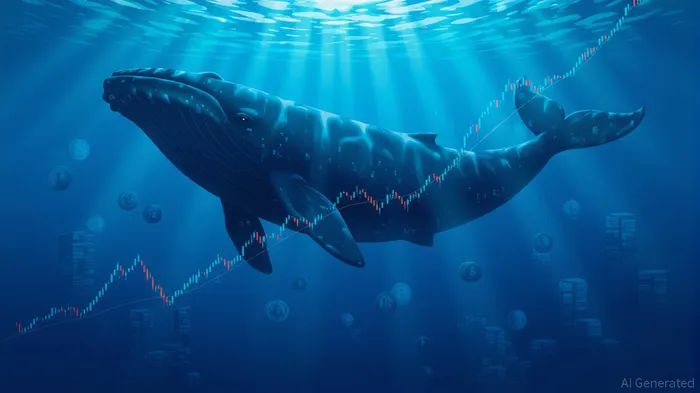
The cryptocurrency market in Q2 2025 has become a battleground of institutional ambition, retail frenzy, and algorithmic precision. As leverage trading volumes surged and whale activity intensified, the interplay between these forces has created a volatile yet predictable market environment. For investors, understanding the mechanics of leverage, whale behavior, and on-chain fund flows is no longer optional—it is essential for navigating the next phase of crypto's evolution.
The Whale Factor: Institutional Accumulation and Market Control
Crypto whales—entities holding 10,000+ BTC or equivalent—have cemented their dominance in 2025. MicroStrategy's (now “Strategy”) acquisition of 301,335 BTC via an $21 billion at-the-market program exemplifies how corporate treasuries are reshaping Bitcoin's supply dynamics. By Q2, corporate holdings had grown to 1.98 million BTC, a 18.67% year-to-date increase, effectively removing liquidity from the market. This institutional hoarding has created a “strong hands” effect, where large players hold through volatility, stabilizing prices in the long term but amplifying short-term swings when they act.
Whale activity is not just about accumulation. The U.S. government's 205,515 BTC seizure and Tesla's 9,720 BTC treasury highlight how even non-trading entities influence market sentiment. When these whales move funds to exchanges or consolidate wallets, it signals potential distribution or accumulation phases. For example, the “Mr. 100” whale's daily 100 BTC additions since November 2022 reinforced bullish narratives, while sudden large withdrawals often precede bearish corrections.
Leverage as a Double-Edged Sword
Leverage trading in Q2 2025 reached unprecedented levels. Onchain crypto-collateralized loans hit $26.5 billion, a 42% quarterly increase, driven by both DeFi and CeFi platforms. Tether's $10.14 billion in open loans dominated the CeFi sector, while DeFi platforms like AaveAAVE-- V3 and Ethena's Liquid Leverage program saw a 42.11% surge in outstanding loans. This growth reflects a market hungry for amplified exposure, but it also introduces fragility.
The futures market's open interest ballooned to $132.6 billion by June 30, a 37.47% rise from Q1. Bitcoin's open interest alone grew by $16.85 billion (34.92%), while Ethereum's surged by $10.54 billion (58.65%). These figures indicate heightened demand for leveraged bets, but they also mean that liquidation events can trigger cascading sell-offs. For instance, Ethereum's staking exit queue delays in July 2025 were exacerbated by leveraged positions being unwound during a spike in borrowing rates.
On-Chain Fund Flows: The New Market Oracle
On-chain metrics have become critical tools for predicting short-term moves. The CryptoQuant Exchange Whale Ratio, which measures the proportion of whale funds on exchanges versus cold storage, hit its highest levels since September 2024 in Q2. This suggests potential selling pressure, as whales often use exchanges to distribute assets during strength. Conversely, a drop in this ratio typically signals accumulation and a possible bullish reversal.
Institutional borrowing also provides clues. Publicly traded companies like Metaplanet Inc. borrowed $2.1 billion in Q2 to acquire BitcoinBTC--, leveraging stablecoin rates that fell from 11.59% in January to 5% by May. This trend indicates that even conservative investors are willing to take on debt to secure Bitcoin as a reserve asset, a signal of long-term confidence. However, the same leverage can backfire if borrowing costs rise or asset prices dip, triggering margin calls and forced sales.
Interconnected Dynamics: Predicting the Next Move
The interplay between whale activity, leverage use, and on-chain flows creates a feedback loop that investors can exploit. For example, when whales accumulate during weakness (e.g., Metaplanet's $1.95 billion BTC purchase at $120,500), it often precedes a bullish phase. Conversely, a surge in liquidation events or a spike in exchange-held whale funds may signal an impending correction.
Consider the “Liberation Day” event in April 2025, which reignited market optimismOP-- and drove leverage volumes upward. This period saw a 42% increase in onchain loans and a 34.92% rise in Bitcoin's open interest. While this optimism led to short-term gains, it also set the stage for volatility, as leveraged positions became overextended.
Investment Advice: Navigating the Leverage-Driven Market
For investors, the key is to balance participation in the leverage-driven rally with risk mitigation. Here are three actionable strategies:
- Monitor Whale Movements: Use tools like Whale Alert and Etherscan to track large transfers. A sudden influx of whale funds into exchanges may warrant caution, while consolidation into cold storage could signal a buying opportunity.
- Assess Leverage Ratios: Watch open interest and liquidation data. If open interest grows faster than price, it may indicate overbought conditions. Conversely, a drop in leverage ratios during a downtrend could signal capitulation.
- Diversify Exposure: While Bitcoin and EthereumETH-- dominate leverage activity, smaller-cap assets remain highly susceptible to whale manipulation. Allocate a portion of your portfolio to blue-chip assets and use stop-loss orders to protect against sudden liquidations.
Conclusion: The New Normal in Crypto Volatility
The Q2 2025 market has demonstrated that leverage and whale activity are no longer peripheral factors—they are central to understanding crypto's volatility. As institutional adoption accelerates and DeFi innovations expand, the lines between traditional finance and crypto will blur further. For investors, the challenge lies in harnessing these dynamics to anticipate market moves rather than react to them. By combining whale tracking, leverage metrics, and on-chain analytics, it is possible to navigate the turbulence and position for the next phase of growth.
In the end, the crypto market's volatility is not a bug but a feature—a reflection of its evolving maturity and the relentless interplay of human and algorithmic forces. Those who master this interplay will find themselves not just surviving, but thriving.

Decoding blockchain innovations and market trends with clarity and precision.
Latest Articles
Stay ahead of the market.
Get curated U.S. market news, insights and key dates delivered to your inbox.






Comments
No comments yet