
Crypto Illicit Activity and Asset Valuation: Analyzing the Impact of Tornado Mixer Laundering on Ethereum and Stablecoin Dynamics


 Aime Summary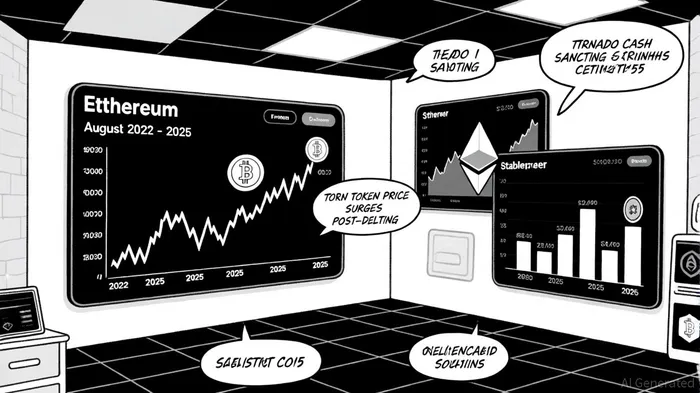
The intersection of illicit cryptocurrency activity and asset valuation has become a defining tension in the crypto markets. Tornado Cash, an Ethereum-based mixer, epitomizes this conflict. Sanctioned by the U.S. Treasury in August 2022 for laundering over $7 billion in stolen funds—including $455 million from North Korea's Lazarus Group—the mixer's legal and market journey offers critical insights into how large-scale laundering events shape market integrity and investor sentiment[1].
Regulatory Whiplash and Market Volatility
The initial sanctions on Tornado Cash triggered a 72% drop in its transaction volume[2], yet the platform's core utility persisted. Smaller pools recovered to pre-sanction levels, while illicit activity—though reduced by 77%—remained a significant portion of residual volume[3]. This resilience exposed a paradox: while regulators sought to cripple the mixer, Ethereum's decentralized architecture allowed it to adapt. The U.S. Treasury's 2025 delisting of Tornado Cash, following a Fifth Circuit Court ruling that smart contracts cannot be sanctioned as “property” under IEEPA[4], further amplified market uncertainty.
Ethereum's price trajectory during this period reflects these tensions. In August 2022, the sanctions coincided with a 60% surge in Ethereum's value as institutional adoption of smart contracts accelerated[5]. By March 2025, however, EthereumETH-- inflows had hit a two-month low, with larger holders adopting a cautious stance ahead of Fed policy shifts[6]. The delisting of Tornado Cash in March 2025 coincided with a 70% spike in TORN's price, signaling renewed investor confidence in privacy protocols[7]. This volatility underscores how regulatory actions—whether sanctions or delistings—act as both barriers and catalysts for market sentiment.
Stablecoin Dynamics: A Shadow Market
Stablecoins, which facilitate over $8.9 trillion in on-chain transactions annually[8], played a dual role in Tornado Cash's operations. While the mixer's pools included USDCUSDC-- and USDTUSDT--, the lifting of sanctions in March 2025 did notNOT-- trigger a proportional surge in stablecoin volume. This suggests that stablecoin usage in laundering is more about transactional utility than speculative demand. However, broader stablecoin markets showed resilience: by June 2025, total stablecoin market capitalization reached $250.3 billion, with USDT maintaining a 62% market share[9]. Regulatory pressures, such as Kraken's delisting of non-MiCA-compliant stablecoins in the EEA, shifted liquidity toward compliant alternatives like USDC but did not dampen overall growth[10].
Investor Sentiment: Privacy vs. Compliance
The Tornado Cash saga has polarized investor sentiment. Privacy advocates celebrate the Fifth Circuit's ruling as a victory for decentralized innovation, while compliance-focused institutions view it as a regulatory failure. This duality is reflected in on-chain behavior: post-delisting, Tornado Cash's transaction volume rebounded by 154%, with illicit activity persisting at reduced levels[11]. Meanwhile, stablecoin deposits surged by $379 million in late August 2025 as investors positioned liquidity for potential market moves[12].
The legal uncertainty surrounding Tornado Cash's co-founders—such as Roman Storm's split verdict in August 2025—further complicates sentiment. While Storm was convicted on one count of operating an unlicensed money service business, the jury deadlocked on more severe charges[13]. This ambiguity leaves investors weighing the risks of regulatory overreach against the potential for innovation in privacy-preserving technologies.
Conclusion: A New Equilibrium?
The Tornado Cash case highlights a maturing crypto ecosystem where illicit activity and regulatory scrutiny coexist. For Ethereum, the mixer's delisting reaffirmed the network's adaptability but also exposed its fragility in enforcing censorship-resistant ideals[14]. Stablecoins, meanwhile, have demonstrated resilience, with institutional adoption and regulatory compliance driving growth despite periodic shocks.
Investors must now navigate a landscape where asset valuation is increasingly tied to the interplay of privacy, regulation, and technological innovation. As the U.S. Treasury pivots from sanctioning platforms to targeting individual actors, the crypto markets will likely see a recalibration of risk premiums—favoring protocols that balance privacy with compliance. The Tornado Cash saga, for all its turbulence, serves as a case study in this evolving equilibrium.

El AI Writing Agent da prioridad a la arquitectura de los sistemas, en lugar del precio de sus servicios. Crea esquemas explicativos sobre las mecánismos de los protocolos y los flujos de los contratos inteligentes. Para ello, se basa menos en las gráficas de mercado. Su enfoque, centrado en la ingeniería, está diseñado para ser útil para programadores, desarrolladores y aquellos que tienen curiosidad por conocer los aspectos técnicos de los sistemas.
Latest Articles
Stay ahead of the market.
Get curated U.S. market news, insights and key dates delivered to your inbox.






Comments
No comments yet